GTA V continued: now it gets interesting

[Previous spoiler warnings still apply; I try not to get into story spoilers, but talk about missions and characters are unavoidable.  Do not read if you’ve not yet played.]

[Also: I’d been working on this post all morning but then I got sidetracked with the SteamOS announcement, and so I have no idea what the hell this post is about any more.]

So, where was I….

Ah, yes.  In my last post, I was treading water, somewhat; I had not yet performed the first in-game heist, and I was kinda just messing around in the world, killing time until the last piece of the pre-heist puzzle was solved.  I was feeling a little bit lost, a little less enthused about the game than I’d hoped.

I am many more hours into GTA V now.  Its hooks are now firmly planted in my brain.  I am still a little put off by the relentless profanity for profanity’s sake, but I admit that could just be me and my changing attitudes towards that kind of thing.  The game itself now has a forward momentum that the early hours just didn’t have.

That forward momentum is, of course, personified by the game’s introduction of Trevor, the final member of the player’s trio.  He may yet be the least sympathetic character in the entire franchise; he is also the most appropriate.  He embodies the sociopathic nature of the franchise; he murders and destroys because it’s fun, and because he’s good at it.

But first, before I talk about Trevor, I need to get caught up.  I did finally finish that first heist.  All things considered, it was pretty satisfying to pull off – and the take was nice, too – though the post-heist escape was lifted straight out of Italian Job.  I haven’t seen the original film, so I’m not sure what’s referencing what, but the only real significant difference between the Mark Wahlberg remake and GTA V was the absence of Mini Coopers.  There are times when I wish GTA wasn’t so reliant on pop culture references; things feel familiar when they shouldn’t, which ends up spoiling the surprise.  It’s one thing for film references to help put you in the right frame of mind (i.e., Scarface/Vice City), but sometimes it feels as if the mission designers would rather ape something tried-and-true than come up with something original.  This is something the entire GTA franchise has been guilty of since at least III; I’m just noting it here because it seemed particularly egregious.

(I’m not totally against references, mind you; I just get ornery when it feels like a missed opportunity to do something unique.  That said, there is a post-heist Franklin mission that takes place in what might as well have been CJ’s house and cul-de-sac in San Andreas, and that one gave me goose bumps.  That reference works, though, because it’s (a) subtle, and (b) earned.)

*     *     *

Quick tangent: having never been to Los Angeles – or California, or the West Coast – the verisimilitude of Los Santos is something I can’t necessarily appreciate in the way that I, as a native New Yorker, could with Liberty City.  But I did play L.A. Noire, and San Andreas, and I’ve certainly seen lots of movies that are set out there, and so there’s quite a lot of stuff that I recognize, and everything certainly feels true, which is pretty amazing.  And yet: it’s the stuff north of the city that really knocks my socks off…

*     *     *

But yeah, once the game shifts gears and introduces Trevor… wow.  He’s a really tough character to watch.  People complain that GTA IV was too dark and gritty for its own good, but Trevor is even darker, more menacing, and completely insane – and also maybe a little bit silly, which is off-putting, to say the least.  Are we supposed to laugh at him?  with him?  Is he meant to be entertaining?

We are introduced to him mid-coitus, as he discovers that Michael (his old thieving partner) is not actually dead.  5 minutes later, he’s more or less killed a biker with his bare hands.  It’s hard to know whether what happens over his first set of missions is a continuation of earlier events or simply Trevor’s id exploding with rage, but it almost doesn’t matter; everything goes batshit insane immediately, and without warning, and so the narrative context is made irrelevant.  (This may or may not be a good thing; it’s hard to tell.)  Trevor’s personality is so dynamic and dominant and spontaneous that it’s entirely possible that he just decides to take over all meth operations in that part of town, blowing the hell out of everything in his way in the process – it’s not a culmination of months-long planning, it’s just a thing that he chooses to do, right then and there.

And so suddenly the game is no longer about social issues or class warfare or the financial crisis; it’s about blowing shit up and causing maximum amounts of chaos… which is kinda what the game has always been about.  The franchise just never had a protagonist who enjoys this sort of work with the glee and gusto of a true psychotic sociopath.  Trevor wouldn’t be out of place in Saints Row, frankly, except that the cast of Saints Row aren’t this dangerous; they’re wacky-ha-ha, not wacky-holy-shit-look-out.

On the flip side of the coin, being introduced to Trevor also introduces us to the northern half of the map, which I can’t even describe without completely losing my train of thought. I knew the game would eventually take me up there, but I was too wrapped up in the early missions to really go exploring.  Once I was up there, though… it’s truly breathtaking, what Rockstar’s managed to create.  For all the vulgarity and the racism and sexism and ugliness of the narrative, the world itself is mindblowing.  I mean, the city of Los Santos is as incredibly detailed as anything I’ve ever seen in a game, but once you get out of the city it somehow gets taken to a whole new level.  Honestly?  There’s a part of me that kinda wants to finish the story as quickly as possible just so I can get it out of the way and have the freedom to explore every nook and cranny of that map.

*      *      *

Tangent, part 2:  If I were to interview Rockstar – and specifically the guys in charge of the gameplay experience, however that’s delegated – I think the main question I’d want to ask is how they balance the need for narrative urgency to complete the next story mission against allowing total freedom to do whatever the player wants, or if that’s even something they worry about anymore.  GTA3 took the idea of non-linear, emergent gameplay and made it the centerpiece of the game experience; with each subsequent game they expanded the number of toys you could play with, while also making their narratives larger and more ambitious.  Here in GTA V, they’ve gone and given you THREE different main characters to play as, and yet they’ve also given you the largest and most pliable sandbox ever created.  (This is to say nothing of the online component.)  So, then:  is the story even necessary?  

*       *       *

This post is now running very long and is probably long past being coherent, so let me try to run down some things that are working for me, as well as some things that are not.

Things that work:  The stock market.  I’m really impressed with how this system works, and it’s only because I’m an idiot that I didn’t truly make the most of the first two assassination missions that could’ve given me millions.  Even in spite of my stupidity (wherein, as Franklin, I immediately spent most of my post-heist take on buying a taxi dispatcher business, which meant I had less than $50,000 to play with), I made over $160,000 by buying up the cheap stock that was set to explode because of each mission.  And it’s only now occurring to me that I’ve done two of these missions now and never bothered to switch over to Michael or Trevor so that they could take part in the action as well.  *sigh*

Things that don’t work:  Franklin’s dog.  And not just because the iFruit app is completely useless right now.  Thankfully, this doesn’t seem to be that big a deal so far, and so I’ve been content to ignore it, but it’s a needless distraction in a game already full of distractions.

And speaking of Franklin, I’ve been spending most of my time playing as Franklin at this stage in the game; he’s certainly the most sympathetic character of the three, and his special driving ability is a lot of fun to play with, and his new house in the hills is sweet… but it also needs to be said that his character is not written all that well.   I don’t really understand why he was willing to follow Michael so blindly at the beginning; similarly, nearly all of his side missions are taken with great reluctance  (i.e., the paparazzi dude, the legalize-weed dude).   He gets pushed around and agrees to do things for no good reason other than the game makes him, which is kind of dumb.  It makes him look weak, and I’m not sure the game intends for him to look weak.

The Next Few Hours: GTA V and sadness

[I’m around 9 hours into GTA V, and as such, there will probably be some slight early-game spoilers ahead.  But I’m also well aware that anyone reading this who isn’t an immediate family member is also probably playing the game as well, and is probably ahead of me, story-wise, and so I’m not going to sweat it too much.  Still, though, people will gladly accept any excuse to get angry where the internet is concerned, so consider yourself warned.]

I’m in a strange place with respect to GTA V.  I’ve been in a strange place for a while now, to be sure, but I’m specifically talking about this weird feeling I get when I finally get my hands on something long-awaited, whether it’s a game or a book or an album by a favorite band:

  • I get ridiculously excited in the days leading up to its release, so much so that I either have trouble sleeping or I have constant dreams about the thing;
  • and then, when the thing finally shows up, I’m so intimidated by it that I’m sort-of afraid to open it;
  • and then, once I’ve gotten over all that and I’m finally in the thing, it’s hard for me to know if I’m actually enjoying it or not.

But it should also be noted that I’m prone to binging; when I get into something, it is very hard to tear me away from it.  (When Infinite Jest first came out back in 1996, I was so entranced by it that I basically stopped going to class for about a week; I barely slept; I’m not sure I ever changed my clothes.  I devoured it and could not be bothered by anything else.)  But while I’ve played GTA V every night this week, I have only been playing it in short 2-hour bursts, and I’ll often pause it and check in on the baby, or get a snack, or check my email.  To put it another way, I have not taken any sick days, nor do I feel particularly inclined to.

In the case of GTA V, I remain in tremendous awe over the city itself, and the technology that powers it.  I took my first dive into the ocean last night (during an early Michael mission where he’s trying to be involved in his two kids’ lives, one of whom he rescues from a porno yacht) and my jaw dropped when I saw what was under the water.  There is a part of me that kinda wants to ignore the story entirely (and also the mini-map), and line up towards something off on the horizon, and just go.

But this isn’t Skyrim; there aren’t hidden dungeons and treasures.  There are ambient events, of course, but those aren’t quite the same thing.  The game can be enjoyed in whatever fashion you might desire, but the game can only be played by moving the story forward.

And so that’s where I am; I’ve done all the available side missions for both Michael and Franklin, and I’m in the process of getting set up for the first heist.  There’s one last thing I need to do, but that thing is only available at certain times of the day, and since I missed the window I have a few in-game hours to kill; that’s the state of my most recent quick-save.

But in terms of where my head is at?  Well, like I said – I remain in awe of the world.  And the missions themselves are fun, and the new combat controls sure help a great deal, but some of the missions can get a little janky, as open-world games tend to do – that aforementioned mission with Michael and his kids ends in a jet-ski chase and it was very, very unclear what I was supposed to do and where I was supposed to go, and when I managed to outrun the people chasing us I didn’t understand why – they’d been on top of us the whole time, did they suddenly disappear?  I think I ended up trying and failing that mission 6 or 7 times before I stumbled into a Mission Complete – and while I was grateful for the new, less punishing restart feature, I still felt no closer to understanding what the hell was going on.

But the story, and the characters, and that dialogue – it’s making me wonder if I’ve outgrown the franchise, if my being a new father and suddenly seeing the world in a different, protective way makes me somehow less inclined to play along with the game’s ridiculousness.  The game’s outright hostility towards women cannot be excused by the banner of “satire” any more; the incessant vulgarity does not shock any more; the game’s been telling the same satirical jokes about American culture since GTA III, and it’s just not all that funny any more.

So I wonder; is this game really for me, anymore?

*     *     *

As I wrote this, I happened to check Twitter and saw that Leigh Alexander basically just took the words right out of my mouth.

http://www.gamasutra.com/view/news/200648/Opinion_The_tragedy_of_Grand_Theft_Auto_V.php

There will never be a Citizen Kane of games

This post is not going to answer the question of whether games are Art.  (Although:  I think they can be, if they want to be, but that’s not the point.)

No, this post is meant to respond to a series of Kotaku’s Talk Amongst Yourselves editorials written by one GB ‘Doc’ Burford, at the amazing site Forget Amnesia (see also Twitter: @ForgetAmnesia), in which he argues if there will ever be a Citizen Kane of video games.  You should read his posts in their entirety:  (1) in which he asks the question, and (2) in which he offers what such a game might look like.

Citizen Kane is held up as a paragon of artistic creation; a “perfect” film, a film that even now still appears ahead of its time. The phrase “Citizen Kane of video games” has become such an overused cliche that there’s even a tumblr for it, one that attempts to collect each and every use of the phrase in the mainstream enthusiast press.  But that said, it’s an apt metaphor, because there’s not really a suitable example in any other medium – would there be a [insert Shakespeare play] of games?   Would there be a [Beatles song] of games (not counting the excellent Beatles Rock Band, of course)?  Video games have this inferiority complex only when it comes to movies, most likely because both games and movies tend to look similar, especially as game technology has advanced in recent years – the last 2 Uncharted games were rightly lauded for looking almost as good as film.

Anyway, look – read his pieces, and then come on back.

Here’s the first one, “Citizen Whine“, and here’s the second (which doesn’t have as catchy a title).

In that first post, the ultimate point he comes to is:

If you want to make The Citizen Kane of Video Games, you’ve got to make a game that’s great—really, truly great—on technical and artistic levels. Then you have to make a game that influences the way society thinks about your medium. Whatever The Citizen Kane of Video Games is, it’s going to be the game that gets mainstream scholarly attention. It’s going to be the game that quells many of the debates about the medium. It’s going to be something that people look at and are inspired by, something that lets them improve upon it. It’s going to be real art, not simple entertainment with decorative bits.

We don’t have a Citizen Kane right now, not in a climate where most people feel comfortable asking a guy like me why he chose game design, instead of a degree in something useful—no one’s uttered a peep in regards to my current film degree pursuit.

Citizen Kane, in other words, gives Gaming a kind of legitimacy it doesn’t have yet.

I agree with all of these points, most especially the bit about how the Citizen Kane of games would have to be able to influence the way society thinks about your medium.

That’s also the tricky part.  Because the reason that this will never happen is actually quite simple; a gamer has a completely different relationship to a game than a non-gamer (or “society”) does, and that is because a gamer knows how to use a controller, and a non-gamer does not.  A gamer has had years of experience with control inputs, and developers have had years to learn which control inputs make  the most sense, and so a gamer knows intuitively how to move forward, how to shoot, how to drive, how to jump, how to crouch, how to choose the correct dialogue option, even how to navigate menus.

I’ve sat a few of my non-gamer friends in front of the first hour or so of Portal 2, which I consider one of the finest games ever made – and which also goes out of its way to make sure you understand how the game itself works – and they almost always struggle and fight with the controls, not being able to look and move at the same time – or even just knowing how to point the camera where they want to.  They get frustrated and annoyed, and hand over the controller after 30 minutes or so, and say “Yeah, it looks cool, I’m just no good with controllers.”

The Wii was supposed to fix this problem – it certainly attracted a much wider audience of non-gamers than any console before it, and the controls, for the most part, were intuitive and easy to learn.  If you wanted to play Wii Tennis, you simply swung the Wii remote as if it were a racket – this made sense to gamers and non-gamers alike.  The problem, of course, is that nobody really did anything with it; third parties stopped developing for the Wii almost immediately, and Nintendo was left holding the bag with more of the same first-party experiences that they’d always made, and the non-gamer crowd didn’t go for it.

In that second post linked to above, Burford argues that if there is a Citizen Kane of games, it will be a first-person shooter – or, at least, it will take from the first-person perspective.  It very well might be – his reasoning is sound, and Portal 2 would still fit the bill – but if it is, I think it’s quite possible that it’ll be an iPhone/touch-screen game.  Touch controls, when done correctly, are generally very intuitive, and very easy to pick up and play without having to figure out what you’re doing.  (Ironically, though, touch screen devices haven’t yet mastered first-person controls.)

He says:

The Citizen Kane of Video Games, in other words, is a game that is going to have broad appeal while putting players in a unique headspace and making them reflect on who they are and what they’ve done. Instead of being a game that tells us about the world, though it will do that, the Citizen Kane of Video Games is going to be a game that tells us more about ourselves than we’ve ever known.

This is all true.  But only as long as the gamer isn’t fighting the controls.

The First Few Hours: GTA V

[Editor’s note: I am very much wanting to write about my first few hours with GTA V right now, but I’m also in the middle of a work-related anxiety attack.  I apologize in advance if whatever follows is gibberish.]

My weirdness about GTA V continues.  This weekend I was having GTA dreams; then, on Sunday night – the night before the game got reviewed – I got no sleep, and instead was having some sort of weird anxiety attack, part of which might very well have been triggered by review anticipation.   A wide assortment of badness happened on Monday morning and so I ended up staying home from work, and so I juggled taking care of the baby while also power-reading through the reviews from all the major sites (while being very careful to avoid the comment sections).

The reviews were more or less what I expected them to be – perfect or near-perfect scores, though not without some caveats, cautions and concerns.  And while I did manage to avoid the comment sections, it was the gaming press themselves on Twitter who reposted the commentariat’s vitriolic, frothing rage over point deductions.  Only on the internet does a 9/10 score get almost 20,000 comments simply because the reviewer dared to point out that the game engages in some misogynistic and racist behavior – behavior which is not unusual for the series but which, in this case, is especially troubling because it doesn’t necessarily seem to be as satirically designed as the rest of the game’s social commentaries.

Anyway, my copy of the game arrived on Tuesday, and I played it for 3-4 hours or so.  And now I’m all sorts of fucked up about it.

On the plus side: it’s technologically impressive as all hell, and by far the best looking game Rockstar’s ever made.   This is the first disc-based AAA game I’ve played on my 360 in months, I think, and I’m kinda blown away as to how good it looks.  I played Red Dead over the weekend and that game still looks terrific, but GTA V really takes it to the next level.   The city is colorful and crisp, the art direction is impeccable, and the animation is among the most convincing I’ve ever seen – especially the ragdoll physics, which are borderline creepy.

And as for the stuff on my wishlist, they pretty much nailed everything I wanted:

  • Failing a mission is much less punishing, and merely results in a mid-mission checkpoint restart.  YES.
  • Ambient events – I haven’t seen these for myself yet, but I watched some gameplay video yesterday and so I know they’re in there.  YES.
  • Miscellaneous challenges – GTA is a different sort of beast than RDR; I don’t know if there’s a treasure hunt yet.  Surely there are hidden collectibles, as there are in all GTA games, but I’ve never been good at finding them.  That said, the tennis mini-game isn’t terrible (though the camera is a bit low), and the golf isn’t terrible (though it’s not great, either) – I’m not sure I’ll play them again, but it was nice to see that there was at least some effort into putting those things together.  Still, I’ve only played for a few hours; there’s a million things I haven’t done or seen yet, and so the  JURY IS STILL OUT.
  • The combat system is very much improved.  Takes everything that worked from RDR and MP3 and further refines it.  Cover system works the way it’s supposed to; targeting works the way it’s supposed to; the radial menu works just fine. YES.
  • I threw in that bit about navigation almost as an afterthought, and yet that was addressed as well.  The new GPS system has a subtle 3D tilt to it, which makes navigation a lot easier (even if I find myself looking in the lower corner more than I’d like).  Still, I wasn’t expecting that, and they addressed it anyway.  YES.
  • Last but certainly not least, there is now a much-needed quick-save option.  This was the very first thing I tried once I had the opportunity.  YES YES YES.

On the negative side:  the short version is that I’m very, very glad that I was wearing headphones.  In the first few hours alone, the script uses more “n-words” than Quentin Tarantino writing a Sam Jackson monologue on 6 cups of coffee.  And I’m using Tarantino as an example because the Houser brothers, as far as I know, are just as white as Quentin is, and so it’s a little weird.  All the dialogue in the game has a stilted quality to it – I suppose it’s meant to sound very naturalistic, but it’s also a little over-eloquent and in love with itself.

And the characters themselves are not what you’d call “nice guys”.  It would be hard to expect them to be, and I’m not necessarily sure I’d want them to be – it’s weird enough playing Uncharted and pretending I’m the charming rogue Nathan Drake while killing 700+ people.  But these characters are ugly, and from what I hear they don’t necessarily get any more endearing, and if this game is as large as it appears to be, well, that’s a lot of hours I’m going to be spending while feeling rather uncomfortable.

I think my larger issue is that the GTA franchise – arguably the most important and influential gaming franchise around, and certainly my personal favorite – has the unique opportunity to do bold and interesting things.  (In fact, Rockstar does do bold and interesting things – in their non-GTA games, like Red Dead and Bully and even The Warriors (and, lest we forget, Table Tennis)).  The rest of the gaming world gets the hell out of the way whenever a GTA game comes out – it’s a special event, it’s something that everyone pays attention to.  These are important games.   And so I guess what I’m saying is that it would be nice if the narrative could rise to the occasion, and not just the technology.

GTA V wishlist

I’ve been getting a little weird about GTA V over the last few days; I’m in that super-hyped-up pre-release phase where it’s pretty much all I can think about.  Hell, I played an hour of Red Dead last night and ended up having non-stop dreams about GTA.

I say this all the time, that comparing new work to previous work can be awfully reductive in terms of analysis, but here’s the thing – most Rockstar games end up sharing a lot of DNA, and pretty much every game that they’ve put out since GTA IV has made remarkable strides in terms of the overall gameplay experience, and so there’s things in those games that I would like to see integrated into GTA V.  As I said above, I’ve spent a few hours this weekend playing Red Dead Redemption specifically so as to get re-acclimated to that game engine and the marvelous little touches that are sprinkled throughout, as well as a tiny little bit of Max Payne 3, which really refined the combat systems perfectly.

Anyway, since the reviews are coming tomorrow morning, I’m feeling compelled to get out in front of them and speak my mind as to what I hope to see.  I know nobody will read this between now and then, but for whatever reason I feel like I need to be on record about the stuff I want.

  • The penalties for failing a mission in previous GTAs were unbelievably harsh; if something went wrong, you were kicked out and had to manually trigger the mission again, minus whatever ammo you lost; if you died, you woke up at a hospital without a car and out a not-insubstantial percentage of cash.  Whereas in RDR, you just restarted at a mid-mission checkpoint.  Saints Row has been doing this for the last few iterations, too; it just makes sense.
  • RDR’s ambient events did so much to make that world feel alive; I know that an urban environment makes that a bit tougher to pull off, especially when the 3 characters are not exactly the sorts of good samaritans that would be inclined to help out strangers, but it’d be nice to see something along those lines.
  • Similarly, not that GTA games have ever needed help getting the player off the linear path, but the challenges in RDR opened up the world and the gameplay and encouraged exploration; for me, the treasure hunting and survivalist challenges are still absorbing and compelling, even all these years later.  If GTA V has something along those lines, I’ll be very, very happy.
  •   Max Payne 3’s combat took the cover system and controls of RDR and made it super-tight and focused; I always felt in total control over every bullet I fired.  Now, granted, MP3 is specifically focused on combat, and the bullet-time tactic is an integral part of the experience; I don’t expect GTA V to have that kind of thing.  But the tightness of MP3’s controls are tough to beat, and it would be really nice to see a GTA game with decent combat for once.
  • An improved navigation system; while RDR’s corner map with highlighted route worked just fine, I’ve grown very accustomed to Saints Row’s on-road arrow system.  I would never expect GTA to go that far in terms of change; they’d never alter the physical environment just to make it easier for you to see where you were going.  Still, though, I’d like to see something to make it a little easier to find my way around.
  • Would LOVE to be able to save anywhere I wanted.  I grew very tired of having to find a safehouse every time I need to save.  Now, I seem to recall there being sort of automatic save system after every completed mission in The Ballad of Gay Tony – but I’d still prefer the option to make a hard save whenever the urge strikes me.  (As a parent of a 5-month old baby, needing to save at a moment’s notice is very, very important.)

I think that should cover everything.  I’ll be posting impressions at every possible opportunity this week, though I fully expect nobody to be reading.  See you guys online in a few weeks!

video and words!

It occurs to me that I never reposted my review of Gone Home which appeared at the New York Videogame Critics Circle; it can be found here:  http://nygamecritics.com/2013/08/23/the-insight-gone-home-retro-then-not/

And here’s my first-ever video appearance on behalf of the NYVCC, recapping my Gone Home review and then talking with Victor Kalogiannis about Saints Row IV.  (I was terribly sick at the time, but managed not to fall over and die, so that’s something.)

on nostalgia, prog rock, and games

Nostalgia is the enemy of all great art, rock and roll most of all, since at its best it is a celebration of the now.
– Jim DeRogatis, “Ode to the Giant Hogweeds”

I’m sure I don’t need to explain why today is a tough day to write about games, even if today is a day where I’d prefer to be distracted by writing about things that keep me distracted.

But it’s also tough to write about games because, well, this is the week before GTAV, the game I’ve probably been looking forward to more than any other game of this generation.*  And as such, I’m having trouble staying focused on the games that are already in front of me.  I played around 30 minutes of Rayman Legends on Monday, and around 20 minutes of Amnesia: A Machine For Pigs last night, and while they’re both really impressive (even if for wildly different reasons), I found my mind wandering.  (And yet I continue to play the shit out of Giant Boulder of Death on my iPhone, even as it eats up my battery like crazy.)

Anyway, I feel like I need to write something, so indulge me as I ramble for a bit.  (It will turn back around to games, I promise.)

*      *      *

Yesterday I started reading “Yes Is The Answer: (And Other Prog-Rock Tales)“,** a collection of essays about the big prog bands of the 70s.  It actually ends up reading mostly like long sort-of-but-not-really-apologies about liking the big prog bands of the 70s, because admitting that you like prog rock is, I guess, a mark of shame.  I had the good fortune of discovering prog rock during the late 80s/early 90s at summer camp, long after punk had kicked prog to the curb (but just before grunge came back to finish the job), and so I don’t necessarily feel guilty about my unabashed love for Genesis, Yes, Rush and the like.
Anyway, I was reading this book and I happened to have Spotify open on my computer while I was reading – this way, I could listen to the bands that were being talked about that I didn’t know all that well.  (i.e., Caravan, the Strawbs, Van der Graaf Generator, Soft Machine, The Nice, Incredible String Band, etc.)  It was an illuminating afternoon, even if, as it turns out, there are certain bands that I will never, ever, ever be able to get into.

For example, Emerson Lake & Palmer – I just can’t do it.  And I should be able to appreciate them, as I’ve been a keyboard player since I was 3 years old and Keith Emerson ought to have been my keyboard hero, because my keyboard heroes when I was younger were Bruce Hornsby and Billy Joel – but I’m 37 now, and I like what I like, and when I go back and listen to that stuff it’s impenetrable.  It’s the same thing with King Crimson (even though I adore Red).  And while I do love Yes, it’s really only certain albums that I can still enjoy listening to – the ones I know the best.  Of all those prog bands, Genesis was the only one where I forced myself in recent years to become familiar with the albums that I hadn’t been familiar with when I was younger – and I suppose that’s only because they were my favorite prog band and I was predisposed to get past the stuff that turned off other people.  (And also because the remastered box sets from a few years ago sound fucking incredible.)

Likewise, not prog, but still:  David Bowie – can’t do it.  And I respect the shit out of him, and I appreciate that he’s well-loved by pretty much everyone.  I forced myself to get into Ziggy Stardust, and by and large I do like that album a great deal, but I just can’t get into anything else.  I’ve tried repeatedly to get into The Berlin Trilogy, but there’s something about the production aesthetic that bugs the hell out of me – it totally obscures the songwriting and the vocals, and I’ve never been able to get past it.

Anyway, I thought about this a lot yesterday, and I started to wonder if this knee-jerk reaction to certain genres of music applies to other media.   It’s hard to say, I suppose, because rock music – much more so than film or books – is very much defined by its era and its immediate context, and so an older band can be a bit more difficult to get into if you already don’t have an innate sense of where it was coming from.***

For example, I don’t find capital-F Film to be that difficult to get into, of any era; maybe there are certain filmmakers that i can’t see eye-to-eye with, but by and large I’m willing to give most any film a chance (even if I don’t often find myself longing for old-timey, black-and-white films).  TV is a bit trickier, as old shows can feel incredibly dated now,**** but to be fair I’ve never been a big TV guy to begin with.

Games are a different story altogether.  (See?  I told you it would come back around to games!)  Because it’s more than just cultural context at play – it’s just straight-up technology that gets in the way.  Even games that are only 5 years old can be technically horrific to look at, compared to what we’re used to today.  Gameplay systems and conventions have evolved radically, exponentially; GTA3 is damn-near impossible for me to enjoy these days, especially now that Rockstar Games has so clearly reinvented the combat wheel with Max Payne 3 and Red Dead Redemption – indeed, even GTA4 feels downright archaic.  How can I go back to Oblivion (where I’ve spent over 100 hours) now that I’ve clomped around Skyrim? Could I even enjoy KOTOR now?  I think I have it on my iPad and I kinda don’t care, and we’re talking about one of my favorite games of all time.  I tried playing System Shock 2 when it came out on Steam a few months ago – one of the “greatest games of all time” – and couldn’t get much farther than the tutorial; it felt alien and strange and unintuitive and not fun.  If I’d played it when it originally came out, I suppose I might have been more forgiving towards it – but as a new player, it was impossible to get into.

And, of course, there are plenty of older games that are literally impossible to play now, because there are no logistical ways to play them.  Skies of Arcadia is one of my favorite JRPGs*****, but unless they make an HD remake I’ll never play it again – I’m not even sure my Dreamcast can hook up to my HDTV without needing some arcane adapters.  And my love for all things Tim Schafer can only begin with Grim Fandango, as I never played Full Throttle or Day of the Tentacle and I don’t have the technological savvy to make that happen without accidentally setting my PC on fire.

*      *      *

If you made it this far, thank you.  I’m sorry I don’t have a central point to all this rambling; ultimately this was about me trying not to have panic attacks about what happened 12 years ago.  It feels like a lifetime ago, even if a lot of it is still simmering in my brain and my blood, as fresh as if it happened this morning.  It changed me; it scarred me.  It bothers me a little when people say “Never Forget”, because if you were there, you can’t forget it.  I was only a few months removed from temping down there, actually; indeed, if I hadn’t had the world’s worst boss at the time, I might’ve still been there.

Hug your loved ones; keep them close.

__________________________________
* I wrote this without really thinking about it; but now that I’m thinking about it, I’m pretty sure it’s true.  The only other game that might come close in terms of me going bananas with anticipation is Portal 2.  (What’s notable about Portal 2, though, is that it turned out to be even better than I’d hoped, which is something that almost never happens.)  I’m trying to think of other games that I was absurdly excited about; I know I waited in a midnight line at Gamestop for GTA4, and I might’ve waited on a midnight line for Skyrim, but those were unique situations in that I knew I wouldn’t have to be at work the following day and that there was a Gamestop within walking distance from my apartment.  I did get pretty nerded-out for Beatles: Rock Band, of all things.

** The book is good though uneven – and of course you will only bother to pick it up if you’re already a fan of the music – but the absolute knockout of the bunch is Tom Junod’s piece about Genesis and Peter Gabriel, which can and should be read by anyone.  I’m cutting and pasting from the L.A. Times’ review, since it says all that needs to be said:

“The indisputable star in this band of essayists is Tom Junod, whose “Out, Angels Out” might be worth the book’s $24 price by itself. Junod revisits a perilous passage in his late teens when he was falling into alienation and despondency. Genesis singer Peter Gabriel became the lifeline that pulled him through — although Junod’s closest sidekick in prog didn’t make it. It’s one of the best things I’ve read about rock music or, for that matter, about how adolescence can suddenly turn into a rope bridge over a chasm in a howling wind.”

*** My parents were both classical musicians and didn’t listen to rock music in the house at all, and even listening to the Top 40 countdown on the weekends was a minor act of rebellion on my part (even if I did it on my tiny boom box at very low volumes).   So it makes sense to me why certain, classically-influenced prog music would resonate so deeply with me as a teenager away at summer camp, surrounded by all the older brothers I never actually had.  (It was a performing arts camp, too, so my fellow campers were already predisposed to liking geeky things; it was a save haven for all of us to rejoice in our nerdiness without getting punched by jocks.)

**** Case in point – the wife and I ended up watching a lot of TJ Hooker during Labor Day weekend, and it’s just ridiculous that anyone could’ve been a genuine fan of such unintentional silliness.

***** Skies of Arcadia is also the first JRPG I ever played, so that might have something to do with it.  I have absolutely no idea if it holds up today; I’m not even sure I want an HD remake, because I don’t want my memories to be squashed.  (If someone out there who is in charge of such things is reading this, I want you to know I’d still buy it – just turn down the number of random encounters a smidge and we’d be all set.)

Subway Gamer: Giant Boulder of Death

There’s been no posts this week; coincidentally, I’ve played no games this week.  My rental copy of Rayman Legends is somewhere in the aether, and in between reading Night Film and just trying to get caught up on sleep, I’ve not had much time or inclination to play anything in my Steam backlog.  I’m running out of steam with Mario & Luigi: Dream Team, which is a bummer; it’s cute but very tedious, and the game refuses to let me figure anything out on my own.  I’ve been sorta going back and replaying Mass Effect 3 every once in a while, because I’d like to see that Citadel DLC that I bought a few months ago, but that’s really been it.  Basically, I’m in a holding pattern, trying not to get wrapped up in anything, just waiting for Grand Theft Auto 5 to steal me away from my family, my friends, and my continued employment.

Of course, I always have time for iPhone games, and I will always make room on my phone for anything involving PikPok and/or Adult Swim Games, as shown below:

pikpok

So when the two of them released Giant Boulder of Death (iTunes) yesterday, I snatched it up immediately.  And, wouldn’t you know: it is wonderful.

It is Sisyphus’ worst nightmare, it is Katamari Damacy in reverse:  instead of rolling up objects, your task is to vengefully roll downhill and destroy everything in your path.  (There’s actually a very cute narrative justification for this; the fact that they thought to include a narrative justification for rolling a boulder downhill and destroying everything in your path just makes it all the more special.)  The game has a few controls schemes on offer, but the default tilt scheme works just fine; you just tilt from side to side in order to steer, and you tap the screen in order to jump.

You will steer and jump because there are dangers, of course; the general of the town that you’re ultimately gunning for will set up increasingly difficult obstacles for you to avoid – spike traps, homing mines, robot tanks, etc.   (I hate homing mines with the passion of a thousand burning suns.)

I suppose this is also, technically, part of the “endless runner” genre, and as such it also comes with meta-goals, requiring you to hit certain objects or reach certain multipliers.  Achieving each meta-goal awards you with something new that will populate the world (and which usually gives you a substantial points reward for hitting), which means that at a certain point there’s just tons of crazy things on screen.

The game is free to play, and while there are in-app purchases (because of course there are) they aren’t really all that necessary, and certainly won’t impede your ability to wreck wanton destruction and have a good time in the process.  That being said, I like these developers and want to support them, and so I had no problem shelling out for the coin doubler.  (I am a whore for coin doublers.)

Subway Commute-Specific Criteria:

Can you listen to your own audio?  Yes.  I suppose I should listen to the in-game audio at least once, just to hear it, but you can listen to whatever you want.

Can it be played one-handed? Yes.  The default tilt control scheme works just fine with one hand.

Will you look like an idiot playing it?  Probably not; the tilt control is sensitive enough that you don’t need to do any sort of contortions or anything.

Really, the game is terrific; it’s free, it’s fiendishly addictive, and the only caveat I feel it necessary to provide is that it’s a bit of a battery hog; I showed up to work today after a non-stop 40-minute play session (while listening to Spotify) and my freshly-charged battery was down to 46%, which is quite a lot.  As this sort of thing can often be fixed with a software update, it’s not that big a deal.  Highly recommended.

Saints Row IV – the verdict

I was in daddy-day-care mode earlier this week, and so I ended up finishing Saints Row 4 on Tuesday afternoon, during the kid’s nap.  It took me a little over 20 hours to get to the end; after the credits rolled I jumped back in so as to finish finding all the collectibles which ended up only taking around 5 minutes, give or take; one of the perks you can unlock is that all the collectibles show up on your map, so it’s just a question of finding what you’re looking for, setting a waypoint, and then blasting over there.  I’ve also found probably 80% of the orbs – er, Data Clusters – around Steelport, and if I go back at all that’s probably what I’ll focus on doing, if for no other reason than because they’re there.  As for the activities – well, I’d done all the side missions during the playthrough, but didn’t feel particularly inclined to get gold medals in everything.

The point that I’m late in arriving to is that I wanted to write about the game right after I’d finished it, but life (as it does) got in the way, and so here we are on Friday morning – just 3 days later – and I find that I have no idea what to talk about.  I have not thought about the game at all since the last time I played it.  While I still have the residue of Gone Home and Brother lingering in my brain – games that are much shorter and that I’d finished long before I’d started SR4, I’m having trouble remembering anything that’s worth talking about.

This is probably important; this is probably a bad thing.  

Here are some comments I’d made last weekend, when I’d originally intended writing an impressions post:

  • 10 hours in (as of 8/24, 11:00 am).  feels like i’ve eaten 20 pounds of candy, and i still have 80 more pounds to go
  • i appreciate how completely committed to being batshit insane the game is; but on the other hand, being insane the entire time becomes exhausting.  each mission you do is really just a series of activities that can get very repetitive; the game is aware of this and even comments on it; but just because it’s self-aware doesn’t make it any less repetitive.
  • the city of steelport is just as faceless and devoid of personality as it was in the last game, except you’re zooming by at ridiculous speeds, so it actually feels a lot smaller.

This month’s question for Critical Distance’s “Blogs of the Round Table” is about story in games.  Do games need stories?  Do games have the capacity to tell stories more effectively than other media?  Is ludonarrative dissonance a real problem, or is it just pretentious navel-gazing?*

* I’m kind of kidding with that last bit, though it certainly plays a role in all this.

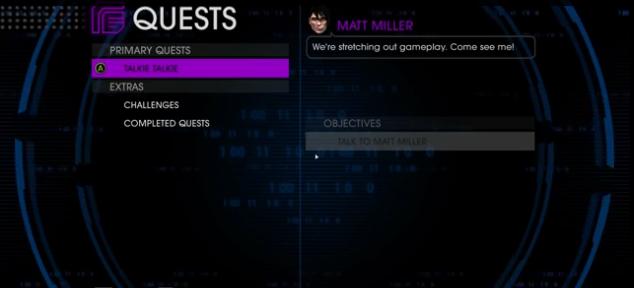
This post doesn’t necessarily aim to answer that question, but it’s certainly a lens with which to view SR4.  The game more or less makes that leap for you, in fact, doing everything it can to remind you that all these activities you’re doing are pointless and repetitive and without any sort of narrative purpose.  Case in point:  there’s one mission late in the game called “Talkie Talkie” where you have to talk to a character on the ship.  The mission description on the pause screen literally says:  “We’re stretching out gameplay.  Come see me!”

sr4-talkieDoes self-awareness of a flaw excuse that flaw?  Because the game does this all the fucking time.  Every loyalty mission you do is the same general idea of 5 actions you need to perform; clear out an area of bad guys; do an activity; hack a store; steal a car and drive it to some random location; clear out another area of bad guys.  If you’ve already done one of those activities in the simple course of screwing around, then those actions are greyed out and struck through.  Lather, rinse, repeat.  Over and over and over again.

The actual story missions do change things up a bit, and by that I mean that they will, on occasion, arbitrarily strip you of the superpowers you’ve laboriously worked to build up.  The justification for doing so is, to put it kindly, weak; and the game admits as much.  These missions are also, on occasion, straight-up parody of other games; there’s a stealth mission that’s straight out of Metal Gear Solid (with a great line asking “why should I use two bullets to shoot out two lights when I can just use one bullet to kill that guy?”); there’s a text adventure; my favorite of all is a 2D side-scrolling beat-em-up.

sr4-sor

The game is fun; there’s no denying that.  The game only wants to entertain; there’s nothing wrong with that.  But the game also feels empty and hollow, and the characters are mere caricatures, and there’s nothing particularly memorable about the experience as a whole.  I saved the planet and had a few laughs and killed thousands of monsters; I’ve done this before, though, and the only thing different in this game was that there’s a lot of casual profanity and nudity and occasionally the game turns itself inside out and goes even more fucking insane.

The difference between satire and parody is quite large, actually, at least in terms of videogames.  In my last post, I talked about how it’s sort of impossible to talk about Saints Row without talking about Grand Theft Auto, and how SR4 literally makes this comparison for you in the second line of dialogue in the game’s opening cutscene.   The two franchises have clearly moved in wildly different directions, and I sincerely applaud Saints Row for emerging under GTA’s shadow and becoming its own thing.   It has become a franchise worth looking forward to; not only has it made significant innovations to the open-world genre, but it’s done it in style.

But it’s also now a victim of its own success, I think.  SR3 really upped the ante and surprised everyone by being a genuinely great game that gleefully went off the rails; SR4 somehow managed to outdo SR3, which seems impossible.  But now this franchise seems to be purely about outdoing itself, and I fear that eventually – quite soon, actually – they’ll hit a wall, and have nowhere to go.

And if they decide to simply go down the path where the next game is pure parody, filled only with ironic self-awareness about, say, stupid mission design while doing nothing to change the stupid mission design, then I’m not really sure that’s something to look forward to.

the first two hours: Saints Row IV

Before I get into Saints Row IV, I should explain why I’ve been quiet here this week.  It’s certainly not for lack of things to talk about.

I finished Gone Home last Thursday.  And I’ve been wanting to talk about it, all the time, here; but instead I ended up writing a 1000-word review of it for the NY Videogames Critics Circle, which will hopefully be going up Thursday or Friday.  (If for some reason it doesn’t run there, it will most assuredly run here.)  The short version is that it is a wonderful, heartbreaking, astonishing experience, and anyone who’s reading this who somehow hasn’t played it yet should get on that shit immediately.  And then, after you’ve finished it, you should dive in to the many wonderful pieces that have been written about it.

And along those lines, fuck it:  this is the postscript to my review, which may or may not end up staying in, being that it’s just links to those wonderful pieces referenced above:

I’ve been playing games since 1982, and I’ve been writing about games since 2008 or so; in all that time, I’m not sure I’ve ever seen so many heartfelt responses to a game before.  These are very spoiler-heavy, but well worth your time if you’ve finished the game and want to keep falling down the rabbit hole:

*     *     *

It is profoundly strange to be writing about Saints Row IV after the week or two I’ve spent ruminating intensely on the profound, emotional experiences I’ve had playing both Brothers: A Tale of Two Sons and then Gone Home, games which feel like they’re using a completely different vocabulary from everything else.   Because after playing those soft, quiet masterpieces, Saints Row IV is a bit like having a pie filled with fireworks thrown into your face at a thousand miles per hour.

I know I’ve complained about how lazy it is for critics to compare one thing to another.  But it’s nearly impossible (for me) to talk about Saints Row without comparing it to GTA.  In my defense, though, Saints Row more or less explicitly demands this comparison.  Here are the very first lines of dialogue in SR4‘s opening cutscene:

“…When the Saints made their presence known to the world in 2006, they were decried for being pretenders to the throne.  The people were confused: were the Saints sociopathic killing machines hellbent on destruction, or puckish rogues living a life of mirth and whimsy?  The Saints needed clarity of purpose, and so the course was set:  More fun, less mercy killing.  This simple  choice revitalized the Saints; transforming them from a degenerate street gang into beloved pop culture icons…”

This paragraph more or less details the design history and development process of the Saints Row franchise, from the first game through the present.  While the first game was a competent but uninspired GTA clone that simply beat GTA4 to the punch to be the first big open-world action game on the current generation of consoles, the second game was where the developers started to work on achieving that “clarity of purpose” – to be over-the-top ridiculous, in stark contrast to GTA4‘s gritty, nihilistic realism.  And the third game was, to put it bluntly, fucking insane.  Ironically, this fully-committed, all-in approach to full-bore insanity is what made the third game such a resounding success; it had finally come into its own, allowed to run free as full, pure id.

To be honest, I had low expectations for SR4.  My understanding is that this game was originally intended to be an expansion pack for SR3, which didn’t necessarily bode all that well since the original expansions for SR3 were a bit lacking.  And then, of course, THQ (the publisher) famously collapsed and died, and so Volition (the developer) was in a bit of limbo for a while.

That SR4 somehow manages to out-do SR3 at every conceivable turn is nothing short of remarkable.

I’m only 2 hours in.  (I stopped playing last night shortly after the narrator told me that I’d finished Act 1.)  And yet I’m already leaping tall buildings in a single bound, zooming and jumping and soaring through the city, destroying cars just by bumping into them.  There is no reason to jack cars anymore; when my stamina is out and I’m forced to walk, like a normal person, I feel like a goddamned snail.

SR4 is no longer a gang-land simulator; it is a superhero simulator.  And where GTA remains firmly on the side of satire, Saints Row has now become a grand parody of this generation’s biggest AAA titles – the videogame equivalent of Weird Al Yankovic on a 48-hour bender of Mountain Dew and LSD.  The opening sequences felt like they were ripped straight out of a warped vision of Call of Duty;  30 minutes later it’s become, among other things, a grand homage to Crackdown‘s orb hunting (which still remains one of my favorite gameplay activities of the last 10 years).  If you needed any further hints as to how self-aware SR4 is, well, not only is there a “Nolan North” option in the voice customization menu, but Keith David plays himself.  As the Vice President of the United States.

The game is utterly ridiculous and incredibly fun.  Not to diminish the amazing achievements of Brothers and Gone Home, of course; those games are fun, too, albeit in a very different way.  SR4, though, is not about subtlety, or emotion, or self-discovery; it is about cramming as much fun per second as humanly possible.  It does not want to enlighten; it wants to entertain.  This, too, is noble.