weekend recap: Dangerous Golf, Overwatch, Blood & Wine

Today’s favorite album:  Steve Gunn, “Eyes on the Lines.”

This was a very busy weekend; lots of fun family activities, plus also a wee bit of a stomach bug last night.  You can’t win ’em all.

I’ve got three games I want to talk about, so let’s get to it.


First up: the eagerly anticipated Dangerous Golf, the first game from the ex-heads of Criterion Games, makers of the Burnout driving games, also known as my personal favorite driving series of all time.  On paper, this sounds like a perfect little arcade diversion: take Burnout’s crash mode, but instead of a car smashing other cars in glorious slow-motion, it’s a golf ball destroying hundreds of fragile, breakable objects in an assortment of rooms.

In execution… well, it’s not quite there.  It’s so close to being great.  Sadly, it feels a little rushed and unpolished.  The impression one gets after an hour or so is that this is a snazzy proof-of-concept physics demo, rather than a well-thought-out game experience.  And it’s not just the strangely bare-boned career mode, or the inconsistent camera control, or the aggravating load times; there’s just a curious lack of attention to detail that make this feel a lot rougher than it ought to be.  Just as an example, there’s no interstitial music.  This is obviously not that big a deal in the grand scheme of things, but it does come off as an oversight that ends up becoming more and more distracting.  Ironically, the 5-second guitar flourishes at the conclusion of each round sound not unlike the sound cues you’d hear after putting a set list together in Rock Band, which is *also* just a bit weird.

There’s also little things like having the control scheme graphic feature a whole bunch of advanced features that don’t actually unlock right away, which can lead to some frustration.  Key example – there’s a thing called “Pistol Tee” and “Pistol Putt”, which happen by pushing RT when you tee or putt (obviously).  But you don’t unlock those two things until after your 2nd “tour” is complete, and even when you unlock them, they aren’t ever explained.  Indeed, the whole putting game is never explained – and you can’t move the camera after you shoot, so when the flag is in a different room you can’t see where your shot is going.

These are things that could arrive in a future patch, but I can’t imagine they would.  I know lots and lots of Burnout fans who have yet to play this game – either they don’t know about it, or they’re busy playing Overwatch, or they just don’t care.  It’s a shame, because with a little more elbow grease this could be a ton of fun.  As it is, it’s almost a ton of fun – and I’m giving it the extreme benefit of the doubt, given that (a) I love golf games, (b) I love the developers’ previous work, and (c) this combination is right in my wheelhouse,  but I don’t know how much more time I’m going to spend with it.

* * *

And speaking of giving prominent game developers the benefit of the doubt – as well as mentioning Overwatch in passing – well, my rental copy of Overwatch finally showed up on Saturday.  I am probably not going to play very much of it.

But I want to stress that this isn’t the game’s fault.

I have nothing but respect for Blizzard’s past work, and Overwatch has received superlative writeups from all the critics I care about, and my friends all love it, and I’m all in favor of vibrant colors and a diverse cast of characters.

The problem, of course, is that I do not like competitive shoot-’em-ups, no matter how amazing they are.  Maybe it’s a genetic thing; maybe I’m never going to like competitive shooters.  It’s the part of every big game that I go out of my way to avoid:  Halo, Call of Duty, Uncharted, Gears of War, Destiny, The Division – I just can’t do it, man.  It’s not even that I suck at them – I mean, I kinda suck at Rocket League but that game’s never coming off my PS4 hard drive*, because even being terrible at it is still super-fun.  There’s a certain mind-set that goes into enjoying competitive shooters, and I just don’t have it, and I don’t know that I ever will.  I’ll be very curious to see what game comes along to break that particular pattern, especially given that I’m always going to be older than the target demographic, and also given that I will eventually spend less time per night gaming than I used to.

Finally, I gotta talk about The Witcher 3 – Blood and Wine DLC.


As I noted last week, I had no idea that I could’ve been playing the first DLC all along.  So I started a new character and began the first Hearts of Stone mission and very quickly  realized that it was all familiar, and very quickly remembered that I’d already played it  and simply forgotten that I’d done so.  So I then immediately started the new one, Blood & Wine.  Now we’re all caught up.

Here’s the thing about this particular bit of DLC – it’s a perfect bit for a player like me, someone who loved the original game but hadn’t played it seriously in a long time and had forgotten what the overall rhythms of the gameplay experience feel like.  Unlike other prominent RPG DLC missions, this is not merely a quest with some side objectives; this is an entirely new and rather large landmass, with at least a dozen heavy-duty side-quests that I’m compelled to tackle if only because I’m still underleveled for the main quest.

I haven’t even really begun to mess with the whole “I own a vineyard and a country villa” angle, if only because I’d already foolishly spent a lot of money improving a different DLC merchant before I realized what I needed it for.

The long and short of it is:  godDAMN I love this game.  I love how this game is built; each quest has its own pace and its own “hook”, and the characters you meet are almost always interesting.  It’s nearly impossible to predict how a given quest will flow; even the monster-hunting quests, which are the closest thing this game has to a “cookie-cutter” approach, are different in terms of your combat tactics.

Here’s another thing about Witcher 3 – it’s completely ruined Bethesda’s RPGs for me. I was already having trouble enjoying Fallout 4, and now I know I’ll never be able to go back to it after this.  Same goes for Skyrim and Oblivion and the like; even if Bethesda remasters them for current-gen consoles, they’ll still feel clunky and archaic.  Playing Fallout 4 after playing Witcher 3 is similar to what it’s like to play GTA 3 after playing GTA 5; even though I adore GTA 3, it’s damn-near impossible to play given how shitty the controls are.  And Fallout 4’s cutscenes and writing just simply aren’t as sharp or as interesting as Witcher 3; and Geralt is infinitely more compelling than any blank cipher I come up with.

But whatever – I’m not here to be sad about Bethesda, I’m here to celebrate The Witcher 3 – one of the finest games of this generation, and one of my favorite games of all time.  I’m so glad to have a compelling reason to revisit it, and I’m even happier that this DLC is, so far, really, really good.


* This reminds me of a question that popped up on Twitter not too long ago – what games will you always keep on your hard drive?   My PC, when it was working, had a 1.5TB hard drive and so everything stayed on it.  My XB1 doesn’t really get used all that often, but I will always make sure that Pinball FX2 stays on, and I suppose I’ll always keep the latest Forza Horizon title on.  (I did recently delete and then re-install Sunset Overdrive, because I forgot how to play it and the only way to re-tutorialize is to completely wipe out any record of you playing it, both locally and in the cloud, and I can’t believe this hasn’t been fixed yet.)  As for the PS4, my primary console of choice – well, I’ve had to do a fair amount of juggling in the last year or so, but I suppose I’ll always make sure I have room for Witcher 3 and Rocket League.

the dummy

So I am a dumb-dumb.

I’ve been complaining for months now that I haven’t been able to get to any of the Witcher 3 DLC, because I started a New Game + and need to be at least level 60 in order to start the last episode, Hearts of Stone.  And even though I’d downloaded the newest installment yesterday morning before leaving for work, it didn’t appear to be available when I started my NG+ save.

So I decided to back out, close out, and see about starting a New Game from scratch.  And lo and behold, there’s an option to play just the DLC (as well as any non-main-storyline quests) as a level 32 character, with properly leveled equipment.

I could’ve been playing the DLC this whole time, in other words, except I didn’t realize it was an option.  Or maybe I did, but ignored it (and then forgot about it), figuring I’d want to get there on my own via NG+ and such.

Unlike other RPGs where I’d find myself attached to my specific character build, Geralt is such a well-defined character in his own right that it seems completely unnecessary to bring my previous hundreds of hours along with him for a stand-alone adventure.  I’m certainly not attached to any of my weaponry or armor, and I have to figure that the DLC content would drop new stuff soon enough anyway.

So, as I said before, I’m a dumb-dumb.  I’ll be playing the Hearts of Stone and Blood & Wine DLCs now, and that’s pretty much all there is to it.


I don’t write about music nearly enough on this blog, and so I’d be remiss if I didn’t point out my current front-runner for Album of the Year: King Gizzard and the Lizard Wizard’s ridiculously awesome “Nonagon Infinity”.  One of their songs had shown up in my Spotify Discovery playlist a few weeks back and I’d thought it pretty good, and for whatever reason I decided to give the rest of the album a listen, and NOW I CAN’T STOP.  Which is helpful, because the album is designed to be listened to on repeat – the last song leads directly into the opening seconds of the first song.  The whole thing kicks a tremendous amount of ass and now I’m finding myself falling down a garage-rock-psychedelic-prog rabbit hole; I’ll be listening to this and Thee Oh Sees for the next month, at least.


I’m about 2/3rds of the way through Justin Cronin’s “The City of Mirrors”, aka the final installment in the Passage trilogy, and it’s… hmm.  I’m enjoying it very much, though it’s paced a little too deliberately – there’s lots of short chapters with cliffhanger endings.  I appreciate that he’s trying to build momentum and tension, but it feels a little artificial to me.

On the other hand, it’s very interesting to see earlier events from the previous books told through different points of view – my favorite sequence in the entire trilogy, Amy’s visit to the zoo (from the first book), is now seen through Amy’s own POV, which adds an illuminating layer of intrigue to an already spectacular set-piece.  And there’s also a very long sequence detailing Subject Zero’s personal history, which contains some of the best pure writing in the whole series.

Obviously, if you’ve read the first two, you’re probably already reading this one.  I’ll be looking forward to talking it over with people once I finish.

preposterous architecture

First thing’s first:  regular readers of this blog know that I have a tendency to post somewhat irregularly.  Unfortunately, due to events beyond my control (i.e., my day job just moved to a new location and my computer monitor is now far more visible than it ever was at the old location), this is probably only going to get worse before it gets better.


I’ve been stressed out about the Goodreads challenge.  I am still 2 books ahead of schedule, but I don’t like only being 2 books ahead of schedule; there’s not a lot of breathing room.  But more to the point, I don’t like feeling like I need to read quickly just to hit some arbitrary number that I selected at the end of last year.

In any event, I finished David Means’ excellent and very trippy meta-Vietnam-memoir “Hystopia” this morning, which means I can now jump to “The City of Mirrors”, the just-released and final installment in Justin Cronin’s wonderful Passage trilogy.  I recently re-read the first two in order to get better prepared; I’d always adored the first book, but wasn’t quite as hot on the second.  After this re-read, though, I thought the 2nd book was much better – possibly because the first book was still fresh in my mind, and also possibly because I wasn’t rushing through the ending and so I found myself better able to follow what was happening.  I still think he’s better at writing about people than he is at constructing elaborate action set-pieces, and to that end the 2nd book is still problematic, but it’s still engaging.


As for games:  I’m finding myself having conflicting thoughts about Uncharted 4, the longer I stay away from it.  It’s tricky.  While I was playing it, I was thoroughly enraptured by it; the pacing is so fucking good and I always felt involved and invested in what was happening.  But now that it’s over, and I’ve read some more critical appraisals, I’m starting to wonder if it’s “THE BEST GAME EVER MADE.”  I certainly wouldn’t go quite as far as, say, David Shimomura’s disemboweling of it in Unwinnable, but there are some interesting points raised therein.

I had planned on replaying it, but as it happens, I’ve found myself more and more entranced by the new Doom.  It started off very slow, almost alarmingly slow – though I concede that this might’ve been because my initial hour or so was spent in that post-Uncharted 4 haze.  But it’s become quite enjoyable.

I don’t have the same relationship with Doom that most people do; I played the first few levels back in the day but I don’t think I ever beat it.   Same thing with Castle Wolfenstein.  The only games I had access to in those years, for whatever reason, were Duke Nukem 3D and then Quake 2.  I’m sure I bought the Xbox Arcade version of Doom, just to have it, but I don’t know that I did anything with it.

Point being, even in my limited experience, I’m familiar with the old Doom enough to recognize that this new Doom feels like it’s coming from the same place.  Certainly the movement feels similar.  The momentum through a combat arena feels the same – constant movement, jumping all over the place, nonstop action, and then a very pleasing break after that last kill, when the music calms down, and then you can begin to explore for hidden stuff (most of which I can’t find, even though I do look for it – even with my recon upgrades, I’m still missing things all the time).  It has the same confounding first-person platforming bits on preposterous architecture.   My first visit to Hell felt… well, not particularly hellish the way a more modern horror game might depict it, but it certainly felt like a Doom version of Hell should, which is appropriate.

I don’t give a shit about the narrative and, refreshingly, the game knows it.  It gives you just enough to point you in the right direction, but doesn’t overplay its hand; nobody’s playing this for the story.  (Which, again, is an interesting thing to experience after playing Uncharted 4, a game in which there are several different levels specifically dedicated to wandering around a person’s private residence, where every single item is part of a larger character study.)


So, yes:  it’s going to be quiet-ish around here for a little bit, until I can better figure out how to write without making it profoundly obvious that I’m not doing actual work-work.  Bear with me.

The End of Uncharted / The First Few Hours of Doom

It’s been a weird week, folks.  That’s all I’ll say about that.


I was hoping to have already written up – if not a “review”, at least a summary of my experience with Uncharted 4.  I finished the game last Sunday evening and then immediately went back and started it over again, this time playing it with the cel shader turned on (which also looks amazing, by the way – I mean, the vanilla U4 is already the best-looking game I’ve ever seen, and the cel shading isn’t a quick thing that Naughty Dog cobbled together; it changes the way you view the game, and somehow makes the violence refreshingly cartoonish).

I’d written on Twitter that it’s rare when a big-budget AAA game feels special.  And what I mean by that is simply that for all the spectacle of U4 – and there is plenty – there’s also a great deal of heart and soul.  There’s an attention to detail – not just in terms of environments, but also in terms of emotional storytelling.  A pause in a conversation; a look passing over a character’s face.  The Uncharted games are lauded for their conversational writing, but U4 also contains a great deal of words left unspoken.

Point being, in terms of blockbuster games feeling “special”, there aren’t many that I can think of.  In recent years, Witcher 3 certainly qualifies (even as I wonder if it’s truly AAA – though the definition of AAA is something for another post); BioshockRed Dead Redemption and Portal 2 certainly come to my mind as well.  I’m sure you can come up with your own examples of Big Games that went above and beyond the call of duty (pun intended) and tried to mean something.

Or maybe I feel this way simply because my expectations for Uncharted 4 were somewhat lower than I anticipated, considering how U3 felt very much like a big fat let-down after U2, and that I worried that U4 was just going to be one soul-less gunfight after another, with some technologically staggering but empty-feeling set-pieces staggered here and there.  That U4 is very much NOT this game, when it just as easily could’ve been, is maybe why I’m so relieved.

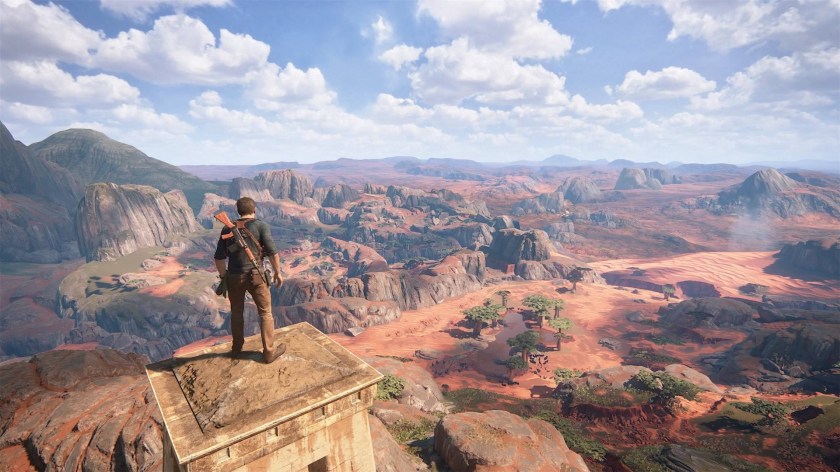
I said in my last post that the game felt remarkably well-paced, and that remains the case through the finale.  The gunfights are still my least favorite part of this franchise, but at least here they weren’t ever truly frustrating the way some of U2 and U3’s gauntlets were; you can anticipate when they’re coming in U4, and they’re over fairly quickly, and then the game just lets you take as much time as you want to explore.  (And play with the camera mode, of course, because HOLY SHIT this game is really, really, really ridiculously good-looking.)

And so while U2 might still have the most exciting set-pieces (the train, the giant climbable dagger, the Nepalese village), I think Uncharted 4 might be the best overall experience.  Certainly it has the most satisfying ending.

On that note, I’m reluctant to do a deep-dive because of spoilers, but I feel compelled to link to Carolyn Petit’s follow-up essay to her review – there are MAJOR SPOILERS in the essay, but it’s also incredibly insightful and well-written and speaks to a lot of the larger issues with the franchise as a whole.  (Funnily enough, I read that follow-up essay as I was beginning my 2nd playthrough; at one point she writes about Nathan Drake’s casual relationship with violence, and immediately after I finished reading that and went back to the game itself I found myself in a prison fight – arguably one of the more brutally violent sequences in the entire franchise.)

I may also be participating in a write-up of the game elsewhere, so I’m going to save some of my thoughts for that piece.  (And believe me, there’s at least 1000 more words I could write right now that I’m holding back on.)  In any event, Uncharted 4 is, for whatever it’s worth, my current front-runner for Game of the Year, and if anything manages to knock it from the top spot, I’ll be very impressed.


It is exceedingly weird to go from U4 to Doom; the two games couldn’t possibly be more different.  Maybe this is why I’m having trouble enjoying it.

Doom feels weird.  I almost wish it was running at 30fps if only so that the graphics would look less… artificial.  Again, it’s hard to come to Doom after spending nearly 20 hours with Uncharted 4, which is almost certainly the most dazzling graphical display I’ve ever seen.

I can appreciate the old-school feel it’s going for; it’s not slow and methodical, there’s no cover to duck behind.  Standing still is instant death.  You fly around the maps, blowing the shit out of everything you see, and even if I’m not necessarily in the mood for this type of thing at the moment, I can at least appreciate the endorphin rush as you melee staggered enemies and commit bloody atrocities in gleefully exciting ways.

To that end, I will agree with Polygon’s assessment that Doom has the best videogame shotgun in decades.  I’m just not sure if that’s enough to get me through the next 8-10 hours.

The First Few Hours: Uncharted 4

Current Status: beginning of Chapter 14, 9:42 hours in, 362 enemies killed, a whole bunch of screenshots taken.

image

Note to self:  When the inevitable “everything sucks, there’s nothing good out” mope-fest happens later this year, remind yourself that in one 4-day span in May, Captain America: Civil War came out and kicked ass, Radiohead put out a new excellent album that kicked ass (albeit in a quiet, elegiac way), and that Uncharted 4 did what Uncharted 4 does, which is to kick ass all over the goddamned place.

whee

I don’t know where to begin with this post, which is OK, since it’s not a proper review.  I mean, I could talk about a million different things – the extraordinary presentation (not just graphically – the audio is just as spectacular), the dramatic changes to the combat (i.e., it doesn’t feel as endless as it used to, and enemies are far less bullet-spongey than before), the fantastic writing and voice acting (and facial animation, too).

image

The best thing about the game so far, though, is the pacing.  My biggest fear for Uncharted 4 was that it would be all combat, all the time, with a minimal emphasis on exploration and traversal and puzzle solving; as it happens, I was completely and utterly wrong on all counts.  This game is all about exploration and traversal and puzzle solving; indeed, as you progress you’ll find that there are multiple paths to your eventual destination, which means that if, like me, you’re hungry for finding hidden collectibles, you will drive yourself completely insane trying to make sure you’ve covered every possible square inch before moving on to the next area.


image

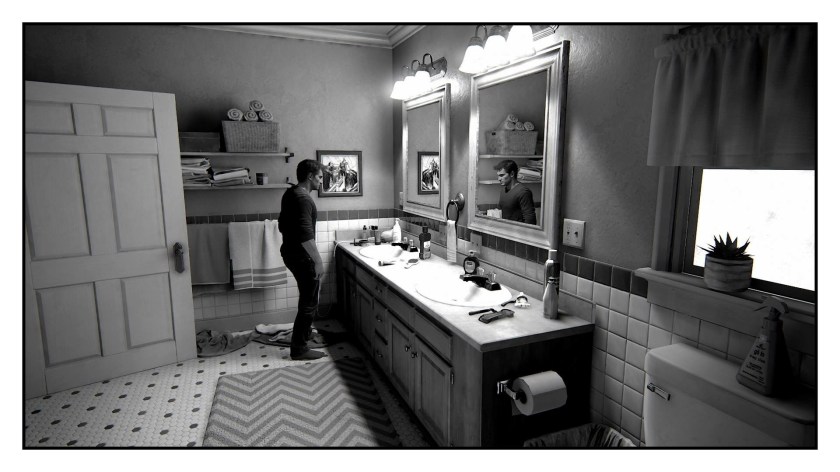
The game is very content to take its time – or, rather, to let you take your time.  Chapter 4 is perhaps the best example of this so far, as it starts with Nathan exploring his attic.  The attention to detail in this chapter is simply staggering; every pixel has been placed with care and attention, and I’m not sure I’ve ever enjoyed wandering around a digital house before.  Every detail tells a story, and in these details you learn about Nate’s domestic life: the quality of his marriage, the disappointment and regret he feels in the life he’s walked away from, the rut he’s fallen into.  Nate is no longer a freelance treasure hunter; he is a shadow of his former self, and everyone around him knows it better than he does.

image

Apparently there’s still quite a bit of game left.  As I noted above, I’m a little less than 10 hours into it, and I thought I was nearing the end, but apparently the game is closer to 20 hours.  And in retrospect, I can see that there are still some significant story beats that need to get tied up; if this is the definitive, capital-E END of Naughty Dog’s involvement in the Nathan Drake saga, and Naughty Dog has made it explicitly clear that the end of this game is it as far as they’re concerned, then there’s quite a bit more to deal with beyond simply getting to the treasure.

I am happy that there’s quite a bit more to deal with.

image


Civil War! Radiohead!

Here’s hoping you all had as lovely a weekend as I did.

First thing’s first:  normally I’m very late to the party when it comes to seeing big blockbuster movies in a timely fashion.  I spent 20 years dealing with the insanity of seeing big movies on opening weekend in NYC, a process that, among other things, entailed getting to the theater at least 90 minutes before showtime to ensure getting even a halfway decent seat, and this eventually wore on my nerves.  So between that and our weird reluctance to hire a babysitter, my wife and I don’t often get to go to the movies together, and certainly not for big big movies like Captain America: Civil War.  (Or, for that matter, Star Wars: The Force Awakens.  My wife and I both saw it separately, and it wasn’t until the movie had been out for several weeks that we were able to see it together.)

But somehow we were able to see it yesterday.

I don’t know how valuable my opinion is when it comes to evaluating Marvel movies.  I’m not a comic book guy, and so my primary exposure to anything involving superheroes is through film – and film will always be different than the source material.  My wife, on the other hand, is a Marvel girl through-and-through, and she devoured the Civil War run when it was in print – indeed, I think the primary reason she was excited about the idea of an Avengers movie in the first place is that it might eventually lead to a film of the Civil War.

My understanding is that the film’s Civil War and the comic book run couldn’t be more different, even if they had a number of common similarities.  Obviously, the comic wasn’t constrained by all the various legal issues that have split up the various Marvel franchises among rival film studios – my wife is an X-Men fan, and so their absence in this Captain America film is rather strongly felt.  The comic was also, if I understand it correctly, spread out over a long-ish period of time; the movie, on the other hand, appears to take place within a 72-hour period, and the one big superhero battle is rather self-contained, all things considered.  It’s more of a grudge match than a capital-W War, like when a fight breaks out between teammates on the bench during a baseball game.

But this is all besides the point; I didn’t read the comics, so it makes no sense for me to look at it from that perspective.  As far as the films themselves, I’ve enjoyed the Marvel Cinematic Universe, for the most part; some films work better than others, to be sure, but all the heroes are well cast and the films possess a buoyant energy – far more so than the DC films.*

Anyway:  of all the MCU films, this Civil War film is almost certainly the best one.  For an ensemble action movie – with an absolutely gigantic ensemble – it’s remarkable how well-paced it is, how every character gets enough space to have their requisite emotional beats, and especially how both Captain America and Iron Man have compelling and valid points of view.

And the action sequences are similarly remarkably well-framed.  Unlike other recent action movies I could name, you can always tell what’s going on, who’s punching who, and there’s none of the motion sickness that seems to be part and parcel with these sorts of set pieces.  There’s one chase sequence in particular involving Winter Soldier, Black Panther and Captain America that is absolutely fantastic, specifically because the stuntwork is excellent and is shot in such a way that you can actually see what the hell is going on.  (The shot of Winter Soldier grabbing the motorcycle is arguably the most exciting shot in the entirety of the MCU thus far.)

It’s been noted by better critics than me that if this movie has one downside, it’s that the villain isn’t particularly memorable, and also that the movie makes up for this by not really needing a villain in the first place.  The Cap’n and Iron Man have been getting under each other’s skin for several films by now, and this film’s conflict is less about current ideological differences and more about, as Tony Stark says, simply “wanting to punch you in your perfect teeth.”

I want to say more, but I don’t want to spoil anything; I just hope I get another chance to see it on the big screen before too long.

*  *  *

The other big cultural event of the weekend: the new Radiohead album, “A Moon Shaped Pool”, was released on Sunday.  I didn’t get a chance to listen to it until late last night, and even then I was being an idiot and struggling with the admittedly ridiculous decision as to how I should get it – iTunes? Amazon mp3? or hope for it to appear on Spotify before too long?

I’ll need a few dozen more listens before I can write about it with any authority, of course.  But even just on first glance it’s clear that this is a gorgeous album, with haunting melodies and Jonny Greenwood’s otherworldly string arrangements doing freakish things to my brain.  The thing about Radiohead albums – for me, at any rate – is that the production is always interesting, even on their lesser tunes, and on this album there are some rather startling and intimate sounds; the ones that got me in particular are how you can hear the piano’s hammers strike each string, as if the microphone was placed an inch away from the piano’s heart.  (I’m reminded of a Flaming Lips lyric – each press of a piano key is like “the softest bullet ever shot”).

It’s perhaps not the grand return to form I might’ve hoped for after the rather limp King of Limbs – I can’t help but wish there were a few more uptempo songs, though I feel certain that “Ful Stop” will absolutely destroy in a live setting – but this is definitely an improvement.  It’s hard to know what I expect from a Radiohead album anymore; the 1-2 knockout punches of OK Computer and Kid A will probably cloud everyone’s judgement on that score, not just mine.  But in terms of pure sonic beauty, this one’s a keeper.

*  *  *

Nothing to report on the games front; my digital copy of Uncharted 4 is already pre-loaded and that’s pretty much where I’ll be for the foreseeable future.

As for books – I finished re-reading Justin Cronin’s The Passage and am about halfway through my re-read of The Twelve, all so that I can get caught up for The City of Mirrors, which comes out in 2 weeks.  Those books are still great!


* I still wish that Edgar Wright had been allowed to make the Ant-Man film that he wanted to make; I bet it would’ve been spectacular.  But I suspect that his directorial vision would’ve been too idiosyncratic with the rest of the MCU; the final film feels constrained and reigned in, and it’s not nearly as joyous and charming as it wants to be.


Return of the Subway Gamer: War Tortoise

I’ve never claimed to understand the appeal of game streaming; why would anyone watch other people play games, when they could be playing the same game themselves?  Even if the streamer is funny or insightful or entertaining, it seems like a perverse way to spend one’s time.

But by the same token, I’m one of those weirdos who is fascinated and compelled by auto-clickers; games which, eventually, play themselves.  I still have an active Clicker Heroes save, which I’ve actually checked on several times today.  I’ve been heavily invested in Cookie Clicker – twice.  I had been playing Mucho Taco on my iPhone, but then put it aside to play Doomsday.   I’ve spent actual money on these games.

So who am I to judge?

Point being:  in the last few days I have become rather enamored of War Tortoise, which is a strange and uniquely compelling hybrid of auto-clicker and tower defense, with an RPG-lite skill levelling system, a strikingly gorgeous presentation (for the iPhone, at least), and the ingeniously designed option to jump in and play, rather than just watch.

This isn’t just an auto-clicker – the gameplay is that of an endless turret sequence.  You can usually just let it run while you tap on various currency drops, but if there’s a tough bullet-sponge enemy bearing down on you, you can reclaim the turret and use some of the heavy weaponry to help take it down.  It’s not necessarily difficult, but there is a strategy involved in terms of how to best spend your money and build up your defenses, and that’s where the fun (for me, at least) lies.

It’s a strange game, don’t get me wrong – I don’t know why I’m on a tortoise, or why I am some sort of field mouse facing off against hordes of armored iguanas and beetles and such – but I don’t care.  The game doesn’t explain any of this, nor does it really need to.  Nobody plays these types of games for any sort of narrative sustenance.

It’s weird, and I’m weird, and I get it, and I accept it.  War Tortoise is awesome.


I’m in a bit of a holding pattern as far as my game playing is concerned right now; supposedly the review embargo for Uncharted 4 drops tomorrow, and while I’m nearly positive I’ll be buying it, I’m still curious as to how it reviews.  I worry it’ll be too combat heavy, but I’ve said that about all the Uncharted games, and by and large they are still enjoyable games.

I bought SUPERHOT for the Xbox One this morning, even though as a Kickstarter backer I already had it on my PC; my PC is basically busted, though, and I never got a chance to finish the game.  It looks absolutely fantastic on the XB1, for whatever that’s worth, and it plays just as well as I remember it playing on the PC, so that’s really all that matters.

I’m close to the end of Ratchet & Clank, which has remained a very pleasant action platformer which eventually gets a little tedious and exhausting.  I’d like to finish it, but I won’t necessarily kill myself to get there.

Most of my gaming has been on the iPhone.  Before War Tortoise came along, I was heavily invested in Marvel Avengers Alliance 2, which is a free-to-play turn-based RPG with impressive production values and a rather enjoyable combat system.  I’ve also been addicted to Loop Mania, a rather deceptively simple arcade game that is easier seen than described.

Mirror’s Edge: Catalyst beta impressions

(I would’ve written about this earlier, except I was under the impression that there was an NDA for closed-beta members.  However, Kotaku just opened up a thread about the beta, and someone there told me that there was no NDA and that EA was actively promoting player streams on Twitter, so: my mistake!)

Unlike other betas in which it’s obvious that the developers are stress-testing their multiplayer servers and getting a feel for how players are reacting to weapons and such, I’m not sure what the purpose of the Mirror’s Edge beta was for, beyond giving franchise fans a sneak peak of this long-awaited sequel.  To be fair, I only had the chance to play it for an hour or so and so I didn’t run across (sorry) any multiplayer options; I suspect there would be some sort of leaderboard for time trials, but that isn’t necessarily something that needs stress-testing.

As someone who admired the first game for its relative strengths but didn’t finish it because the combat was overwhelmingly stupid and awful, I can’t necessarily articulate what it is that I’d want from a sequel – beyond getting rid of the gunplay.  I don’t remember much of the larger narrative from the first game; all I do remember, frankly, is the incredible visual style and the often-exhilarating parkour.

To that end, I’m not sure that Catalyst delivers.  The graphics are not as pristine as I’d expect them to be – but then, this is a beta, and I’m sure there’s quite a bit more spit and polish left before the game goes gold.  The free-running feels essentially the same, even if the control scheme isn’t quite as intuitive as I’d like (lots of L1 and L2 on the PS4 controller, with the face buttons used for hand-to-hand combat).

My biggest issue with the game, though, is that it feels very much like it’s trying to be an Assassin’s Creed clone, and not a particularly interesting one at that.  It has that same quasi-open-world feel and the same skill-tree system of upgrades, but it feels clumsy in my hands.  More to the point, the writing is awful.  Everybody is annoying, uninteresting, speaking the same cliched game-dialogue we’ve all heard for years.  The first person Faith meets when she gets out of [prison?] is the same annoying-new-guy stock character we’ve seen a million times.  I have no idea why I’m doing anything, nor do I know why I have to do it so quickly.  The mission designs, at least the few that I played through, are all standard cookie-cutter missions – collect a bunch of things, deliver them to point A, evade your pursuers.  The time trial stuff is fun in principle, though it’s silly from a narrative point – I understand the need to tutorialize for the new player, but if Faith is this legendary free-runner, why does she need to prove herself to anybody – even if she was in prison?

I’d like to say I’m still cautiously optimistic, but I’m not sure that the problems I’m seeing here are the sorts of things that can be fixed by June.

On The Ethics of Game Criticism

[This is an IM conversation between me and my buddy Greg, regarding Arthur Gies’ non-review of Star Fox Zero over at Polygon.]

G:  in other news, arthur gies continues to be
a bit of a pretentious tool (by refusing to review star fox

J:is that good/bad, re star fox?
from everything else i’ve read, it’s a bit of a shitshow

G:  it’s essentially a bad review that has no score
and claims not to be a review.
i.e. it’s such a mess i can’t even be bothered to
finish it to review it (even though that’s
my job and the game is maybe 5 hours long)

“It is, to be blunt, a miserable experience, and
the idea of playing more fills me with the kind of
deep, existential dread I can’t really justify.”
i mean, jesus howard christ, that is quite a thing
to write about playing a janky video game
to complete a work assignment.
J:  at least he’s not mincing words

we’ve all played games that shitty
G: sure
J: for it to be a big-name exclusive for an ailing system,
and for it to be a terrible game – well, one can make
the argument that keeping the piece as is
is a good way to get page views and get nerds all angry

but
G: but i think he needs to suck up
his existential dread, push through the
last two hours of the game and put a number on it.
J: what difference would that make, though?
G: i see it as more of a way to feed gies’s ego.

well for one thing, it would pull down
the metacritic average of a game that advertises on their site.
like, ok, his piece is essentially a scathing review.
but then why go through this whole charade about
refusing to review it on some kind of purportedly
principled basis of how it is offensive to his immortal soul
that nintendo might have expected him to finish the game?
the game has a 71 on metacritic. gies could have
sucked it up instead of making an arbitrary stand here.
i should mention that i have often liked gies’s writing
and podcast musings in the past, but he occasionally
lets his brash egotism show too much, and i think
this may be the flagship instance of that.
J: i don’t know, though. for one thing, fuck metacritic.
for another, if a flagship title is going to suck that badly,
why not stick to your guns? there is nothing that will be gained
by his finishing a piece of shit. the idea that
his opinion can only be “complete”
once he puts a number next to it bothers me.
G: i hear you, but i also think polygon has put in place
certain standards and procedures – including putting
numbers on games which, while admittedly sometimes
arbitrary and always reductive – as part of
the core content they provide to their readers.
J: i agree that not finishing a thing for an assignment is dicey.
you don’t often hear movie reviewers walk out of a film,
a food critic walk out of a meal,
a music critic walk out of a concert / turn off an album.
G: while i think he should have finished the game
and written a review, i’d also have preferred if he
put a number on it without having finished it,
which i think in instances like this is totally fair.
the score would reflect that the game is so bad that
the first couple of hours extinguish any desire to
finish the rest, i.e. even if the last two hours
was ingenious the game would be a 2.
I don’t think reviews have to have numbers, but
where you’re the reviews editor at a site that does it,
then it seems very prima donna to be all
“ugh, finishing this 4 hour game that
has an invincibility mode is beneath me”
[Simultaneously:]
J: that being said, there is no other popular medium
i can think of where *not* finishing a thing is par for the course.
G: well, this is also one of the only mediums where
most of the actual consumers also don’t finish.
J: right, exactly.
i guess i’m less inclined to be bent out of shape over it
because i simply don’t give a shit about Nintendo right now.
i can’t even update my 3DS system software, which is
the only Nintendo product I still own –
i’d been thinking about getting Bravely Second,
but I’m not sure I can even buy it if I can’t update the firmware.
G: right, i don’t care about nintendo or star fox,
so am not really bent out of shape about it…
but the story has pushed me over into
the “arthur gies is a douchebag” camp.
was it FF12 or 13 that had like 15 hours of
corridor battles and then opened up?
games like that illustrate the insufficiency of a single number score.
see also gies’s review of bayonetta 2 which dinged it
for its over sexualized character design.
in those cases i don’t really care what the number score is
as long as the objections to the game are spelled out in the text.
J: I think FF13 is the one that you’re thinking of.
but of course, FF13 also had a part 2 and a part 3 as separate releases

so if Gies’ objections to Starfox are spelled out
in his non-review, why are you giving him
a hard time this time? because he didn’t finish it?
(i’ve not yet read his piece.)
G:  because i think it was very ego-driven.
poor me, i’m not going to follow our site’s standard policy
because i have existential dread about… playing this video game.

it’s obviously a very small deal in the scheme of things…
but polygon is a video game website, at which
he is the reviews editor. their readers have
certain reasonable expectations, and i see
very little reason other than self-indulgence
that he needed to write it up this way.
J:  if he forbids anyone else on staff to play it to completion,
that’s one thing. if he (and the rest of the staff) feels
that his statement speaks well enough to not
need a rebuttal, that’s another thing.

i used to get bent out of shape at Pitchfork all the time;
their numbers were so completely arbitrary, and
reviewers would purposefully be hyperbolic
if only because that’s what the readers expected.
they ruined more than a few careers with some “0.0” scores, frankly.
and lots of really positive-sounding reviews only got stuck in the upper 6s, low 7s
and in the early days, their writing was far more
obtuse and pretentious – reviews written as one-act plays,
dialogues between people, etc.
i can’t necessarily get bent out of shape at Gies
for taking a stand here. maybe he has a
particular fondness for Star Fox from his childhood
and this game was making him so miserable
and unhappy that he decided it wasn’t worth it to continue.
i guarantee that in a month, nobody will even remember this happened.
G: sure, this will come and go quickly and again is not at all a big deal.
but i’m not so forgiving of gies refusing to do his job.
or, doing his job (posting what is basically a negative review)
under the guise of some grand offense to his integrity
as a gamer having been committed by this game.
[At this point, I finally read the piece in question, and skimmed through the comments, and saw that this same exact conversation was more or less taking place over there already.  Also I had some day-job work to attend to, and at this point I decided I wanted to post this conversation here.]
J:  Ultimately, yes, in the grand scheme of things it’s not that big a deal.
but i guess I’m finding myself surprisingly OK with him
leaving it as-is. I have little-to-no time these days,
and if I’m playing a game that sucks, I feel little-to-no
obligation to finish it. Granted, if I write about it,
I’m writing for an audience of maybe 20 people
and I’m not getting paid, nor are my opinions affecting
people’s salaries and bonuses because I affected a Metacritic average.
but as it is, i barely have time to finish the games that i actually DO enjoy, too.
G:  but i think the fact that you are not
a professional game reviewer – much less the head
game reviewer at a leading gaming site –
makes that much, much more excusable.

it’s a little silly to speak of the “rights” of polygon readers
to a full, scored review, but NO one could suggest any of
your readers has a right to expect certain specific content from you.
it just seems to me that instead of doing what
polygon does, gies decided, OKAY, I’M GOING TO MAKE A “STATEMENT”!
J: yeah, but i think that’s his right as a critic to say “fuck this.”
G: i wish he had either (a) just shut up, or
(b) recognized that his non-review was as much
a review as any numbered piece on their site.
instead, i saw this as him preening.
J: i remember flipping through (I think) an issue of Rolling Stone
back in high school, and they were reviewing
Billy Ray Cyrus’ “Some Gave All”, and the entirety of
the one-star review was “Some don’t give a shit.”

this sounds more like you v. Gies.
if it was anybody else, do you think you’d be this aggravated?
or, rather, what if this was Gerstmann?
[Editor’s Note:  Greg does not care for Jeff Gerstmann.]
G:  i would generally agree that it’s his right
as a critic to say “fuck this”… if he weren’t
the reviews editor at a major site that has
certain requirements about reviews.
what do you think gies would have said to
a freelancer who came back to him and said
“sorry dude, i can’t finish this cuz existential dread.”

see, that’s the thing. giant bomb is irreverent
and that’s part of their schtick.
polygon tends to take itself more seriously,
which is fine and even generally laudable.
i just don’t see how this was necessary or fits into their content model.
i’m not reflexively anti-gies. i often find him
interesting and, e.g., appreciated the issues he raised
about the design of the bayonetta character in his B2 review.
but if you’re going to have standards,
however arbitrary they may be, then be
consistent enough to stick with them.
it just doesn’t add up for me.
he says their general review policy is that
a reviewer must have finished a game or
made a good faith effort to do so in order to review it.
it’s one thing if the game was so awful or had
such impenetrable difficulty spikes that this
represented a real “good faith effort” to finish it.
but in that case, they should have published his piece as a “review”.
otherwise it’s just him excepting himself
from the standards he helped create and oversees.
i’m coming off as caring about this much more than i actually do.
J:  yeah, but it makes for an interesting perspective.
i.e., what is it that we, as gamers and readers
of critical opinions, expect out of the reviews we read?
most reviewers i’ve talked to HATE the fact that
they have to put a number next to what they write at all.
G:  it seems to me the options available to him
based on polygon’s policies were (a) acknowledge
that you made a good faith effort but found the game
so offensive that you couldn’t finish it, and
review it on that basis, (b) push through the
additional TWO HOURS and then review it,
(c) if there was some personal issue that made you
decide you couldn’t finish/review the game,
assign it to someone else, or
(d) shut up about journalistic standards in general.

i agree [about putting numbers next to a review],
BUT POLYGON HAS CHOSEN TO DO SO.
it’s not about whether numbered reviews are a good thing.
i expect different things from different outlets.
from SFTC, i expect to get whatever it is you feel
compelled to write, in whatever form, on whatever topic, etc.
for polygon, a site that links to its ethics policy
on every review and has a fair amount to say
on the topic of gaming journalism as a profession,
i expect them not to toss their policies and standards
over their shoulders to indulge their reviews editor’s
egotistical need to whine about the existential dread
a short, bad game caused him to feel.
J: I agree with you in principle, and yet I still feel
like it’s OK for him to have abandoned those principles
in this specific case. I might be chalking that up to
my own feelings about Nintendo, of course;
if he wrote this about something that I
actually cared about, I might feel differently.

it is odd, in any event, to feel any particular way
at all when you see a specific name attached to an article.
i didn’t used to feel this way.
If this is the beginning of a larger trend of
“fuck it, i’m out” at Polygon, that might be something
to consider. but then i’d expect them to
address it a bit more formally.
G:  it’s not that i can’t imagine a circumstance
where he could have taken this approach.
it would have made far more sense for FF13,
e.g. but this is a 4-5 hour game with an invincibility mode.

i think it would be totally fair to write of FF13:
“however wonderful this game may get after 15 hours,
it is unreasonable to expect gamers to slog through
that much mediocre content to get to
the rewarding stuff. i gave up before i got there. 6/10”
J: yes, BUT: when you review games professionally,
you do it in a vacuum; you wouldn’t necessarily know
about the game opening up after 15 hours if you gave up at 14:59.
G: ok… but he gave up after a couple of hours.
if one of his employees had done that, i would expect him/her to be fired.
J: well, but we’ve all given up after a couple of hours.
i’ve given up after 5 minutes.
G: totally different context tho from a professional reviewer.
it’s not like this game has a 22 on metacritic.
however much the control scheme may have
been a failed experiment, it’s not “broken”.
I don’t see how a few hours in he gets to
throw his hands up on a game he’s been assigned
to review for work and instead write a piece about existential dread.
i get how work can fill one with dread and anxiety,
as i know you do. i don’t see how that comes from
a couple of hours of playing a bad game.
and if i went to my boss and said “i’m sorry,
i couldn’t draft this contract any more because
it was filling me with existential dread”, i would
expect either to be fired or sent on
short term disability leave on the spot.
J: I think it’s slightly different here, though.
because in the piece he is very specific about
what he hates, and what makes him miserable, and
why he refuses to finish it, and why his refusal
to finish it constitutes his personal opinion about it.
writing up a legal contract is not a matter of
expressing one’s personal opinion. the inability to
finish a shitty game because the game is so shitty…
that kinda speaks for itself.
G: but then why isn’t that a “good faith effort”
to finish the game and why isn’t the piece a review?
J: i agree with you in that it is not becoming of
a professional writer to give up on an assignment,
and then hand that assignment in anyway.
G: it’s weird that he let himself off the hook
for writing a review, then wrote a review anyway.
J: and i would agree that i’ve never really seen
this kind of thing from a major games site before.
even Alex Navarro’s infamous “Big Rigs” review – he did try.

[Gies] is careful to say that it’s a non-review.
he might’ve filed it in the “reviews” section for it
to be properly located, but he says it’s not a review,
and acknowledges that he can’t give it an actual score.
it’s more of an opinion piece than a review.
which i fully acknowledge is a sentence that doesn’t make any sense.
G:  exactly. especially because at polygon,
the review-writer does not choose the number score.

they write the text, then their review editor panel
agrees on a number.
and it would seem he’s written enough
for them to have done that in this case.
and it would seem he’s written enough for them
to have done that in this case.
(for context, i care not a whit about star fox games,
having no wii u and having never played a single
minute of any star fox game that preceded this one.)
J: i’m right with you on that last statement;
i’ve never played Star Fox, never owned a WiiU,
have no Nintendo feelings whatsoever.
G:  i have nintendo feelings, even if
they’re currently in hibernation.

i never played too much wii, but goddamn
if their mario games weren’t fucking stellar.
i am hoping the NX delivers because when
nintendo is on their game no one can touch them.
J:  it should also be noted that i’m not sure
anybody had any strong feelings about this
particular title leading up to its release.
i don’t recall reading any super-exciting preview coverage of it.
which is to say: he’s not shitting on Uncharted 4.
not saying that Uncharted 4 might not deserve it! who knows?
G: well, it’s a pretty venerable franchise.
i’m not sure how big its following is, but
i’d bet that there’s a very passionate core of star foxers.
J: but rather that this isn’t necessarily AS big
a deal as it might seem, even if he’s shitting
on a first-party Nintendo game.
G:  no i agree, it doesn’t seem like a big deal at all.

to me.
just made me roll my eyes pretty damn hard.

The First Few Hours: Ratchet and Clank (ps4)

[Note:  I will be on vacation next week, but unlike last week this is a for-real vacation, in a warm and sunny climate with beach access and a full Kindle and nothing on my to-do list.]

After dozens and dozens of hours in The Division‘s freezing wasteland of post-apocalyptic NYC, and a few more hours in the sci-fi nonsense of Quantum Break, I can’t help but note how refreshing it is to be playing the new Ratchet and Clank, a game where there’s more color in one scene than there is in both of those other games combined.

I have a very soft spot for action platformers, is the thing.  Even in the absence of a Nintendo-filled childhood, I am an avid fan of the genre.  Give me your Crash Bandicoot, your Rayman (2), even your Voodoo Vince.  There is a lack of self-seriousness in these games that is so goddamned refreshing; yes, you might have to kill some monsters here and there, but it’s never upsetting in the way that shooting is.  In R&C, I can fire up a disco ball that gets all my enemies dancing, and then I can blast them with my Pixelator gun, turning them all into dozens of 8-bit sprites that brilliantly explode into hundreds of nuts and bolts upon a solid whack of Ratchet’s wrench.  It is endlessly satisfying.

I’m not sure I’ve ever played an R&C game before, to be honest.  I think there might’ve been a PS3 title that I rented for a few hours, but I might be confusing that with a Jak and Daxter game:  in any event, I am given to understand that this new R&C game is a complete re-building/re-booting of the original, much in the same way that Oddworld rebuilt Abe’s Oddysee into New & Tasty.  As such, I suppose I can see that there are certain elements of the game’s design that might feel a bit antiquated, but I can forgive those sorts of things very easily; beyond the game’s ridiculous good looks (I’ve heard R&C games feel like “playing a Pixar movie”, and even after only a few hours I totally get it), it’s just a joy to play.  And it does feel very much like “play”; it does not feel like “work”.  Even going back to earlier areas to find hidden stuff with newly-acquired gadgetry doesn’t feel like grinding; I’m just happy to be out and about.