Weekend Recap: Killing Nazis on the Moon

(Before I forget, I wrote up a thing over at Gamemoir taking a guess at what Rockstar’s new title is going to be.  It went up yesterday, when most of the USA was away from the internet, so if you’d like to check it out, here it is.)

Here’s something I never expected to say:  I’m far more interested in finishing Wolfenstein than I am in firing up Watch Dogs, which just arrived and which is sitting in my messenger bag at this very moment.  As much of a sucker as I am for open world games, and as much as I succumbed to the insane amount of hype that Watch Dogs had gunning for it, I am thoroughly enjoying Wolfenstein and very well might go back to play it again once I finish it – or, at least, go back chapter by chapter to find all the hidden stuff I missed.

Whenever I talk about “shooter fatigue”, I’m talking about a combination of things:  (1) a lot of the big budget shooters (and there are quite a few of them) basically feel and look the same; (2) those shooters have very flimsy narratives and it’s often a struggle to understand why you’re going where you’re going or why you have to kill so many people beyond those people being “the enemy”; and (3) I’ve grown weary of having the murdering of virtual people as the primary game mechanic.

Wolfy solves a lot of these problems for me, actually, and one of them comes as a complete surprise.  In 2008 I’d complained of how tired I was about shooting Nazis, actually:

Nazis have been the de facto bad guys in popular culture for the last 50 years. They are a perfect enemy; nobody gets offended when you have to kill them. Castle Wolfenstein illustrated this in interactive 3D, and the videogame boom as we know it was born.

I think, however, that we’ve reached a point in our society where the evilness of Nazis has lost a bit of its power. The videogaming generation did not grow up in WW2, and neither did its parents. When you kill Nazis in videogames, you’re not avenging the horrors of the Holocaust anymore, or freeing Europe from the tyrannical grips of a monster; you are killing bad guys in order to make it to the next checkpoint, and Nazis have always been an easy target for game designers because (a) you don’t have to worry about cultural sensitivity issues, and (b) who doesn’t enjoy killing Nazis? It’s just that most WW2 games these days don’t really focus on the why; they focus on the experience of the soldier in the middle of the battle, rather than the reason why the soldier is over there in the first place, and as a result, the enemy Nazi soldier is no longer as capital-E Evil because they all look the same and there’s so damn many of them.

As it happens, that same column was about how zombies were the new Nazis, and how I thought that was kind of great, because we needed a new type of baddie to kill.  Now, of course, zombies are everywhere, and it’s gotten to the point where I actively avoid playing games with zombies – even The Walking Dead Season 2 – because I’m so, so tired of them.

So you can imagine the irony in which I’m now singing the praises of a game that eschews zombies altogether and goes back to killin’ Nazis, and how much goddamned fun it is to be killing all of them.  I feel, at times, like I’m a part of the Inglorious Basterds, and it can feel downright cathartic to mow down wave after wave of them.

And I also can’t say it enough, how impressed I am at how good the game feels.  The shooting is excellent; your arsenal is potent and varied, and I’m always pleased at how I can improvise and change tactics with a different weapon if my preferred gun is low on ammo.  (Also:  dual-wielding automatic shotguns is insane.)  The game is also fantastically paced, especially for my personal tastes; there is plenty of action, to be sure, but there are also welcome lulls (and also dedicated sections in the resistance safehouse) where I can root around and look for hidden items and secrets (of which there are so many, which is delightful).  I’m probably 8 or 9 hours in at this point and there have only been maybe 3 or 4 times where I’ve come across a frustratingly high spike in difficulty (one section in particular drove me bananas, though I did eventually manage to outlast it), and those spikes were often solved simply by remembering that I don’t always have to charge in head-first.

I remain surprised at how much I’m enjoying myself, and part of that may simply be that I never expected a Wolfenstein game to be this good.  The Wolfenstein brand has always been more important than the games themselves, I think; the original game is what started this whole 3D first-person shooter thing in the first place, and while we may have fond memories of playing it way back when, I don’t know anyone who prefers that game to Doom.  I played bits of the last few Wolfenstein sequels on consoles, and they always felt somewhat out of date; or, rather, that each subsequent sequel felt like a desperate attempt to keep the IP relevant.  This game, on the other hand, feels remarkably fresh and alive, and yet it also knows how silly it is.  After wiping out most of a U-Boat’s crew, the captain exasperatedly exclaims – “What’s wrong with you?  He’s just one man!”  B.J. Blazkowicz himself, after infiltrating the Nazi lunar base and radioing back to his resistance HQ, says, “Well, I’m on the fucking moon.”

Re: that silliness – I understand what the critics are talking about w/r/t the game’s wildly divergent tone.  There are opportunities for character development that never quite get maximized, and one can get the impression that the corporate overlords at Bethesda/ZeniMax took the developers aside and said “Hey, enough with the talky-talky, we need more shooty-shooty.”  Still, what’s there can be rich and deep and dark, and I guess I’m just grateful that it’s there at all.  B.J.’s comrades have very different motivations for joining a resistance that they all acknowledge has nearly no chance of succeeding, and even if they’re not given all that much to do, they feel real enough to make you feel like part of something important.

It’s a hell of thing, really, to make a Wolfenstein game in 2014 feel important.  To that end, I tip my cap to Machine Games, who’ve made something quite special indeed.
The First Few Hours: Transistor, Wolfenstein

I’m heading off the grid in a few hours; the wife and I are celebrating our 10-year anniversary and, as such, I will be doing everything I possibly can to not look at the internet for a few days.

Before I go, though, I did want to jot down some thoughts on this week’s big releases.

1.  Transistor, the latest game from Supergiant, certainly appears at first glance to be cut from the same inspirational cloth as their previous release, Bastion: it’s got a remarkable art style, a striking musical backdrop, and a bit of running commentary (from your sword).  The gameplay is quite different than its predecessor, of course; it’s actually got one of the most unique combat systems I’ve ever gotten my hands on.  It’s one part hack/slash, one part turn-based strategy, with both parts happening at the same time.  It sounds complicated, and it sort-of is, at first.  Certainly the special powers you acquire are not all that well explained, and while it’s cool that you can link them together to create unique combinations, it’s not particularly intuitive, and I find myself feeling confused rather than empowered.   I trust that the story will get around to explaining itself a bit more, as the game starts in medias res and hasn’t yet fleshed itself out.  I’m still early on, but I’m feeling a bit put off.

2.  Wolfenstein: The New Order, on the other hand, is something I wasn’t expecting at all – an old-school shooter dressed in next-gen finery, and executed really, really well.  The biggest knock against it from the major sites is that it has a rather inconsistent tone; in one moment you’re surrounded by surprisingly three-dimensional characters that’ve been through hell and back, and in the next moment you’re shooting the crap out of dozens of Nazis and their mechanically-enhanced dogs, all the while scooping up food, ammo and armor like they were candy.  The food in particular makes Bioshock‘s trash-eating look quaint, but it’s also a throwback to the original game, and somehow it works.  I’m happy to turn off my brain for it; the game (and the Dualshock 4) feels quite good in the hands, and the various set pieces I’ve encountered so far are pretty spectacular.  (I’m currently in the London Science Museum, a little bit past the area celebrating the Nazis’ successful moon landing.)  And there’s so many secrets!  So many nooks and crannies!  Oh, man, I know I’ve complained of shooter fatigue but this is very much hitting the spot.

3.  I’ve also been dabbling a bit more in Final Fantasy X on the Vita.  It’s… well, having never played it originally, I’m not really sure what to think about it.  It certainly looks quite nice, and the combat is well-tuned, but the sphere grid is… um… completely insane?  And also the dialogue is mostly ridiculous, and the voice acting is not doing the script any favors?  It’s hard to know how much of it I’m supposed to be taking seriously.  The overall story has a certain momentum that I can stick with, but each moment-to-moment cutscene is just… silly.  I’m rather inexperienced when it comes to Final Fantasy games, having only actually finished 13-1 (before I knew it would have 2 sequels) and having dabbled a bit in a few others, so I have no idea where FFX ranks among the hard-core fans.  I gather it’s mostly notable because it was the first FF game to be fully 3D?  Is that right?  Anyway, the most difficult part for me is finding the time to play it; I’m not thrilled about the idea of pulling it out on the subway, and the Vita is too conspicuous to play at work, and my home-play time is gonna be mostly devoted to Wolfy and Watch Dogs (and Transistor, when I decide to switch it up).

Lastly, I’ll have a piece going up on Monday over at Gamemoir about my guesses for Rockstar’s next title, and I’m also hoping to have this other thing for Videodame that’s turning out to be one of the more difficult and intimidating things I’ve ever written.  I’m a little nervous about it, mostly because it’s me talking about things that I generally don’t talk about, and explaining why I don’t talk about them.  And then I think I’m finally doing something for Unwinnable, and I’m aiming for the first week of June for that one.  It’s weird to be doing more writing about gaming than actually gaming, but that’s also why I’m doing all this in the first place.

Enjoy your weekend, everybody!

The First Few Hours: Child of Light

As noted yesterday, reviews for Ubisoft’s highly anticipated Child of Light are a bit all over the place; they are generally positive, but some are much less effusive in their praise than others.  I tempered my excitement accordingly before firing it up last night.

One thing everyone seems to agree on is that it’s absolutely gorgeous, and in this I absolutely concur.  The game uses the same engine as the fantastic (and equally gorgeous) Rayman Origins and Rayman Legends, and to great effect – every pixel seems to be lovingly hand-crafted and placed with delicate care.

Another thing that people seem to be noticing is that the game is told entirely in verse… and that the writing is not particularly good.  I also concur with this.  I’ve got no problem at all with a game or book or film told in verse, as long as the verse itself is artful and uses the form wisely and to its advantage.  Here, though, the writing is in verse ostensibly because it’s a bedtime story, but there’s no poetry in it – it’s awkwardly written and often seems forced.  After an hour or so of reading this crap, I came to the following conclusions:  either (1) an executive gave a note to the writers to make the poetry a bit less flowery so as not to antagonize dudebros and the writers basically threw their hands up in disgust, got drunk, and rewrote the script in about an hour before storming out of the office, or (2) the decision to go with verse took place at the very last minute, and the writers (or interns, or someone’s friend who had some free time and could work cheap) scrambled to put at least a first draft in place before the code went off for submission.  Or, alternately, what’s in the game is the first draft, and the subsequent revisions got lost in the shuffle.

It’s a shame, basically, because it’s so distracting from what’s otherwise a beautiful fantasy.  The game itself is a Metroidvania adventure-RPG with a sort-of turn-based timed battle system – you gain abilities as you progress and level up and previously inaccessible areas become open for discovery; there are treasure chests (though no real loot to speak of, at least not that I’ve yet come across); there also are some light puzzle elements.

I’m having a nice time with it, and I’m certainly curious to see more of where it’s going.  It’s just a shame that the writing is so dumb.

The First Few Hours: Trials Fusion (PS4)

Current Status:  I’m around 2.5 hours in.  I’ve gotten gold medals in all of the first 2 locations (“Easy”), I’ve completed the third tier with silvers (“Medium”), and I just unlocked the trick system, which also opened up a whole bunch of locations, costumes and bikes (including 4-wheel ATVs).

I have been a heavy-duty Trials fan for what feels like years now, even if I’m nowhere near an expert.  There was an early, PC-only version (whose name escapes me at the moment) which I was terrible at, but when the Trials games appeared on Xbox 360 I immediately devoured them, even as I repeatedly beat my head against the wall of “Hard” difficulty.  Last year, when I was in my hard-core PC gamer phase, I even went and bought the Trials HD edition on Steam (which combined those first two XBLA games, plus added some bonus content) and tried to play that for a little while, although that PC version is kinda terrible.

And as I think I mentioned earlier this week, I’ve become fiendishly addicted to Trials Frontier, a completely new game for iOS, with a free-to-play model that is surprisingly not terrible.  The game plays just fine, but the reason why it’s worth bringing up here is that it’s also made some significant tweaks to the Trials formula – namely, it’s now a kind of RPG, in that there’s a narrative, a “bad guy”, and a host of NPCs that give you tasks that reward you with XP, money and blueprints for new bikes.

What this iOS game ultimately succeeded in doing is to make my appetite for a proper, next-gen edition all that much more difficult to sate.  Thankfully, I didn’t have to wait very long.

There are good and bad things to discuss with regards to Trials Fusion.  Let’s start with the good.

It should come as absolutely no surprise that Trials Fusion is drop-dead gorgeous.  I’m aware that the Xbox One version came with a day-one patch that upped the resolution a bit, but the PS4 version arrives fully formed in glorious 1080p, and a frame rate that feels pretty rock solid despite the craziness of the backgrounds.  And, man – there is a lot of craziness happening in the backgrounds.  Buildings explode, wind farms collapse, dams break – and the draw distance is deep, so everywhere you look there’s something bananas going on, even if it’s something that looks 5 miles away.

The game also feels great, and a lot of this has to do with how much better the PS4 controller is at handling the fine-tuned movements that are vital to landing certain jumps or climbing steep inclines.  I do not find myself missing the 360 controller, which says pretty much all that needs to be said as far as that goes.

And the level of variety in each course is astonishing.  Again – I’m still towards the beginning of the game, but each course is radically different and shows off a hell of a lot more than I ever saw in the last-gen games.  I have no doubt that the creator community is going to go absolutely nuts once they get their hands on the tools.

There’s also, like in the iOS version, a quasi-RPG system, though it doesn’t yet appear to serve any real purpose.  You gain XP and money for completing levels and meta-objectives (more on that in a second).  I think I hit level 20 last night, but that doesn’t really mean anything as far as a noticeable increase in my skills or in my bikes – all it means is that I’ve reached certain plateaus where previously locked bikes and clothes are now available for use.*

* I think it would be neat, eventually, to have an RPG system in a Trials game that actually improved your skills dependent on how well (or how often) you executed them – like in Skyrim, or (digging deep here) Aggressive Inline.  So, for Trials, if you show that you can land flips regularly with ease, you should have greater control over your spin with a heavier bike, for example.

Those meta-objectives are interesting, in that they can be tough to ignore.  The levels are already pretty challenging, but once you see that you can earn bonus XP for landing 10 flips in a zero-fault run, or if you avoid touching certain colored obstacles on the course, those things are tough to un-see, and so it adds an extra layer of stress to your run.

The biggest change to the Trials formula is probably the trick system, but since I only just unlocked that before calling it a night last night, I’m not quite ready to discuss it.  It’s a neat idea, though, and I suspect that it’ll give multiplayer matches a lot more depth.  (Oh, yeah, there’s multiplayer.  Haven’t tried that yet, either.)

Alas, not all is perfect in Trials Fusion.  In a game famous for giving you the ability to immediately restart a race at the touch of a button, the biggest grievance I have is the interminable waiting that happens after you finish a run; there’s a period of what may be only 30 seconds but feels like 20 minutes as the game does… something… after you finish.  Perhaps it’s sending your run to the uPlay cloud?  I’m not sure what the cause is, but it takes WAY too long and completely ruins the flow.

The weirder aspect is that there’s also an attempt here of some sort of narrative.  There are two disembodied voices that you hear – one is a male announcer, making either kinda lame jokes about how it’s only been 14 minutes since the last workplace accident, and to “keep up the good work”, or else some weird attempts at giving the weather.  The other is a female AI named Cindy, who walks you through each tutorial phase and who also tends to chirp in from time to time to comment on the male announcer’s ramblings.  Between the futuristic laboratory environments and the AI companions, it’s almost as if they wanted to set a Trials game in Portal‘s Aperture Science, but forgot to hire funny writers.

And, also, the writers they did hire did not factor into account how many times you might restart a race – which, if you’re like me and you’re determined to get as close to gold as you can, is an awful lot – and so you’ll hear the same quips over and over and over and over and over again, until they stop making any sense (if they ever did make sense), and you kinda just wish they’d shut up.  Cindy keeps making these odd comments about how nice it is to see you – or, at least, this version of you, anyway – and this is strange in a game that takes such gleeful joy in ragdolling your rider in increasingly bizarre and convoluted ways after each finish line.  Is the joke that we’re just a bunch of clones?  Is that the big twist?  That’s not really that big a stretch.

Anyway – long loading times and weird storytelling aside, it’s a next-gen Trials game, and if that’s the sort of thing that tickles your fancy, well, you’ve probably already downloaded it.


The first few hours: Infamous Second Son

CURRENT STATUS:  I’m around 3-4 hours into Infamous: Second Son; I’ve acquired smoke and neon powers; I think my karma is whatever Level 3 Good is called (“Champion”, perhaps).

ON THE ONE HAND, Infamous Second Son is a graphics whore’s delight.  It is, without question, one of the most beautiful-looking games I’ve ever seen.  It is so pretty, in fact, that I now feel fully justified in upgrading to a PS4.  I don’t know how to articulate the game’s beauty in a technical sense, so I’m linking to Eurogamer’s Digital Foundry analysis of the game’s first hour in case you need to know how and why.  What I can tell you is that even in spite of some minor frame rate jitters, the game is jaw-dropping to behold.  Seeing neon light reflected in puddles – or even just the way the ambient light fades as you absorb the neon from a nearby sign – is stunning.  The animation is also quite spectacular – there’s so many subtle details in the way the main character Delsin moves, or how his hands articulate as he runs (or even as he stands still).

And while I still wonder why Sony feels it necessary to make sure that every game uses the Dualshock 4’s touchpad whenever possible, at least it’s used wisely here – and by “wisely”, I mean “very quickly and very infrequently.”  The game also uses the controller in a novel way whenever Delsin starts tagging, Banksy-style; it’s a little gimmicky, sure, but it’s not offensively gimmicky.

And I’d also be remiss in mentioning the supercharged move you get when you max out your karma combo meter specifically with the neon power – it feels like a summons right out of Final Fantasy, except it’s you doing it, and it’s spectacular.

ON THE OTHER HAND, though: the game is really, really difficult and frustrating.  I expected this sort of thing in Dark Souls 2, and even though it’s part of the experience it annoyed me so much I nearly broke the game disc in half.  But I didn’t expect it here, and that’s what’s so dumbfounding – especially since, unlike in Dark Souls 2, a lot of my deaths feel horrifically unfair.  Regardless of how many superpowers Delsin might absorb, he can only take a miniscule amount of damage – and the enemy is really good at juggling you in place so that you can’t escape.  When I die, I die a lot, and it makes me feel less inclined to explore and do certain side activities, at least until I’ve powered up my abilities a bit further – and I haven’t seen anything in the way of upgrading my defensive abilities, like taking more damage or the like.  I find myself stopping a play session not because of time, or because I ended in a chapter break, but because I’m frustrated and can’t figure out how the hell I’m supposed to defeat this wave of enemies without getting chopped into bits.

And while the virtual Seattle on display is absolutely gorgeous, I don’t really have a good feel of the city since a lot of my travelling is along rooftops and such.  It’s the same sort of disconnect that I had with Saints Row 4 – the city feels abstract because I’m not really in it the way that I am in, say, GTA V‘s Los Santos.  I suppose at some point I should write up a thing about cities in open-world games and why some of them work better than others, but in the case of I:SS it’s really just that I’m constantly moving around and so I don’t really have a sense of where I am at any given point.  A waypoint appears on my map, and so I head in that direction.  There’s no home base, no point to return to, and so the experience of being in the city is somewhat ethereal and transient.  I’ve already been to the Space Needle, the harbor and a bunch of other places but I couldn’t tell you how I got there, or how I’d get back.

I’m not quite sure what to make of Delsin as a character.  After about 10 minutes it becomes clear that the developers couldn’t hire Nolan North, so they hired a sound-alike; the problem is that Delsin is all over the place as a character.  He’s charming, he’s a wise-ass, he’s well-meaning but very high-strung and confrontational, he’s bad-but-also-good.  He changes from scene to scene but not in any noticeable direction, so there’s no sense of journey or arc; almost as if his interactions with other characters were written by completely different people and then shuffled out of chronological order.  I’m still early in the story, so there’s certainly plenty of room for him to eventually land, but right now it’s hard to relate to him.  (I’m not even sure I know how old he is; his older brother, a cop, looks 20 years older than him and in the pre-release trailers I thought he was Delsin’s father.)

The graphics go a long way towards keeping me engaged, and I’m certainly going to stick with it for the foreseeable future.  I just wish I was having a bit more fun.

the first few hours: Dark Souls II

So I think I’ve established here that I am not the target audience for Dark Souls II.  I’ve never particularly enjoyed “difficult” games, irrespective of the perceived “fairness” of those games; and in the brief time I spent with the earlier games in this franchise, I was able to glean what the game was going to be like, and then know that it wasn’t for me.

That’s all well and good; not every game is meant for everybody.

Anyway, here’s a hypothetical question:  if Dark Souls II was a game of average difficulty, as opposed to notoriously unforgiving difficulty, but in every other respect was the exact same game – would anybody care?  Is the game’s difficulty and obscurity the actual appeal?

Because last night I did in fact give Dark Souls II a second chance.  I made it to the first town, and then to the first bonfire outside of town, and I killed things and got killed, and so while I acknowledge that I’ve seen but a tiny sliver of what the game has to offer, it also showed me plenty:

  • Utterly strange sound design, where (for example) walking through tall grass sounds like a very stiff whisk broom sweeping across ragged sandpaper
  • Ponderously dull voice acting.  This has been true in the limited time I’ve spent with the previous two games, so I guess it’s a franchise trademark, but still.  There are other ways of instilling gravitas in your dialogue besides asking your voice actors to slowly drone the words.
  • Striking visual design, to be sure, but marred by surprisingly bad visual fidelity.  I installed the game to the 360’s hard drive – usually that helps – but MAN, this game has moments of supreme ugliness and jank.  Definitely does not look like a late-era 360 game – there are plenty of games that look a lot better than this.  And considering how terrible the PC version of Dark Souls I looked, I’m not necessarily holding out hope that the PC version of this game looks remarkably better.
  • Unintuitive control schemes.  My very first death in Dark Souls II was from trying to jump and instead plummeting into a lake.  Jumping requires being in a “dashing” state (i.e., pressing B), and then clicking the left thumbstick.  In most games, jumping only requires one button press.  I get that this isn’t a platforming game, but considering how cheap some of my deaths have been (like accidentally falling off cliff-sides and such), having to perform such an awkward maneuver to achieve a simple action is a bit off-putting.

Essentially, without the unforgiving difficulty and the willful obscurity of your objectives, the game is kind of a mess, and probably wouldn’t be all that interesting.  So, then:  am I going to bother playing it for much longer?  Especially with Infamous and MGS arriving later this week?

The Next Few Hours: Thief

It is much easier to describe what’s wrong with an OK game (or film, or book, or album) than what’s right.  Problems/mistakes are often very specific and universally recognizable, whereas positive traits can sometimes only be felt, and then only after a few hours of play.

To that end, let me at least start off this post by saying that I don’t actively hate Thief anymore.  My original list of problems still holds true, and I’ve been able to identify a bunch of new ones (which I will list below), but I’ve managed to become intrigued by what I’ve seen, and I must admit that I am enjoying the actual moment-to-moment gameplay quite a bit.  I’m still playing as non-lethally as I can – even avoiding takedowns whenever possible – and pulling off a mission without being spotted is quite a thrill.

Basically, if you can ignore the incoherent narrative, the bizarre design choices, the choppy voice acting, the strangeness of the City’s lack of any definable characteristics, and the juvenile, puerile titillation of the first half of the brothel mission (which is the mission I just finished), and you just concentrate on straight-up thievery and stealth, there’s some genuine fun to be had.

But it can be very, very hard to ignore all that other stuff.

[It occurs to me that some of the stuff I complain about below could be design choices that were in the original games, and that the developers felt obligated to keep for that reason.  I hope that’s the case, actually, instead of the alternative; but in any event, the fact remains that those original games came out a long, long time ago, and game design has evolved considerably since then, and some of these issues simply should not be there anymore.]

1.  Polygon’s Ben Kuchera recently wrote a great piece about checkpoints, and how difficult they are to properly design and implement.  Thief’s checkpoint system isn’t necessarily terrible, but it can be incredibly frustrating and/or annoying.  More to the point:  unlike, say, Tomb Raider (another Square Enix joint), which automatically saved every time you found a collectible item, Thief only saves under three conditions:  (1) you manually save, (2) you enter a new area, or (3) you hide in a closet without being in a combat state.  So if you’ve been cleaning up the town for a bit [see 1a below for more on this] and then accidentally get into a scuffle – and if you didn’t engage in one of those 3 conditions above – you will lose all of your progress since your last save if you end up dying.  As I said before, I’m trying to play non-lethally, and as such I’m deliberately not equipped to go toe-to-toe with anyone; if I get discovered, I more or less just give up and reload and try to figure out another approach.  But if I haven’t manually saved in the last 2o minutes, after scooping up a few hundred dollars worth of loot?  I’ve gotta do it all again.  Which sucks.  

1a.  Again, this isn’t necessarily that big a deal, BUT:  loot can be found anywhere, especially in places where it has absolutely no reason to be (i.e., coin purses in bird nests; golden ashtrays on raised wooden planks where no smoker would dare to loiter).   While this serves as a useful enticement for fully exploring the environment, it’s also without any logical sense whatsoever, and so it feels incredibly artificial and breaks any suspension of disbelief.  Another way to say it is that it doesn’t feel like I’m stealing so much as I am simply picking up litter.

2.  The map is useless.  If you find a hidden passageway the game will alert you that the map has been updated, but it literally doesn’t matter, because the map makes no sense.  It serves no useful function; it shows neither direction nor location, but rather a bunch of interconnected rectangles.  The game has an objective marker in your field of view anyway, and so all you need to do is head in that direction in any way you choose.  But if you find a hidden area and want to remember where it is?  Or if you want to go to a shop to resupply before going on a mission but can’t remember where the shop is located?  Too bad, there’s no ability to set a custom waypoint.

3.  Further to that last point, the game does not explicitly give you an opportunity to resupply yourself before a mission, which is insane.  I’d managed to scoop up a bunch of loot after the first mission, and I knew there were tools that I could now afford (specifically, the wirecutter) that I wanted to play with, and I sort of assumed that I’d find a vendor before heading to the brothel mission.  But aside from randomly stumbling across a vendor in a very out-of-the-way corner (who was only selling different kinds of arrows and basic supplies), I was not given a chance to buy the things I needed, and I didn’t know that the only place I could buy that stuff was in the complete opposite direction.  And once I figured it out, I still had to remember where the shop actually was, and the map – again – was utterly useless in that regard.

4.  This is less of a complaint and more of a bug, I think; I often stumble upon throwable objects (which come in handy if I need a pesky guard to go somewhere else), but the game will tell me that my inventory is full and that I can’t pick it up.  Except my inventory is not full, and whenever I need to throw something, the game tells me I have nothing to throw.  Does this mean that I can only carry a certain overall total of tools, and so if I’m carrying too many water arrows I can’t carry throwable bottles?  Or does this mean that the game is simply fucked up?  I can certainly carry infinite amounts of loot (which don’t weigh me down or make any noise, either)…

5.  I’m still very early, and I’ve not seen all there is to see.  But the brothel mission is so weird.  For starters, the brothel itself feels larger than the City that encloses it, and this is to say nothing of the second half of the mission (which feels substantially larger than the brothel that encloses it).  Then there’s the brothel itself, which features a lot of boobs and simulated screwing and a lot of dialogue that sounds as if it were written by overly horny 14-year-olds (who should absolutely NOT be playing this game, if only for this mission alone).  The mission also involves this weird hidden rune thing and a cipher that you use to crack it, except I don’t remember picking up the cipher in the first place, and in any event the controls you use to interact with it are backwards.  (Plus, there seems to be another bug; the game only starts identifying these runes as significant once you find a certain one.  I’d been staring at a different one first, for 5 full minutes, trying to figure out what it meant, before moving on and finding the one that “triggered” the cipher.)

You see what I mean?  This post is over 1200 words long and I spent at least 1000 of them describing the game’s problems, and only 200 or so saying I was having enough fun to stick with it.  Criticism is a tough business.

The First Few Hours: Thief

I played just over one hour of Thief last night; I finished the prologue, and then made my way to the clocktower (via the jewel store?).

Look, I know literally nothing about game design or programming or really anything about the game development process, and yet the things that are wrong with Thief leap off the screen almost immediately:

1.  Horrendous voice acting / even more horrendous voice casting.  This shouldn’t necessarily be at the top of the list as far as deal-breakers go, but JESUS CHRIST.  If you want to convince me of the reality of the world you’ve created – and if the world you’ve created is not a melting pot like modern New York City, but rather some medieval European town – try to make at least 50% of your townspeople sound like they’re from the same place.  And if, for some unknown reason, such a feat is not possible, try to not cast people who sound like they’re former cast members of Jersey Shore.

2.  Using the PS4 controller’s touchpad as the inventory screen.  The touchpad can be used for many things, I suppose – it is quite responsive – but the way they’ve designed the inventory management is so mind-boggling that it kinda makes me want to not use anything if I don’t absolutely have to.  My understanding is that the Xbox One version uses a radial menu system that makes some degree of intuitive sense; without seeing it in action, I can’t comment on it, but it must be better than what’s happening on the PS4.

3.  Unintentionally ugly character models.  Especially Garrett.  Thank goodness you don’t see his face all that much.  It’s not uncanny valley-bad; it’s just bad.

4.  If you must open your story with a well-worn trope of the brash young apprentice vs. the master, at least try to make at least one of the characters sympathetic.  Garrett is a whiny asshole, and the girl – I’ve forgotten her name already – is an even whinier asshole, and I was not in the last bit sorry when she died at the beginning of the prologue (if that is in fact what happened to her – considering how predictable the story is already, I’m sure there’s a good chance she’s not dead at all).

5.  Speaking of which, what the fuck happened between the prologue and the first chapter?   I’m willing to suspend my disbelief when necessary, but I literally have no idea what happened.  I’m hoping this gets explained soon.

As far as the rest of it… well, it’s not really all that terrible, which is what’s frustrating.  The comparisons to Dishonored are apt, though honestly I’d rather be playing Dishonored.  Since I’m here, though, the sneaking and thieving and hiding and such are all pretty good and satisfying to pull off.  I am determined to play as sneakily as possible, which includes not knocking anybody out if I can avoid it, and so cleaning out a jewelry store while a guard was patrolling the same room did feel pretty awesome.  Of course, the guard’s AI pattern was pretty easy to decipher, and so it wasn’t necessarily as tense as it could’ve been, but still – the act of thieving (in that particular scenario) was well executed.  So, there’s that.

Like I said the other day, I’m coming to this game with very low expectations; I never played the original games, and I was let down by the 2004 Xbox game.  I’m playing this mostly because I want to keep the dust off my PS4, and so I’m doing everything I can to keep myself interested and motivated.  It’s just… man.  It’s hard not to be disappointed when you can see the potential for greatness being overwhelmed by all the junk being poured on top of it.

The First Few Hours: Bravely Default

EDITOR’S NOTE:  I’ve said repeatedly I wouldn’t apologize on this blog for extended absences, but I do feel compelled to at least offer an explanation of why I’ve been quiet for the last few days; in short, over the long weekend my wife was sick, and then the baby was feverish, and then, finally, I became afflicted with a horrendous stomach virus that I’m only now finally recovering from.  

And then, of course, yesterday I finally felt OK enough to start putting some words together, and I got about 900 words into this post, but then the office internet collapsed and died.  Which is just as well; I think I needed to rethink what this post was about anyway.

CONTEXT:  I am currently a little over 12 hours into Bravely Default.  My party is all around level 30, with job levels between 7-9.  (And if you’ve already played it, I just finished the ill-fated visit with the Water Vestal.)

*     *     *

I am weird when it comes to JRPGs.

Let me back up.  I’ll be the first to admit that there are some glaring holes in my gamer resume.  I missed out on the early NES systems and the PS1 and PS2, and so there’s quite a lot of classic games that I just never had the opportunity to play.  And as today’s topic concerns the JRPG, I should admit right up front that my very first one was 2000’s Skies of Arcadia on the Dreamcast – which is still one of my favorite games of all time – and then I played nothing until, probably, Blue Dragon on the Xbox 360 (which is most assuredly not one of my favorite games of all time).

I am fascinated by JRPGs, even if they do a lot of things that annoy me.  If a JRPG is announced for a platform that I own, I’ll feel compelled to seek it out; and once I get my hands on one, I’ll do my best to spend 30-60 hours with it; but I won’t necessarily feel compelled to finish it.  Of all the JRPGs I’ve played (and you can maybe count them on your fingers and toes), I think I’ve only ever finished 2 of them: Skies of Arcadia and Lost Odyssey.  [EDIT:  I just remembered that I also finished the first Final Fantasy XIII, though I only got about halfway through the second one, and didn’t bother with this most recent installment.]

At their best, they are incredibly absorbing, even if their narratives generally follow along the same lines – a rag-tag group of children, one of them possibly an amnesiac, all on a world-saving quest that usually involves finding or activating 3 or 4 magic things.  Whatever, it doesn’t matter; the production values are usually top-notch, and after 10 hours or so the turn-based combat system becomes less about survival or urgency and instead becomes a sort of zen puzzle to solve, and then there’s loot and equipment and magic and all sorts of customization rabbit holes to fall into.

But at their worst, they are tedious beyond belief.  Because if the combat system isn’t engaging, then each and every random encounter feels like a slow death; and if the story isn’t at least picking up the slack, then one begins to wonder just what the hell they’re doing with their life.  Hell, even the great JRPGs can get tedious after a while.  I loved the hell out of Lost Odyssey, but by the 70th hour I’d more or less had enough.

In any event, the common element among all JRPGs is that, above all else, they are long.  Say what you will about the value propositions of short games like Gone Home or Brothers:  A Tale of Two Sons – if the “hours played:dollars spent” ratio is meaningful to you, JRPGs give you your money’s worth and then some.  These days, though, this is a bit problematic for me.  The last console JRPG I played was Ni No Kuni on the PS3, but I never had a chance to finish it, even after sinking 20+ hours into it; the game was quite good, it’s just that my son had just been born, and I couldn’t find any time to sit down and play it.

And I suppose, then, that this is partly why I’m enjoying Bravely Default as much as I am. In this modern era, JRPGs feel tailor-made for portable gaming; if I have 20 minutes to kill, I can plow through a dungeon, or mess with some equipment loadouts, or just mindlessly grind away and level up.  And Bravely Default goes out of its way to actively encourage this sort of behavior – I mean, the game rewards you for putting it in sleep mode.

Indeed, even though most JRPGs still have this archaic, old-school quality about them, Bravely Default features a ton of modern conventions and features.  More to the point, the level of customization that the game lets you have over it is quite staggering, and very much appreciated.  You can change the rate of random encounters, you can change the difficulty on the fly, you can change the animation speed during combat (except for special moves and summons…es?), you can change jobs/skills whenever you want – you can even write your own dialogue for your character’s special moves.  

(And I’m also happy that my former addictions to time-based stuff like Farmville are paying off in the “repair your village” meta-game, as most of my shops in the village are already at level 10.  I’ve got dudes toiling in there at all times, and because I have a good idea as to when my next playing opportunity will be, I’m almost always getting rewards right when I open the game back up.)

As far as JRPGs go, it does a lot of things quite well.  While there’s a lot of hubbub about this Brave/Default twist to the combat, it’s actually quite standard as far as turn-based combat goes; the Brave/Default thing basically means you have the additional option of being either really aggressive, or really defensive, depending on the situation.  As my party is generally pretty overpowered, I mostly just have Tiz and Edea go Brave 4X and set the two Mages to Default, and I’d say 90% of the battles I’ve had are over in one turn by being so hyper-aggressive.

I’m wondering why I’m so involved with it, is the thing.  Because as far as narratives go, so far this seems pretty standard.  4 children from wildly different backgrounds – one of whom is an amnesiac! – come together to save the world in a quest that involves repairing 4 crystals, etc.  And my initial concerns about the incredibly over-written, quasi-pretentious dialog have not really changed all that much; I tend to skim through the cutscenes as fast as the button presses will allow, because the writing continues to be absurdly flowery and overwrought, and the voice acting does it no favors.  (Though, to be fair, there are a few moments that have been surprisingly funny, most of which involve Ringabel’s lecherous and lewd behavior.)

I suppose I’m engaged with it because it’s the first game I’ve played on the 3DS in a long time that’s really, genuinely fun to play (all apologies to Link to the Past, which is simply not resonating with me).  And the graphics are quite stunning, which makes exploring the world and every nook and cranny of the dungeons a real pleasure.

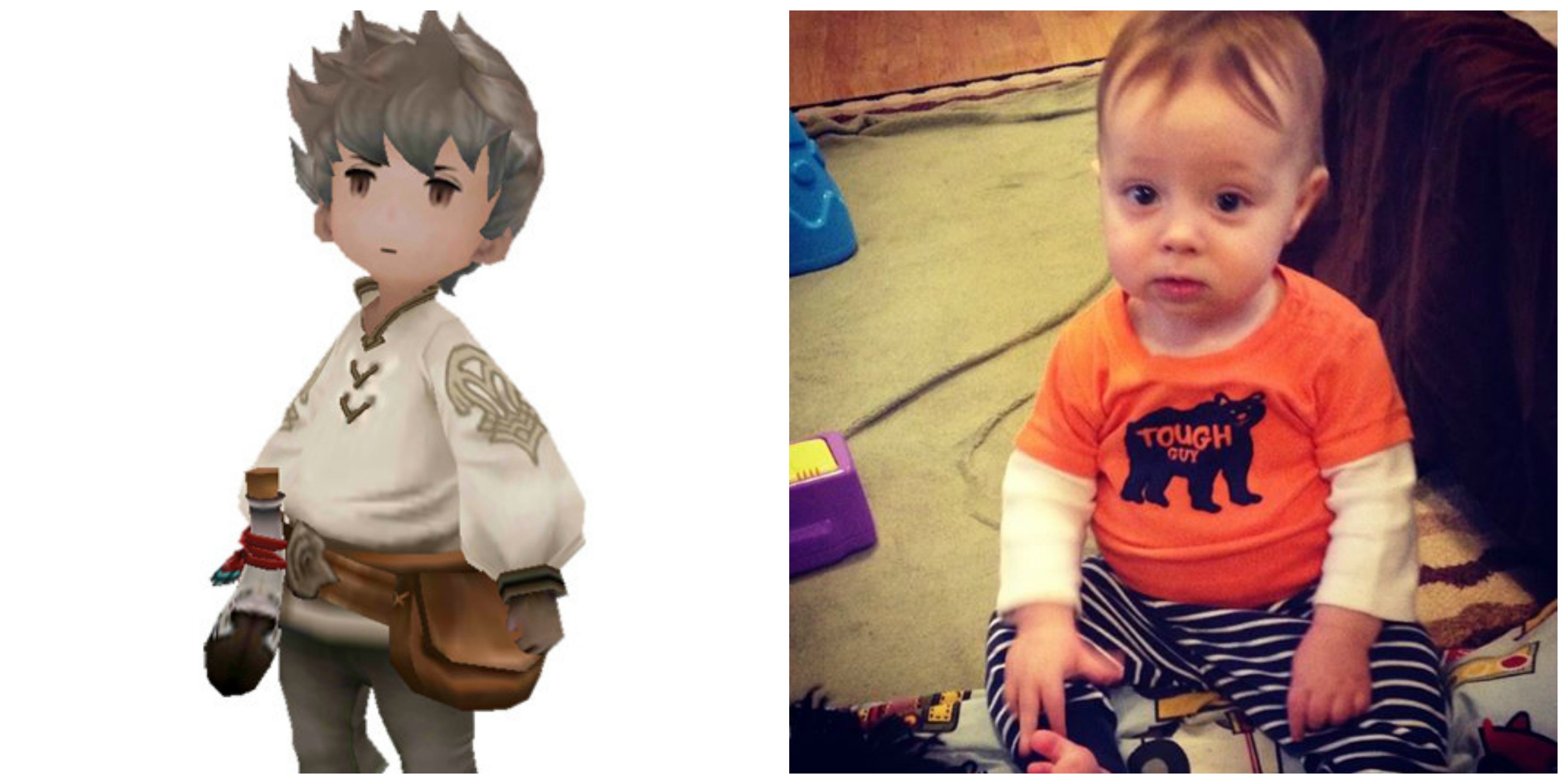
Also?  I know this is going to sound weird, but the character Tiz kinda reminds me of my son, a little bit, if my son were older.

Tiz_v_Henry

One of the cooler aspects of the game is that you can import special moves from friends and people you meet via StreetPass.  And it occurs to me that even though I’ve had my 3DS for, what, almost a year now, I don’t have any 3DS friends!  So here’s my Friend Code:

0146-9096-2825

The First Few Hours: the new Lara, the new-ish XCOM

cw

So on Tuesday, I spent $60 to digitally download Tomb Raider: Definitive Edition for my PS4.  As I’ve already played and beaten this game (to 100% completion) twice already on the PC, I was a bit apprehensive about why I had to buy it; if I’d only been willing to wait a few more days, I’d have received a rental copy early next week.

There are three reasons why I succumbed, as it turns out.  The first reason, as always, is that I am a consumer whore, and I cannot resist the temptation of instant gratification.  (Even if “instant gratification” in this particular case means waiting over an hour for the download to finish, and then (because the game is still familiar) playing through the beginning so quickly that I caught up with the download progress and had to turn it off for the night.)

The second reason is that, like most PS4 owners, I really, really want to play games on it.  Even if it’s a game that I’ve already played before where the only real difference is a number of substantial graphical improvements.  (Exhibit A:  Assassin’s Creed 4.)

The third and final reason is, perhaps, guilt?  Square-Enix came right out and called the original release a “failure”, even as it sold 3.5 million copies in its first month.  As I was already a Tomb Raider fan, and as I was also a big big fan of this reboot, I felt compelled to at least offer my support – again – in getting a sequel made.  I don’t know what else I can do, Square-Enix.

In any event:  I bought it, and I’ve played through a few hours of it, and for the most part I can say that I’m happy I bought it, even as the graphical enhancements are not as eye-popping as I’d hoped.

This is not to say it looks bad, of course.  I never played the original version on console, but on my PC it looked quite nice, and this enhanced version on the PS4 generally looks phenomenally better.  Most everything looks sharp and crisp and finely detailed; forests actually feel dense and, well, forest-y, with swaying foliage and trees and mists; Lara’s face is far more expressive and realistic.

Still, there’s some weirdness here and there.  In that opening gameplay sequence, where Lara is suspended upside down, the much-vaunted TressFX has her ponytail hanging upside down, but her bangs remain right-side up; when Lara crouches in crawlspaces with her torch, the fire against the roof is still a 2D sprite; when Lara moves through water, the water still ripples oddly and unconvincingly; the deer that you hunt still look… weird.  These are very small nitpicks, to be sure, but the whole point of this “Definitive Edition” was that the graphics were redone, and as I’ve already played the hell out of this game I can’t help but look at the small stuff this time around.

The game is still great, I’m happy to say, and I’m also still impressed by the PS4 controller.  I know I keep bringing it up, but you gotta understand – I hated the Dualshock 3 almost as much as I loved the Xbox360 controller.  My only gripe is that I keep forgetting how the face buttons are configured, which means I usually fail the game’s quicktime events the first time around.  That aside, the game works just fine, especially where combat is concerned, and so now I am really getting excited for Uncharted 4.

*     *     *

As far as Operation Backlog is concerned, I have spent the last week or so slowly playing through XCOM Enemy Within, which feels a bit like a “remix” rather than a full expansion.

I am playing it on Easy, because I’m a grown-ass man and I can do whatever I want; but also because I’m still terribly intimidated by the game.  I try as hard as I can to not make any mistakes, because the game absolutely beats the shit out of you if you do, and so every mission is very stressful and tense and I’m kinda just creeping along, desperate to stay in cover, trying to remember which of my squad are holding the medkits just in case.

I have not gotten far enough into the game to get into the “Meld” business – I’ve only done the first 5 or 6 missions, and I’ve got quite a stockpile of the stuff, but I don’t think I’ve yet built the requisite facilities to work with it.  It may take some time, really, as my play sessions only tend to last for one mission (and then the requisite post-mission housekeeping).  I can only take so much stress, people.