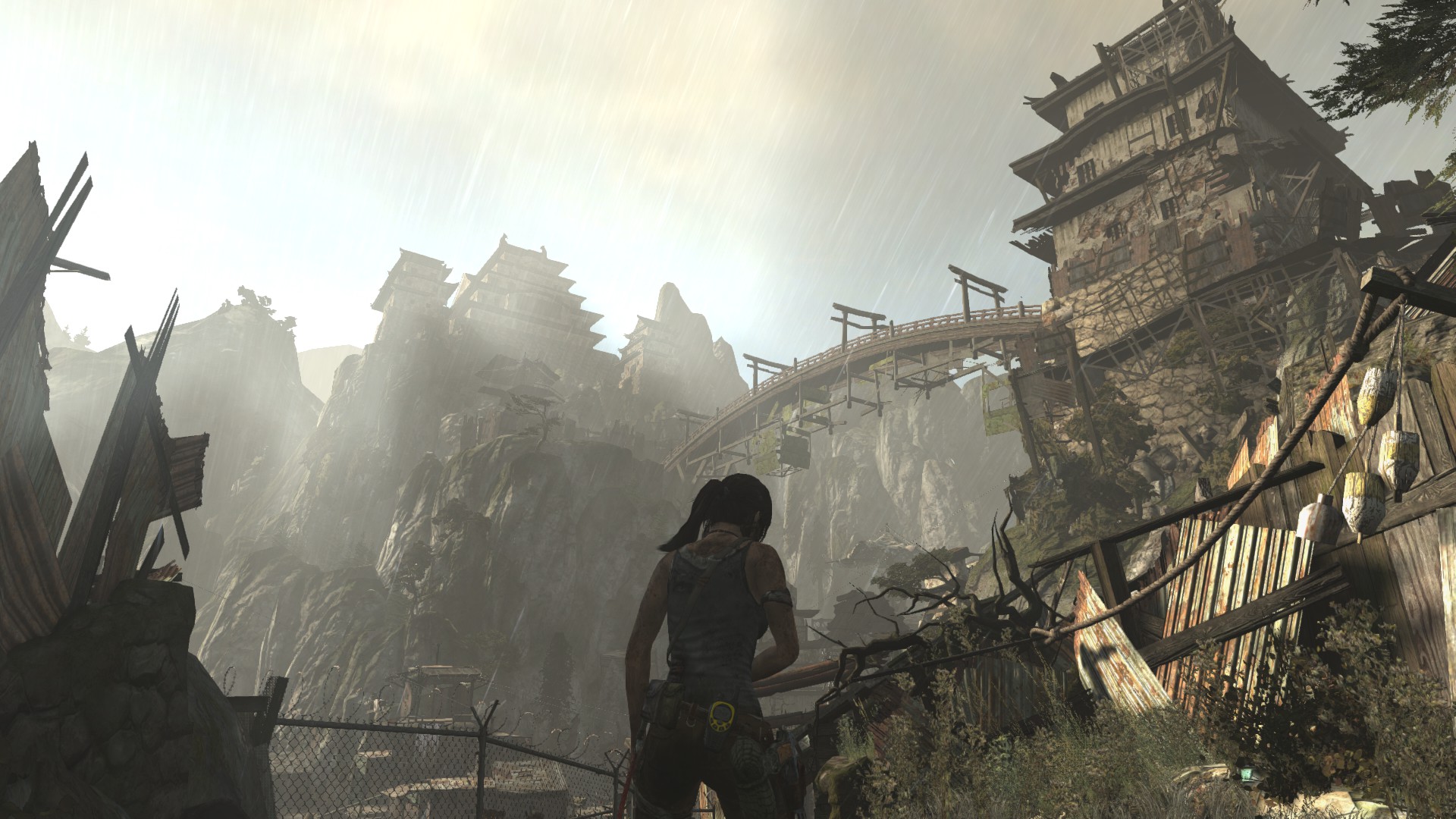
The Next Few Hours: Thief

It is much easier to describe what’s wrong with an OK game (or film, or book, or album) than what’s right.  Problems/mistakes are often very specific and universally recognizable, whereas positive traits can sometimes only be felt, and then only after a few hours of play.

To that end, let me at least start off this post by saying that I don’t actively hate Thief anymore.  My original list of problems still holds true, and I’ve been able to identify a bunch of new ones (which I will list below), but I’ve managed to become intrigued by what I’ve seen, and I must admit that I am enjoying the actual moment-to-moment gameplay quite a bit.  I’m still playing as non-lethally as I can – even avoiding takedowns whenever possible – and pulling off a mission without being spotted is quite a thrill.

Basically, if you can ignore the incoherent narrative, the bizarre design choices, the choppy voice acting, the strangeness of the City’s lack of any definable characteristics, and the juvenile, puerile titillation of the first half of the brothel mission (which is the mission I just finished), and you just concentrate on straight-up thievery and stealth, there’s some genuine fun to be had.

But it can be very, very hard to ignore all that other stuff.

[It occurs to me that some of the stuff I complain about below could be design choices that were in the original games, and that the developers felt obligated to keep for that reason.  I hope that’s the case, actually, instead of the alternative; but in any event, the fact remains that those original games came out a long, long time ago, and game design has evolved considerably since then, and some of these issues simply should not be there anymore.]

1.  Polygon’s Ben Kuchera recently wrote a great piece about checkpoints, and how difficult they are to properly design and implement.  Thief’s checkpoint system isn’t necessarily terrible, but it can be incredibly frustrating and/or annoying.  More to the point:  unlike, say, Tomb Raider (another Square Enix joint), which automatically saved every time you found a collectible item, Thief only saves under three conditions:  (1) you manually save, (2) you enter a new area, or (3) you hide in a closet without being in a combat state.  So if you’ve been cleaning up the town for a bit [see 1a below for more on this] and then accidentally get into a scuffle – and if you didn’t engage in one of those 3 conditions above – you will lose all of your progress since your last save if you end up dying.  As I said before, I’m trying to play non-lethally, and as such I’m deliberately not equipped to go toe-to-toe with anyone; if I get discovered, I more or less just give up and reload and try to figure out another approach.  But if I haven’t manually saved in the last 2o minutes, after scooping up a few hundred dollars worth of loot?  I’ve gotta do it all again.  Which sucks.  

1a.  Again, this isn’t necessarily that big a deal, BUT:  loot can be found anywhere, especially in places where it has absolutely no reason to be (i.e., coin purses in bird nests; golden ashtrays on raised wooden planks where no smoker would dare to loiter).   While this serves as a useful enticement for fully exploring the environment, it’s also without any logical sense whatsoever, and so it feels incredibly artificial and breaks any suspension of disbelief.  Another way to say it is that it doesn’t feel like I’m stealing so much as I am simply picking up litter.

2.  The map is useless.  If you find a hidden passageway the game will alert you that the map has been updated, but it literally doesn’t matter, because the map makes no sense.  It serves no useful function; it shows neither direction nor location, but rather a bunch of interconnected rectangles.  The game has an objective marker in your field of view anyway, and so all you need to do is head in that direction in any way you choose.  But if you find a hidden area and want to remember where it is?  Or if you want to go to a shop to resupply before going on a mission but can’t remember where the shop is located?  Too bad, there’s no ability to set a custom waypoint.

3.  Further to that last point, the game does not explicitly give you an opportunity to resupply yourself before a mission, which is insane.  I’d managed to scoop up a bunch of loot after the first mission, and I knew there were tools that I could now afford (specifically, the wirecutter) that I wanted to play with, and I sort of assumed that I’d find a vendor before heading to the brothel mission.  But aside from randomly stumbling across a vendor in a very out-of-the-way corner (who was only selling different kinds of arrows and basic supplies), I was not given a chance to buy the things I needed, and I didn’t know that the only place I could buy that stuff was in the complete opposite direction.  And once I figured it out, I still had to remember where the shop actually was, and the map – again – was utterly useless in that regard.

4.  This is less of a complaint and more of a bug, I think; I often stumble upon throwable objects (which come in handy if I need a pesky guard to go somewhere else), but the game will tell me that my inventory is full and that I can’t pick it up.  Except my inventory is not full, and whenever I need to throw something, the game tells me I have nothing to throw.  Does this mean that I can only carry a certain overall total of tools, and so if I’m carrying too many water arrows I can’t carry throwable bottles?  Or does this mean that the game is simply fucked up?  I can certainly carry infinite amounts of loot (which don’t weigh me down or make any noise, either)…

5.  I’m still very early, and I’ve not seen all there is to see.  But the brothel mission is so weird.  For starters, the brothel itself feels larger than the City that encloses it, and this is to say nothing of the second half of the mission (which feels substantially larger than the brothel that encloses it).  Then there’s the brothel itself, which features a lot of boobs and simulated screwing and a lot of dialogue that sounds as if it were written by overly horny 14-year-olds (who should absolutely NOT be playing this game, if only for this mission alone).  The mission also involves this weird hidden rune thing and a cipher that you use to crack it, except I don’t remember picking up the cipher in the first place, and in any event the controls you use to interact with it are backwards.  (Plus, there seems to be another bug; the game only starts identifying these runes as significant once you find a certain one.  I’d been staring at a different one first, for 5 full minutes, trying to figure out what it meant, before moving on and finding the one that “triggered” the cipher.)

You see what I mean?  This post is over 1200 words long and I spent at least 1000 of them describing the game’s problems, and only 200 or so saying I was having enough fun to stick with it.  Criticism is a tough business.
On Walkthroughs

It’s been a weird week.  That’s a vague statement, and I’m not really in a position to elaborate, so just trust me when I say it’s been a weird week, and we’ll leave it at that.  And on that note:

Let’s talk about walkthroughs.

I am weird when it comes to walkthroughs.  I mean, I’m weird about a lot of things game-related, as I’m discovering, but I’ve got very weird and specific and deep shame issues when it comes to using them – even if I’m looking at it simply to see how far along I am.

And yet I’m also not shy about using them compulsively, depending on the game.  Like, for example, L.A. Noire.  While I had no problem with the crime scenes or the combat, every interrogation scene was played with a walkthrough.  I was fanatically obsessive about acing every single question; and because the game’s interrogation system was kinda broken, I kinda felt justified in cheating.  Perhaps it ruined the spirit of the game, but I didn’t care.

[TANGENT:  Funny that L.A. Noire comes up, as I’ve been wanting to go back and play it again lately, for some reason, and maybe writing about it.  If I do, I promise to do it without a walkthrough.  (Well, I’ll try, at any rate.  It’s been long enough at this point that I can’t necessarily remember all the right answers.)]

Similarly, I’ve not been shy about using walkthroughs for the Professor Layton games, and I’m very much aware that using a walkthrough for a puzzle game specifically defeats the purpose of playing the game in the first place.  Honestly, though?  Some of the puzzles aren’t clear in their design or their purpose (or, alternately, the graphical fidelity of the DS/3DS screen obscures the illustrations).

Point is, I use them.  I don’t like it when I do (because I’d rather solve the damned thing on my own) but I do (because I’d rather finish the game, if I’m enjoying it).  I’m too old and socially withdrawn at this point to care what the outside world thinks of me, but it doesn’t matter – I beat myself up about it plenty.

(And since I’ve already gone on record about my feelings regarding god mode, this shouldn’t necessarily come as much of a surprise.)

Anyway, I’m bringing this up because over the last 2 days I’ve been very happily grinding along in Bravely Default.

(And can I just say, again, how much I appreciate the game’s willingness to let me “break” it if I want to power-level for an hour or two?  For example: yesterday I decided to go on a sidequest tear.  So I unlocked every available job, and then I went to the highest-level dungeon I could find, set the random encounter rate to 100%, set battle speed to 4x, hit “Auto”, and just went nuts bringing every job up to level 8 or 9 or so.  I’ve got tons of gold, my party is near level 60, and I felt like I actually accomplished something.)

(But on that same note, it also raises one of the game’s weird gameplay peculiarities; the regular battles are over in two turns at the absolute worst, but the boss battles are often 10-15 minute slog fests that require completely different kinds of strategy.  It’s almost like I’m playing two different games.) 

ANYWAY.  I happened to look at a walkthrough for Bravely Default a little while ago – really just to see how far along I was – and then, because I saw how much more was left (I’m apparently at the end of Chapter 3), I was curious, and so I took a peek at what happens next, and I suddenly got really, really bummed out.

****SPOILER ALERT*****

It appears that once you awaken the fourth crystal, which is what I’m about to do, [something] happens, and then you have to re-awaken all 4 crystals again.  And then, after you do that, you have to do it a third time.

*****END SPOILER ALERT****

I’ve spent almost 25 hours playing this game, and I’ve had a good time with it so far, but that. fucking. sucks.  That is lazy game design.  That’s bullshit, and in a weird way I’m kinda glad I know already so that I don’t have to experience being disappointed when it finally happens.

[I have more to say on this topic, but I must cut this post short.]

Game Journalism in Two Nutshells

1.  From the excellent and cathartic Dear Trolls tumblr:

Before you hit the ‘post comment’ button, you should wait ten seconds and just…think.
Think about the nature of the sentiment you’re about to put out into a public forum.
Think about what that comment says about you.
Think about whether or not that comment adds anything of worth to the discussion at hand.
I’d like to think that, if you did wait that ten seconds, you’d maybe decide against posting your little comment.
Maybe you’d realize that pointless, hateful snark is not, in fact, the absolute height of human communication.

DavidWurzel on “Game Developers Choice Awards honor Anita Sarkeesian”


The 3rd Annual New York Videogame Critics Circle Awards

As far as I’m personally concerned, last night’s award show ended up a resounding success.  I probably could’ve stood a little closer to the microphone during my award presentation, but hey – I didn’t fall down, I didn’t panic, I didn’t run screaming into the hallway.

Here’s a link to my segment (with some low audio, sorry!):

http://www.twitch.tv/m/407464

There was also an exclusive behind-the-scenes preview trailer shown for Bioshock Infinite: Burial At Sea Part 2; it was rather spoiler-heavy, so I’ll link to this Eurogamer trailer breakdown, in case you don’t want to get, you know, spoiled.

I was also tremendously grateful to be able to apologize in person to Kotaku’s Evan Narcisse for my disastrous Left 4 Dead performance from a million years ago.

Here are the winners from last night’s show.  Looking over it now, I’m starting to wonder why I was so down on 2013 for most of the year; it turned out to be a rather stellar year.  And I’m really starting to want to revisit The Last of Us again…

  • Best Handheld Console Game:  The Legend of Zelda: A Link Between Worlds
  • Best Kids Game:  Super Mario 3D World
  • Best Writing in a Game:  The Last of Us
  • Best Mobile/iOS Game:  Ridiculous Fishing
  • Best Indie Game:  Gone Home
  • Best Music in a Game:  Bioshock Infinite
  • Best World:  Grand Theft Auto V
  • Best Overall Acting:  Steven Ogg (Trevor), Grand Theft Auto V
  • Best Game:  The Last of Us

A Series of Transitions

This is not an apology for not writing this week, but rather an explanation of sorts:  the day job has been extremely busy and hectic and stressful, and I’ve been going to bed on the early side of things when I get home.  Not much time for writing or gaming.

Though, that said, I did manage to finish Tomb Raider: Definitive Edition (PS4) this week.  It is still a fun and worthwhile experience, and the graphics are noticeably improved from the already-impressive previous version.  The narrative is still a bit whackadoo, and I’m still weird about seeing Lara thwack a dude to death with her pickaxe (which somehow counts as a stealth kill), and I’m not entirely sure that this is worth $60.  But I’m glad to have played it, and to have let the developers know that I’m still on board for this sort of thing, thank you very much.

Also downloaded Outlast (which is this month’s free Playstation Plus game, even though I already have it on the PC).  I played right up to the first real jump scare (which is about where I got to on the PC), and turned it off.  It doesn’t look to be enhanced in any way for the PS4, but – more to the point – it looks like the PC version with all the settings turned way up, and so that bodes quite well as far as I’m concerned about the PS4 getting quality indie games.

Speaking of quality indie games, I will be writing a review of Jazzpunk for the NYVCC, which should go up later next week.  I have not yet touched it – I’ll be buying a retail copy like a regular shmoe – but everything I’ve seen indicates that it will be a wacky good time.

And speaking of the NYVCC, the 3rd Annual Critics Awards are happening next Tuesday, and I’m going to be one of the award presenters!  Which is very exciting indeed.  My category is Best Mobile Game…

…and speaking of best mobile games, I cannot recommend enough the new game Threes, which came out last night.  (This Polygon piece about the game’s development is a must-read, by the way.)  It’s made by the guys behind Puzzlejuice, and it is absurdly addictive, and I can’t stop playing it.  Also worth picking up is Spell Quest, which is a free word-search RPG (similar-ish to Bookworm Adventures).

I am also working on a slightly more ambitious piece for this here blog about games and memory, although I suppose I’ve already jinxed it by mentioning it here while I’m currently stalled out on it.  That will go up whenever it’s ready, which who knows when that will be.

on social anxiety, solitude, and multiplayer shooters

I’ve said that I’m not really into multiplayer a number of times, but it wasn’t until this weekend that I started to figure out why.

This was a rough weekend, personally speaking.

Saturday in particular was a busy day – a morning playdate at the first of many 1-year birthday parties we’ll be attending this year, and then, in the evening, a housewarming party at the astoundingly beautiful home of some college friends.  Both of these events were fun, in and of themselves – and it was nice to be out and about as a family, the three of us moving about the city with ease – but at the end of the day I was emotionally spent.  Sunday was decidedly less busy – an afternoon trek out to the local department store for baby supplies and foodstuffs – but it also required driving, which is almost always a source of anxiety (especially in Brooklyn).  When I went to bed, I did end up sleeping soundly, but not necessarily restfully.

A year ago, I’m not sure I’d have made it to even one of these things, let alone all three.  So the fact that I was able to do all these things, and spend quality time out and about with my family – this should be a good thing, right?  And it is; it’s absolutely a good thing.

Except: I’m drained.  I feel hollowed out, exhausted, melancholic.  I feel adrift, really; I feel like I just want to curl away somewhere, where the world can’t hurt me (and where I can’t hurt it back, however unintentionally).

As for why I’m writing about this here?  Well, as I think about all this, it occurs to me that my social anxiety issues are probably the main reason why I’m generally reluctant to participate in multiplayer games.

Case in point.  On Friday, my rental copy of Battlefield 4 for the PS4 showed up.  My good buddy Gred, who’d been hounding me for weeks to get it, wasn’t going to be able to jump on until later Friday night, so I figured I’d take the early part of the evening to play through the campaign while the rest of the disc installed itself.  I lost interest in the campaign quickly enough (specifically in the 2nd mission, the one where you have to rescue two people from the top of a hotel; I ultimately bailed when, after I finally succeeded in destroying a tank with a land mine, I had to destroy another tank with a land mine), but fortunately Gred was available by that point.

Gred was a wonderful tour guide, showing me how the game worked, which of the classes was best suited to my playstyle, how this particular map was laid out (I can’t remember the name, but there’s islands and sunken aircraft carriers and a giant hurricane eventually sweeps through the map towards the end of the session), etc. etc.  And it all looked incredible; 64 people in a session yields some pretty spectacular sights, even from far away – I’m dodging sniper fire while watching two airplanes dogfighting on the other side of the map, blowing the hell out of buildings and radio towers, 10-foot waves slamming jetskis into the rocky island shore, helicopters blitzing strafing fire on either side of the building I’m taking cover in, all hell breaking loose for 60 full minutes.

In a weird way, it was kinda refreshing that the session was so big – it meant that my failings as a player didn’t stand out quite so obviously.  I was a bit of a wallflower, to be honest – I’d tag along behind Gred, occasionally firing wildly at enemies, but mostly getting headshotted from unseen snipers.  I was there really just as a visitor, a tourist, seeing what all the fuss was about, trying not to hurt my team too badly.  And I’m happy to say that in spite of my dreadful K/D ratio, our team ending up winning.

This is, more or less, my approach in real-life situations, too; I’ll attach myself to one person for most of the night, taking in the sights, listening to the music, gradually getting drunk and hoping that the buzz takes some of the anxiety’s edge off a little, and generally just hoping against hope that I don’t embarrass myself in front of a room full of strangers.

I was grateful to have Gred there, is the thing.  Because without him, I would’ve been completely at sea; overwhelmed by the madness of 63 other strangers with guns, or else simply retreating to a corner of the map, watching but not participating, afraid of screwing everything up.

I tend to handle life much better when I’m alone.  I can experience a thing on my own terms, at my own pace, and be alone with my own thoughts.  Solitude can get lonely at times, to be sure, but there can be profound meaning in a solitary experience.  I am (again) reminded of something Tom Bissell wrote in his review of GTA V:

Almost everyone I know who loves video games — myself included — is broken in some fundamental way. With their ceaseless activity and risk-reward compulsion loops, games also soothe broken people. This is not a criticism. Fanatical readers tend to be broken people. The type of person who goes to see four movies a week alone is a broken person.  Any medium that allows someone to spend monastic amounts of time by him- or herself, wandering the gloaming of imagination and reality, is doomed to be adored by lost, lonely people. But let’s be honest: Spending the weekend in bed reading the collected works of Joan Didion is doing different things to your mind than spending the weekend on the couch racing cars around Los Santos. Again, not a criticism. The human mind contains enough room for both types of experience…

For me, the single-player experience is, by and large, comforting.  And with a good game the experience can often times feel more engrossing than books or films, because it’s an experience that I get to directly participate in; I get to literally inject myself into the narrative and have a direct influence on the story.  I can’t be judged by other people (until after the fact, I guess, if they’re looking at my gamerscore), I can’t offend anyone, I can’t embarrass myself.  If I need to go to the bathroom, I can pause the game and not annoy anyone; if I need a break, I can walk away and not get teabagged by some douchebag on a camp-out kill spree.

I don’t play games to win; I play just to play.

I suppose that, when it comes to the real world, my social anxiety kicks in because I don’t want to “lose”, whatever that might mean.  It’s been a difficult struggle to acknowledge that the vast majority of social situations don’t actually have this win/loss structure, and that I can have a good time simply by being present in the moment, surrounded by friends (or strangers, as the case may be), and allowing the experience to simply happen, and to just be.

It’s not so cut-and-dry in the game world, though.

Broken Age, Part 1: the reconsideration

In my last post, I’d said that I’d been struggling to stay engaged with Broken Age, the long-awaited, Kickstarter’d 2D point-and-click adventure game by Tim Schafer and Double Fine.  And I went off into some tangents about my personal feelings towards the Kickstarter process, and whether or not I was still interested in adventure games in general.  (That discussion, unfortunately, did not quite get to the point where I could find a way to include a link to Old Man Murray’s immortal classic “Death of Adventure Games”, so I’m including it here simply because I can’t not include a link to it if I’m talking about adventure games.)

I’d mentioned that I’d reached a point in both stories where the path was no longer linear – I’ll try to avoid spoilers here the best I can, but basically in Vella’s story I’d reached the 2nd (“cloud”) town and wasn’t sure what I was supposed to do, and in Shay’s story I had been given a set of three urgent tasks but no real idea how I should tackle them.  I found myself feeling a little intimidated, I suppose, and when I get intimidated I sometimes tend to shut down, as opposed to persevering.

Well, it turns out that all I really needed was 24 hours to clear my head and come at these things with fresh eyes, and I ended up finishing both stories (Shay first, then Vella – which, now that I think about it, is probably the best way to do it) shortly thereafter.

Broken Age’s puzzles (such as they are) aren’t necessarily difficult or obtuse; your inventory is relatively small, and most of the time your objects interact with other objects in ways that make sense.  (As much as I dearly love Grim Fandango, there were a number of puzzles that simply broke my brain in half – I’m remembering a puzzle in the first act involving bread crumbs and an inflatable balloon.)  I suppose I was intimidated simply because when it comes to classic adventure games, I like to get things right, and I keep forgetting that there’s no real way to achieve a fail state.  At the end of the day, there was really only one puzzle that I couldn’t figure out without the help of the internet (i.e., using the crochet needle to trick the Weaver into going to a forbidden destination – I knew the crochet needle was involved, but I couldn’t figure out the solution – and in fact I still can’t, because the walkthrough I used didn’t actually explain why it worked).  Everything else was, for the most part, relatively straightforward.

What I really want to talk about, of course, is the cliffhanger at the end.  I won’t, of course, unless we take this into the comment section below.  Suffice it to say, I think it’s a pretty neat trick – and when I think back on certain elements of Shay’s story, there’s quite a lot of telegraphing – and now I absolutely cannot wait for Part 2.

Beyond that, the game is an absolute joy.  Marvelous voice acting with a very charming and witty script, outstanding art direction, a beautiful and evocative orchestral score.  This is, in fact, what I was hoping for when I backed this thing in the first place; I’m glad I finally came around to appreciate it.

Weekend Recap: Nintendo, Broken Age, a lack of fantastic newness

1.  The big news story on Friday was Nintendo’s horrible, no-good, very bad earnings report, and the subsequent discussion, hair-pulling and gnashing of teeth on the big sites and Twitter was more or less focused on how Nintendo can turn things around.  I sometimes feel like I’m the wrong person to comment about anything Nintendo related, being that I never had a Nintendo system as a kid and so I don’t feel any particular pull towards the company; and yet, now that I think about it, I think I might very well be the perfect person to comment about what Nintendo needs to do.

*  This sounds insane, I know, but the first Nintendo-built hardware I ever owned was not an NES, SNES, Gameboy, Super Gameboy, N64 or Gamecube – it was, in fact, a DS.  And I mainly bought it for Nintendogs, thinking that my wife might get a kick out of it – we were dog-less at the time, and I thought it might help scratch that itch.  The DS was a great system by the time I got my hands on it – it had a really diverse lineup of games, and those games seemed to take full advantage of the DS’s strange setup (which, ironically, made the system feel less strange the more you played with it; in fact, the DS probably helped pave the way for the acceptance of the “second screen”).

I bought (and then regretted buying) a Wii; I bought (and enjoy, sorta) a 3DS; I have absolutely no desire to buy a WiiU.  I have no desire to buy a WiiU because: (1) there hasn’t been any significant new first-party IP in years, which means that if you buy a new Nintendo console you know exactly what you’re going to get, which is a bunch of Mario-themed games, a Zelda, maybe a Metroid, a Super Smash Brothers, and that’s more or less it, and so if you don’t really care about those franchises, there’s nothing to look forward to; and (2) there is no third-party support at all, which makes the prospect of owning just a Nintendo console incredibly limiting.

New IP is a risky business, of course, and considering that there are still rabid fans for their existing franchises, it seems like the best thing for Nintendo to do is stay the course, continue iterating and reiterating on what the fans already know and love, and hope that one of them does really well.

The lack of third-party support, though… that’s the killer.  (That’s what ultimately led to the death of the Dreamcast – once EA stopped putting out Madden and the rest of its sports titles, that pretty much ended other third-party prospects.)  Because if you (like me) don’t particularly care about Mario or Zelda, there’s literally no reason to own a Nintendo console – nobody’s porting their games over, and the ones that do don’t really know how to take advantage of the WiiU’s peculiar hardware.  (With the notable exception of ZombiiU, of course, which is a game I haven’t played.)

I won’t pretend to know anything about game development, but even I can see that Nintendo seems to be operating in some sort of tech bubble, wholly unaware of the innovations made by its competitors.  One only needs to look at Nintendo’s online services to figure out just how behind the times they are.  This Eurogamer feature written by an anonymous third-party developer goes into some pretty jaw-dropping detail about how difficult it is to develop a WiiU title, from a wide variety of angles – there’s one quote in particular, though, that’s been attracting a great deal of attention:

The discussion started off well enough and covered off our experiences with the hardware and (slow) toolchain and then we steered them towards discussing when the online features might be available. We were told that the features, and the OS updates to support them, would be available before the hardware launch, but only just. There were apparently issues with setting up a large networking infrastructure to rival Sony and Microsoft that they hadn’t envisaged.

This was surprising to hear, as we would have thought that they had plenty of time to work on these features as it had been announced months before, so we probed a little deeper and asked how certain scenarios might work with the Mii friends and networking, all the time referencing how Xbox Live and PSN achieve the same thing. At some point in this conversation we were informed that it was no good referencing Live and PSN as nobody in their development teams used those systems (!) so could we provide more detailed explanations for them?

That’s bad enough.  The developer’s conclusions about the WiiU’s failure, though, seem to mirror my own:

[…]I’d like to highlight some interesting points that have been on my mind recently. Firstly, third-party support. Do you remember all the hype surrounding the Wii U launch? All those third parties showing videos of existing games that they were going to bring to the Wii U? Whatever happened to a lot of those games?

After the initial flurry of game titles a lot of the studios quietly backed away from their initial statements and announced, with minimal press, that they were in fact not going to make a Wii U version. The reasons behind a particular title not appearing on the Wii U are all pure speculation, but I personally think that a combination of:

  • Previous development experience using the toolchain and hardware put off development teams from making another title on Wii U.
  • The technical and feature support from Nintendo were lacking for third-party studios. There was a feeling internally that if you weren’t a first-party development studio, you were largely ignored by Nintendo, as we were superficial to their profits. Internally developed titles would save Nintendo and we were just there to add depth to the games catalogue.
  • The sales figures for the Wii U console were not looking that good soon after launch. There was a lot of confusion in the general population around the launch as most people thought that the Wii U was some kind of add-on to the Wii, they didn’t know that it was a new console. This lack of awareness probably contributed to the console not getting off to the start that Nintendo would have hoped and put off studio from developing on the hardware.
  • Nintendo also fell victim to bad timing. A few months after the console launched the next-gen hype train stepped up a gear as Sony announced the PlayStation 4, with Microsoft joining the fray a few months later. Don’t forget that many of the larger studios would have known about the hardware months before it was announced, well before the Wii U hardware actually launched.

So, these larger studios had a choice. Would they develop a port of an existing game to a console with limited capabilities and limited market penetration? Or put their teams to work on developing new features and concepts for the “real” next-gen consoles that were going to be launched that year? When you look at it this way, the choice isn’t that hard.

[…]

Doubtless, the first-party developers at Nintendo will make the hardware sing – they always do – but the situation looks grim for those of us in third-party development, with the opportunity to progress on the hardware held back by both the quality of the tools and the lack of financial reward for tailoring our code to the strengths of the hardware. So where does that leave the Wii U?

I didn’t mean to quote so much!  The whole article is worth a good read and does a great job of articulating the myriad of problems the WiiU faces, if reading about such things is something you’re interested in.

2.  As for me:  not a lot of gaming for a 3-day weekend.  I basically inched along in Broken Age and sped through a bunch more AC4 on the PS4.

I am… having trouble staying engaged in Broken Age, sorry to say.  It’s beautiful and charming and witty and very sweet, of course, and so that’s all wonderful, but… I don’t know if it’s the game, or if it’s me, or what, but I’m just not feeling all that inclined towards staying with it.  I’ve reached a point in both stories where the path for each story has become somewhat non-linear, and I suppose not knowing what to do next is a little intimidating.  (I felt the same way at various points in Grim Fandango, for what it’s worth, and I love the hell out of that game.)

I’ve only supported 3 things on Kickstarter; a friend’s film project, a second sequel to one of my favorite films of all time (Hal Hartley’s Henry Fool), and Broken Age.  There’s been lots written about Kickstarter and the psychology of donations and the service’s various up- and down-sides (this Kotaku feature is but the latest), and that’s all well and good; I supported the things I supported because I’m fans of the creators and wanted to see their work succeed.  I don’t necessarily feel “ownership” over these projects; in the specific case of Broken Age, I didn’t want to watch the making-of stuff, or see anything about the game’s development, because I wanted the experience to be unspoiled.  All I did was to give them the money I’d have given them anyway, except that in this case I was helping the game actually get made.

So I don’t necessarily come to the game with unusual expectations, is what I’m trying to say.  That being said, I have high expectations for anything that has Tim Schafer’s name on it, because I’m a huge fan of his and most of everything he’s ever made has been something I’ve enjoyed greatly; funding the game on Kickstarter wouldn’t have changed that.  Getting a chance to play a new game in Tim’s old creative wheelhouse should be something special and celebrated.

Perhaps it’s simply that I don’t enjoy old school point-and-click adventure games the way I used to, no matter how lovingly crafted they appear to be.  Even with Telltale’s recent resurgence in games like The Walking Dead and the Fables game, I’m not drawn to them the way I might’ve been a few years ago; I can’t explain why, other than that I start to get fidgety and anxious after a while.  I suppose I should explore this in depth at some point.

In any event, yeah – I’m a little over an hour into Broken Age.  The girl is in the cloud town; the boy has escaped his room and is making further plans with the wolf guy.  Normally I’d feel OK in writing a “First Few Hours” post at this point in a game, but where Broken Age is concerned I feel like I should play through this first half before making any formal declarations.  And like I said above, right now I’m having trouble staying involved in the game, and I don’t know if that’s my fault or the game’s.

As for AC4… well, I’m playing it primarily because I want to feel like I didn’t waste my money buying a PS4.  I kept almost downloading Battlefield 4 and Need For Speed Rivals and then chickening out at the last minute, mostly because I don’t want to spend $120 on games that I’m playing simply to have something to play.  Fortunately, AC4 looks and feels so much better on the PS4 than it did on my PC that the experience is largely positive; and if it feels repetitive, well, I am finding that I’m going through it a lot faster (because I know what I’m doing).

My rental copy of Battlefield 4 shipped today; that should arrive by Thursday, and so I’ve saved $60.  I’m not sure if I’m going to wait for Need for Speed, or keep my rental queue clear for Tomb Raider: Definitive Edition.  I’m maybe inclined towards waiting for Tomb Raider, because (as with AC4), it’s a game I like a lot, but more prettier.