on David Mitchell, writing lyrics, and celebrity deaths

Between Bowie and Rickman alone, I’m just shredded to bits.  I have work to do, and I can’t focus.  I have emails to respond to, and I don’t know what to say.  I’m writing this post if only so that I can remember how to put words together.

I have completed my chronological journey through David Mitchell’s work, tidying up my second read of “Bone Clocks” during this morning’s commute.  Even though I’m a little sad that this “project” is over, and that there’s nothing of his imminently appearing on the horizon (even if there are a ton of things coming out eventually), I’m glad that I took the opportunity to read it all.  In fact, I think it’s safe to say that he’s become my new favorite author.  I haven’t felt so overwhelmingly book-nerdy since finishing “Infinite Jest” back in college.  Certainly my 2nd reading of “Cloud Atlas” was much more enjoyable than the first, if only because I now have a much better sense of the grander scale that Mitchell is working in.  And seeing familiar characters pop up in different contexts is always neat, and yet it never felt particularly gimmicky; given that all these books are connected, it really just makes them feel somehow truer.  For example:  you already get a really thorough sense of Hugo Lamb when you read his chapter in Bone Clocks, but when you read Black Swan Green, you see him as a teenager through the worshipful eyes of his cousin, and suddenly you have a greater sense of how deep Hugo’s charm is (as well as a brief glimpse of his cunning manipulations).  Similarly, it’s only once you read everything that you see how deep a character like Marinus actually is; it’s one thing to hear him recount his history in Bone Clocks, but it’s quite another to actually be with him in the 1800s in “Thousand Autumns of Jacob de Zoet”.  And it’s also interesting to see how larger-scale events correspond throughout his work – one can suddenly see that the futuristic, very troubled Earth presented in the two late sections of Cloud Atlas are part of the same cataclysm that takes place in the coda of Bone Clocks.

Speaking of which – against the recommendations of all my Facebook friends who are also hard-core Mitchell nerds, the wife and I ended up watching the filmed version of “Cloud Atlas“.  Although, if I’m being honest, we only made it through the first hour or so, before we both started fading out.  I have seen enough of it to know that I probably don’t have to finish it, and my wife (who hasn’t read the book) had little to no idea what the hell was going on, and so I don’t think she’s inclined to finish it either.  That being said, I don’t outright hate it, though there’s plenty of things to be intensely disappointed by.  Yes, the chopping up of the book’s structure is terrible – though I suppose I can understand why the filmmakers felt that they had to do it, given that the book is not necessarily jam-packed with excitement and that fitting this entire book into a 3-hour package is going to mean you need to amp up the pacing a bit.  I suppose I can even get behind the idea of having actors playing multiple roles, although that’s not really what the book is about, and it also means that Tom Hanks is horrendously miscast in nearly every role he steps into.  (To be fair to Tom Hanks, though, I’m also dangerously close to overdosing on him, because my son is obsessed with “The Polar Express“, another film in which Tom Hanks plays multiple roles; I think I’ve seen Polar Express at least 30 times since Christmas.)  And to the film’s credit, I am somewhat astonished at how closely some of the film’s visuals matched my own imagined set design – the Frobisher segment in particular is nearly note for note.  Indeed, for all the film’s flaws, you can’t say that the filmmakers weren’t passionate about the project; this is clearly a labor of love.

The problem, really, is that the book’s most visceral appeal (for me, at least) is in its use of language, and in seeing how language evolves in each of the story’s eras, and in the futuristic sections of the film the viewer is never really given an opportunity to let the language’s evolution sink in.  This is most notable in the post-apocalyptic future, which is damn near unintelligible without subtitles.  If I were scoring this using Nathan Rabin’s “World Of Flops” system, I might feel generous enough to give it a “Fiasco”… but I haven’t finished the film, and it’s probably best if I don’t.  But in reading Rabin’s WoF column about the Wachowski’s “Jupiter Ascending“, this paragraph seems pretty close to capturing what’s up with Cloud Atlas:

…the Wachowskis are auteurs whose failures are as audacious, ambitious, heroically sincere, and achingly romantic as their extraordinary early successes.

As far as filmed adaptations of David Mitchell go, though, I would very highly recommend checking out the 13-minute short film “The Voorman Problem“, which is an adapted excerpt from Mitchell’s second novel, “number9dream” (and which is also later referenced in “Bone Clocks”, as a matter of fact).  It’s very short, excellently cast, exceedingly faithful to the source material, and feels very much like some sort of Twilight Zone nightmare.


I was home with my son on Tuesday – he had a bit of a fever – and during his nap I downloaded and started playing Assassin’s Creed Chronicles: India.   I’m playing it on XB1 instead of PS4, if only because, for whatever reason, it was available for download on XB1 several hours before it was on PS4, and I needed something to do.  (I suppose I also bought it there because I needed to further justify my purchase of the XB1’s Elite Controller, which is, without a doubt, the greatest game controller ever made.)  I like these sorts of 2.5D stealth platformers, and I just wish I wasn’t so goddamned terrible at this particular one; I can’t tell if the game is really difficult, or if I’m just very bad at it.  It could be both, frankly, for all I know.  It’s certainly very pretty to look at.  If nothing else, it makes me very hungry for Mark of the Ninja 2, which I very much hope is a thing that exists.

I’m not really playing anything else, though, which I’m strangely OK with.  Like I said at the top of this post – I’ve been very much a book nerd for the last few weeks/months, and I haven’t felt so excited about reading in years, and it’s a really pleasant feeling to have.


I’m hell-bent on getting some lyric-writing done, because once I have lyrics I’ll be able to finish this album, and I need to get it out the door while I still like the music.  Have I talked about my struggles with writing lyrics here?  I might have, which is why I’m reluctant to repeat myself.  In any event, the album was conceived under some heavy-duty emotional stress, and even as I’ve managed to extricate myself from within all that baggage, I still have to look at it in order to write about it.  And it’s hard to write about parts of your past when you’re not particularly proud of yourself.  I feel like I need to apologize to everyone I know, which is difficult when the two people I most need to apologize to won’t respond.  (This is actually true; last year I sent out some emails which were quite difficult to write, and never ended up hearing back.)  That said, it’s still gotta get done, and so I’m pleading with whoever’s in charge of this stuff to PLEASE STOP WITH THE DEATHS OF IMPORTANT PEOPLE.  This is hard enough as it is.


My Year In Reading: 2015

Way back in January – another life ago, it seems – I wrote that I’d hoped to read 30 books by year’s end.  As it turns out, I made it to 35 – and I’m working on 36 at the moment.  I gotta say – my new commute makes reading a hell of a lot more convenient, but it also helps when you’re really enjoying what you’re reading.  I’d like to say I could make it to 40 next year (which would be neat, given that I’ll also be 40 years old), but one never knows how these things go.

Still and all, here’s what I read in 2015, in something approximating chronological order:

The Book of Strange New Things, Michel Faber  A-
Technically I started this in late December, but the book is long.  I found it rather beautiful, but also quite heartbreaking.

The Martian, Andy Weir  B-
I still haven’t seen the movie, and my initial impulse was to leave it that way, since I found the book rather dry, overly technical, and surprisingly devoid of tension given the circumstances.  But hey, people seem to love the movie, so maybe it’s worth checking out.

The Egyptologist, Arthur Phillips  A
One of the best books that I read this year – at once funny, mysterious, and moving, and featuring one of the most dark, twisted and unexpected endings I’ve ever come across.  The less said, the better.

Your Face Tomorrow (trilogy), Javier Marias  B+ (combined)
I’d wanted to read these for a long time, but it wasn’t until earlier this year that Kindle versions were made available; I promptly devoured them, or at least attempted to devour them – as interesting as they are, they can be slow and tedious at times, and his endless sentences, while deliberately stylistic, can be exhausting.  Of all the books I’ve read this year, these probably got under my skin the most – even if, during the reading, I found them slow-moving.  Still, when I put up my Favorite Sentences post, a great many excerpts will appear from this series; even though the people and places of the book couldn’t be further removed from my own experience, there were whole sections that felt ripped out of my own life (for better and/or worse).

Silver Screen Fiend, Patton Oswalt  B+
Patton is a tremendous writer – his best stand-up routines succeed in large part because of his ability to pick the perfect words – and I found this memoir of his early stand-up years to be rather affecting.  That said, it didn’t get nearly as dark as he kept insisting it would, and the last third of the book is simply a list of all the movies he watched during the relevant time frame, without providing any additional insight beyond the specific few he talks about in the book proper.

Yes Please, Amy Poehler  B+
I’ve been a Poehler fan for, what, nearly 20 years now, back when the UCB was a cancelled Comedy Central series and a free weekly improv show instead of the all-powerful comedian factory of today.  I was going to enjoy this no matter what.  I think certain sections are a little phoned in – her Parks & Rec chapter might as well be a multiple-choice quiz – but other sections are deeply powerful and resonant.

Orfeo, Richard Powers  B
As with games, I keep a spreadsheet of the books I read; it helps tremendously for posts like this, but also just to better remind myself of what I read and what I was thinking about at the time.  My comment this year’s spreadsheet, alongside this entry, simply says “remarkable prose, & remarkable grasp of the act of listening, but what did I actually read?”  I suppose I expected more of a plot that was advertised as some sort of hybrid between a technological thriller and a study of avant-garde classical music of the 20th Century.

I Am Pilgrim, Terry Hayes  B
One thing I need to do for these spreadsheets going forward is to figure out why I bought certain books; I have no memory of buying this (or the next two books on this list, for that matter), or what might have made me get it.  It’s a solid thriller, very much the sort of thing you’d buy at an airport, and I seem to recall enjoying it because it wasn’t trying to be something that it wasn’t; it’s an espionage thriller and that’s all it wanted to be, and to that end it’s a fun read.

Submergence, J.M. Ledgard  C
My spreadsheet comment:  “Beautiful writing, but what is the point of this book?”  Even now I have trouble remembering what happened here.

Skinner, Charlie Huston  B-
“Fast-moving technobabble”, I wrote, though in retrospect I do seem to recall liking this more than the B- I gave it at the time.

The Thousand Autumns of Jacob de Zoet, David Mitchell  A
I’d bought this when it first came out, but was reluctant to start it given that I’m not really a big fan of historical fiction, especially during a time and place that I know literally nothing about.  But I’m glad I finally got around to it, because it’s beautiful and absorbing and has one of the best and most satisfying endings I’ve ever read.  I wrote a little more about it here.

The Disaster Artist, Greg Sistero and Tom Bissell B-
I’m a “fan” of the “movie”, and I’m also a huge fan of Tom Bissell, and so this seemed like a slam dunk – an insider’s account of not only being a part of one of the most legendarily terrible movies ever made, but as a close confidant of Tommy Wiseau, the film’s star, writer, director, bankroller, and all-around weirdo.  Alas, it’s not as illuminating as one would hope; Wiseau remains as opaque as ever, and the behind-the-scenes stuff mostly ends up being depressing.

VALIS, The Divine Invasion, The Transmigration of Timothy Archer, Philip K. Dick —?
I’m not sure how it happened, but I realized I’d never read any PKD before.  I’ve seen a bunch of film adaptations, and one of my favorite books from the last few years is The Cardboard Universe (which is a fake encyclopedia about the fictitious Phoebus K. Dank), but I’d never gotten around to the genuine article.  A good friend gave me a copy of Timothy Archer a few years back, and then Amazon apparently had some sort of PKD bonanza because I bought, like, a whole bunch of his stuff on the cheap.  To that end, I decided – for some reason – to start with the Valis trilogy.  Maybe not the best choice?  It’s paranoid and angry and feverishly written – although I suppose it’s a better place to start than the Exegesis, which I must admit I did not finish, or even really start.)  In 2016 I’m gonna try to read …Palmer Eldritch and Ubik, which I also picked up in that Amazon sale.  (And if you have other recommendations, I’m all ears.)

The Song is You, Arthur Phillips B-
As noted above, I loved the hell out of The Egyptologist and felt compelled to check out Phillips’ back catalog, and when I read this book’s synopsis – an unrequited love story told through music – I felt like this book was literally made for me (especially as I was trying to write lyrics about the same subject matter).  I suppose my expectations were too high, then, because I didn’t enjoy this nearly as much as I’d hoped – even if the writing is still excellent.  There’s some unintentionally creepy bits to the story, and there’s also some very unnecessary and distracting side-plots that add the wrong sort of tension.  I will get around to the rest of his stuff next year.

The Three-Body Problem, Cixin Liu B+
Having never read Chinese science fiction before, I didn’t really know what to expect from this highly acclaimed first volume of an award-winning trilogy.  The prose is a bit dry – and it’s hard to tell if that’s the translation or just the source material – but it’s certainly very fascinating, and it’s quite a treat to read a familiar genre from a radically different socio-economic perspective.  I learned a lot about Chinese history, too, which helped flesh out Susan Barker’s The Incarnations (which I’ll get to shortly).

The Rabbit Back Literature Society, Pasi Jaaskelainen C+
So one of my projects this year was to tackle my ever-increasing backlog, which is the sort of thing that happens when you own a Kindle and have poor impulse control; you buy stuff and then forget you have it, because you can’t physically see it.  I don’t remember buying this, or why I might’ve bought it, but I felt obliged to read it for some reason; I don’t remember reading it.  My Google notes say:  “a ghost story with no ghost and very little story.”  And yet I gave it a C+, so I guess it had something appealing in its atmosphere.

Going Clear…, Lawrence Wright A
This had already been on my to-do list even before the HBO documentary came out; the documentary was stunning, and the book is even more exhaustive in its story-telling.  It’s riveting, meticulously researched, objective, and scary as hell.

Seveneves, Neal Stephenson A-
I’d worried a bit about Neal, frankly.  His previous book, Reamde, was rather dull and disappointing – I recall hearing that he’d intended it to be the sort of thriller you’d pick up at an airport, but it was still dreary and unexciting – and his recent foray into videogame development ended on a sad note.  I might’ve been hedging my bets heading into this one, but I came out feeling like he’s on top of his game yet again.  It’s hard (and occasionally dry) sci-fi, but it’s also truly thought provoking and interesting, and the meticulous attention to detail in the first two thirds of the book results in a final third that is simply breathtaking.

The Ghost Network, Catie Disabato B-
This book had a bit of hype surrounding it, as well as an intriguing set up – a Lady Gaga-esque singer suddenly goes missing, and the quest to find her reveals a whole bunch of secret-society-ish stuff within a hidden underground train system – and as such this ought to have been in my wheelhouse.  It’s an entertaining enough read but it doesn’t quite go anywhere, although the ending is pleasingly enigmatic.

The Brief Wondrous Life of Oscar Wao, Junot Diaz A
So glad I finally got around to this one.  It’s magnificently written; Diaz is enormously talented and the prose nearly leaps off the page.  Enthralling and intoxicating.

The Gone-Away World, Nick Harkaway A
And here began my obsession with Nick Harkaway; if I hadn’t read this book, I probably would’ve continued on my Arthur Phillips spree.  A good friend had raved about him for years and I finally gave it a go, and I’m really glad I started here, because this one is the best of the bunch.  Without question, the most fun I’ve had with a book in years; my Year In Sentences post could easily have been twice as long if I’d elected to quote everything I’d highlighted.

Angelmaker / Edie Investigates!, Nick Harkaway B, B-
Angelmaker is another fun romp, though reading it immediately on the heels of Gone-Away World probably did it a disservice; Edie Investigates is a very short side-story with one of Angelmaker’s characters which I finished in about 30 minutes.  It’s fun, but didn’t feel necessary.

The Shining Girls, Lauren Beukes B
A fabulously intriguing premise (surviving victim hunts her time-travelling serial killer), not quite as well executed as I’d like.

My Struggle part 1, Karl Ove Knausgard B+
I’m not sure if I’m going to get around to the other volumes – there’s only so much navel-gazing I can take, and I already take quite a bit, and it’s not quite the earth-shatteringly brilliant thing I’d been expecting.  But as far as memoirs go, it’s absorbing and his descriptive abilities are really quite stunning; I remember this book visually more than anything else.

A Head Full of Ghosts, Paul Tremblay B
A creepy little ghost story with a dark and horrific twist of a tableau at the end; it had been brought to my attention as something that a fan of Mark Danielewski’s House of Leaves might enjoy, and that’s certainly true, though the book’s structure might get in its own way a little bit.

Tigerman, Nick Harkaway B+
As with Angelmaker, it’s fun and well-written and with a gut-punch of character reveal and a heartbreaking ending; also as with Angelmaker, it’s not quite as magical as Gone-Away World.

The Rook, Daniel O’Malley B-
As with most of the B-minuses on this list, The Rook is a really interesting premise (an amnesiac soon discovers she has supernatural abilities and is part of a secret organization that battles other supernatural monsters and such), which isn’t quite well-executed as it could be.  I might stick around for the inevitable sequels, though; the world is pretty neat.

The Incarnations, Susan Barker B+
A Chinese taxi driver receives a series of anonymous letters documenting his previous lives and how they intersected with the letter-writer.  It’s a bit more heavy and dark than I expected it to be – which is not a knock on it at all, I just wasn’t prepared for how fucked up it is, emotionally speaking.  As noted in the entry for The Three-Body Problem, there’s a lot about China’s history that is also pretty fucked up.  (I’m also learning a bit more about it at the present moment, as I’m reading David Mitchell’s Ghostwritten, which talks a bit more about 20th Century Chinese history and how deeply, deeply fucked up it was.)

Gilliamesque: A Pre-Posthumous Memoir, Terry Gilliam B-
Entertaining but also a bit scatterbrained – much like his films.  Not nearly as detailed as I’d have liked it to be – for instance, I might’ve blinked and missed the part where he joined Monty Python.

Slade House, David Mitchell A-
This is a short novella, which I believe may have started as a Twitter experiment before turning into a rather haunting series of interconnected stories.  Hard to say if it’s necessary to have read The Bone Clocks before starting this one, but I can’t imagine anyone reading this who hasn’t read Bone Clocks, so take that as you will.  If nothing else, this also inspired me to start reading Mitchell’s complete works, in chronological order, because it’s become apparent that every single one of his books is connected to the other.  And considering that almost all of his books contain interconnected stories inside of themselves, I feel compelled to see just how far the rabbit hole goes.  (As noted above, I’m already 3 or 4 stories into Ghostwritten, and I’ve already seen brief glimpses of characters I know.)

City on Fire, Garth Risk Hallberg A-
THE GREAT AMERICAN NOVEL, screamed the advance hype, in addition to the gigantic advance the author received and the subsequent bidding war over the film rights.  I’m happy to say that it does live up to the hype; this is a 900+ pager that never feels self-indulgent or overly clever.  It’s vivid and memorable and extraordinarily well-paced (which I believe I’ve mentioned here several times over, but it’s worth mentioning again if only because making a 900+ page book move quickly is a rather impressive feat).  Maybe it doesn’t quite stick the landing as well as it could, but I can’t hold that against it too much; the book itself is a wonder.


“It Is Time To Turn In Your Kazoo”: Favorite Sentences of 2015

In keeping with last year’s post, here are my favorite sentences/phrases/passages from the books I read this year.  (And I’ll get to those books in a separate post.)

from “The Book of Strange New Things”, Michel Faber:

“Some people go through heavy stuff. They fight in wars. They’re in jail. They start a business and it gets shut down by gangsters. They end up hustling their ass in a foreign country. It’s one long list of setbacks and humiliations. But it doesn’t touch them, not really. They’re having an adventure. It’s like: What’s next? And then there’s other people who are just trying to live quietly, they stay out of trouble, they’re maybe ten years old, or fourteen, and one Friday morning at 9:35 something happens to them, something private, something that breaks their heart. Forever.”

from “The Egyptologist”, Arthur Philips:

The following items will be irretrievably lost someday quite soon: Beethoven’s works. The beer you prefer. All record of your ancestry. The place you first kissed a girl. Toffee. Coffee. The landscape you associate with peace and liberty. Any evidence of your boyhood, real or just fondly recalled. The sensation that all that stands before you and your loved ones is a series of aspirations, accomplishments, setbacks, meals, ceremonies, loves, heartbreaks, recoveries, next acts.


from the “Your Face Tomorrow” trilogy, Javier Marias: (the books are hard to recommend, and yet I could fill up an entire post with passages from them)

Part One:

…it’s shocking how easily we replace the people we lose in our lives, how we rush to cover any vacancies, how we can never resign ourselves to any reduction in the cast of characters without whom we can barely go on or survive, and how, at the same time, we all offer ourselves up to fill vicariously the empty places assigned to us, because we understand and partake of that continuous universal mechanism of substitution, which affects everyone and therefore us too, and so we accept our role as poor imitations and find ourselves surrounded by more and more of them.

* * *

…we forget what we say much more than what we hear, what we write much more than what we read, what we send much more than what we receive, that is why we barely count the insults we hand out to others, unlike those dealt out to us, which is why almost everyone harbours some grudge against someone.

* * *

…when someone withdraws their laughter from us, that is a sign that there is nothing more to be done.

* * *

The kind of people who, on the phone or at the door, say simply ‘It’s me’ and don’t even bother to give their name are those who forget that ‘me’ is never anyone, but they are also those who are quite sure of occupying a great deal or a fair part of the thoughts of the person they’re looking for.

Part Two:

“You never felt for me what I felt for you, nor wanted to; you kept me at a distance, not even caring if we never saw each other again, and I do not reproach you with that in the least; but you will regret my going and you will regret my death, because it pleases and contents one to know that one is loved.”

Part Three:

I want it to be known that I exist and have existed, and I want my deeds to be known, but that frightens me too, because it might ruin forever the picture I’m painting of myself.

* * *

Nostalgia, or missing some place or person, regardless of whether for reasons of absence or abandonment or death, is a very strange and contradictory business.

* * *

More time passes, and there comes a day, just before the last trace vanishes, when the mere idea of seeing the lost person suddenly seems burdensome to us. Even though we may not be happy and may still miss them, even though their remoteness and loss still occasionally wounds us—one night, lying in bed, we look at our shoes alone by the leg of a chair, and we’re filled with grief when we remember that her high heels once stood right next to them, year after year, telling us that we were two even in sleep, even in absence—it turns out that the people we most loved, and still love, have become people from another era, or have been lost along the way—along our way, for we each have our own—have become almost preterite beings to whom we do not want to return because we know them too well and the thread of continuity has been broken.

* * *

Luisa was for me one of those people whose company you seek out and are grateful for and which, almost in itself, makes up for all the heartaches, and which you look forward to all day—it’s our salvation—when you know you’ll be seeing her later that evening like a prize won with very little effort; one of those people you feel at ease with even when times are bad and about whom you have the sense that wherever they are, that’s where the party is, which is why it’s so hard to give them up or to be expelled from their society, because you feel then that you’re always missing out on something or—how can I put it—living on the margins.

* * *

‘Why do I tell you these things? You are not even here.’
(which, as it turns out, is actually from:
http://www.poetryfoundation.org/poem/182860 )


from “Silver Screen Fiend”, Patton Oswalt:

Does anyone act more like an over-serious senior citizen with time running out on their chance for immortality than someone in their twenties?

* * *

There was comfort in preemptive disappointment. Because it was never your fault.


from “Yes Please”, Amy Poehler:

Apologies have nothing to do with you. They are balloons in the sky. They may never land. They may even choke a bird.

* * *

Getting older makes you somewhat invisible. This can be exciting. Now that you are better at observing a situation, you can use your sharpened skills to scan a room and navigate it before anyone even notices you are there. This can lead to your finding a comfortable couch at a party, or to the realization that you are at a terrible party and need to leave immediately.

* * *

It’s important to know when it’s time to turn in your kazoo.

from “Orfeo”, Richard Powers:

You want to live in a hermitage in Times Square, with a big sign pointing to you reading, hermit.

* * *

A friend says: “I just heard the strangest song ever.” Do you run away or toward?

from “Valis” (book 1), Philip K. Dick:

They ought to make it a binding clause that if you find God you get to keep him.

* * *

The gentle sounds of the choir singing “Amen, amen” are not to calm the congregation but to pacify the god.

from “The Song Is You”, Arthur Philips (a disappointing book, but which is endlessly quotable.)

he had the sensation that he might never be so happy again as long as he lived. This quake of joy, inspiring and crippling, was longing, but longing for what? True love? A wife? Wealth? Music was not so specific as that. “Love” was in most of these potent songs, of course, but they—the music, the light, the season—implied more than this, because, treacherously, Julian was swelling only with longing for longing.

* * *

He recognized his dumb urge never to think about her again even as he failed to stop thinking about her, perhaps because of the energy required to stop those other thoughts.

* * *

“You never know when you’re about to be too old for some things. You only know when suddenly you are too old.”


from “The Transmigration of Timothy Archer”, PKD:

I should stand up and ask Mr. Barefoot a meaningless question and then go home while he is phrasing the perfect answer. That way he wins and I get to leave. We both gain.

* * *

I would not want to make you unhappy by detailing pain, but there is a crucial sort of difference between pain and the narration of pain. I am telling you what happened. If there is vicarious pain in knowing, there is actual peril in not knowing. In aversion lies a colossal risk.

from “The Gone-Away World”, Nick Harkaway (I could quote this goddamned book all goddamned day):

There is a noise as of incoming mortars or a train crash or the steeple of the church falling into the vestry. It is a vast, tectonic, tearing noise which seems to come from everywhere. In truth, it is probably none of these things, but it is very loud, and I am a small boy.

* * *

From somewhere across the room comes the sound of a mime getting beaten up.  

//  

You have to worry about someone even mimes find creepy.

//

All the walls come down inside my head. I am betrayed, murdered, rescued, healed and bereft. I have saved the world and been rewarded with five shots in the chest, booted out to die in mid-air on a dusty road. I am toxic waste. I have known heaven, and now I am in hell, and there are mimes.

* * *

We all carry a multitude of ghosts around with us: impressions of other people, strong or weak, deep from long acquaintance or shallow with brevity. Those ghosts are maps, updated with each encounter, made detailed, judged, liked or disliked. They are, if you ask a philosopher, all we can ever really know of the other people in the world.

* * *

He has made his loathing of height into a definition. He is not so much short as antitall.

from “Submergence”, J.M. Ledgard:

She walked all the way to the Hotel Ostende and back and bumped into him when she came into the lobby. It was awkward. But then life is never neat, it is made up of doors and trapdoors. You move down baroque corridors, and even when you think you know which door to open, you still need to have the courage to choose.

* * *

If you talk about the acceleration that is in the world, you have to talk about the advances in computational power. There was a recent momentous day when a computer at the Los Alamos National Laboratory in New Mexico achieved petaflop speed. One thousand trillion calculations a second. How to conceive of such a rate? If everyone in the world were given a pocket calculator and ordered to tap out sums for six hours a day, it would take them until the twenty-fourth century to match the calculations a petaflop computer can perform in a day. The exaflop is the next step in the history of computing: one quintillion calculations a second. Then the zetraflop, yottaflop, and the xeraflop. The goal is nothing less than to slow down time and colonize it. Of course, a petaflop computer uses more electricity than the power grid of an African city. Then there is the problem of asking useful questions of it.


from “My Struggle, Volume 1”, Karl Ove Knausgaard:

…an enormous contradiction arose between the person he was, the person I knew him to be, and the person he presented himself as.

* * *

I remembered hardly anything from my childhood. That is, I remembered hardly any of the events in it. But I did remember the rooms where they took place. I could remember all the places I had been, all the rooms I had been in. Just not what happened there.


from “Tigerman”, Nick Harkaway:

He didn’t really have much of a temper. Hadn’t, until this moment. But here he was, alone in a garden, declaring a war of extinction on a field of tomatoes. It was so wasteful. That notion made him stop, bewildered, and he wondered at the idea that it was wasteful to chop down plants, but somehow not so much so to do the same with men.

* * *

“…Space. The place where British people do not go because the British space programme is, what, two guys with a really long stick?” “In that way, Jed, it is very much like U.S. healthcare.”


from “The Thousand Autumns of Jacob de Zoet”, David Mitchell:

Creation never ceased on the sixth evening, it occurs to the young man. Creation unfolds around us, despite us, and through us, at the speed of days and nights, and we like to call it “love.”

* * *

“The soul is a verb.” He impales a lit candle on a spike. “Not a noun.”

from “Gilliamesque: A Pre-Posthumous Memoir”, Terry Gilliam:

Suddenly everything was being commodified, and once an act has to have a particular object attached to validate it, then it isn’t the same act any more. I think what it ultimately comes down to is not being able to be sure of the line between what you’re really experiencing and what has been programmed into you. These days I’d call this a ‘Philip K Dick moment’, but at that point I had yet to read any of the visionary books Dick was churning out at an astonishing pace just up the California coast in San Francisco. As it was, I’d just be walking along the beach in Venice or Santa Monica – hand in hand with the woman I loved, the waves lapping and gulls crying – not being sure if this seemed wonderful because it actually was wonderful, or because I had seen so many ads that said it was.

from “City on Fire”, Garth Risk Hallberg:

“…an artist is someone who combines a desperate need to be understood with the fiercest love of privacy. That his secrets may be obvious to others doesn’t mean he is ready to part with them.”

* * *

But why do they call you Sewer Girl?” “Nicky says I’m stuck on a lower level of consciousness. Because I’m from Shreveport, or whatever. It’s like, if you didn’t grow up in the city, it’s hard for dialectical materialism to be your bag. I still get sentimental about moms and deer and my horoscope and stuff.”

* * *

He feigned slumber for the couple hours it took to reach Altanta, and the ten minutes from there to the farm. When he opened his eyes, he was facing a plain, tin-roofed house, pale in the dusk. It might have been someone else’s except for the complicated things it did to his heart.

* * *

… Mercer looked around. There was no way anyone could hear. But the walls could, and the earth, and the ghosts of horses, and the state of Georgia.


The First 33 Hours: MGS V

One of the reasons why it’s been so quiet around here lately is that I’ve been working on a gigantic freelance thing about Metal Gear Solid V.  I handed in my draft last night; it clocks in at a little over 3800 words, which makes it somewhat long-winded, but also appropriate given the subject matter.  The article is ostensibly about my long, sordid history of active loathing and befuddlement of the Metal Gear franchise, trying to figure out just what it is about these games that gets under my skin the way no other game seems to do.

In the meantime, though, I’ve been playing the shit out of MGS V, and I have lots of comments about it that weren’t particularly appropriate for the article I was writing.

Current status:

  • 33 hours
  • 23% overall completion
  • 31% mission completion (16 missions completed)
  • 19% Side Ops completion

One of the reasons why I was able to finish my draft yesterday is because I’ve hit a bit of a wall in the most recent story mission, one where I have to extract a moving vehicle out of a convoy of tanks.  The game’s checkpoint system kinda sucks, which is why I’m a bit frustrated at the moment.  The mission starts by putting you a short distance from a guard post; you take over the post and discover the convoy’s route.  At that point you can do whatever you want, and after some trial and error I decided to take a shortcut and head to a camp towards the end of the route, which would give me plenty of time to clear out the camp and prepare to lay siege to the convoy.  The problem is, I’m able to clear out the camp with no problem, but the convoy destroys me, and when I restart at the last checkpoint, it puts me all the way back at the beginning of that second camp’s stakeout – which means I’ve lost at least 30 minutes of progress, and which also means that I’ll be a bit more aggressive the second time around because I’ve lost patience.

As far as stealth games go, MGS V is remarkably free of the usual trial-and-error routine – except in situations like this one, where I’ve yet to figure out how to solve the convoy issue, and where I’ll continue to butt my head against the puzzle until I eventually figure it out.  It just becomes less fun the 5th or 6th time around, especially since the game doesn’t let you keep all the collectible stuff you’ve found if you restart.

Beyond that particular bit of frustration, I have to admit – I’m having a really good time with it.  I mean, 33 hours is nothing to sneeze at, and now that I’m done with the article I might actually be able to relax a bit more and stop hyper-analyzing every single pixel.  I’m grateful that the game makes the exposition stuff optional and relatively unobtrusive, especially since the few cassette tapes that I’ve bothered to listen to are dull and awful and absurd in all the usual Kojima-esque ways that normally drive me insane.

I suppose I should start mixing up the times of day a bit more; I usually do my sneaking around at night (because if the game’s going to give me that option, why the hell not), and so there’s only one dark gray color scheme that I get to see.  I’m sure the deserts of Afghanistan and the savanna plains of Africa would be a bit more vibrant in the day.

In any event – yes, I’m enjoying it.  Normally I get a little annoyed if the game isn’t clear about why I have to get from Point A to Point B, but in this case the instant objective is simple enough to understand, and since I don’t give a shit about the larger soap opera, I can stay focused on the task at hand.  And even though the general infiltration techniques that I use remain largely the same from mission to mission, the game still manages to feel quite fresh; each situation is just different enough that it keeps me on my toes.  In the early going I felt that the “open world” was a bit misleading, because while there is a gigantic open world, there’s almost nothing to actually do in between each mission area.  There’s a lot of running around over empty space, in other words, which can get tedious (until I remember that I can call for a vehicle via supply-drop).

I will never get over the stupid dialogue and the endless, meaningless acronyms; there’s no way around it for me.  I get that the melodrama is part of the attraction to fans of the game, and that this franchise wouldn’t be what it is if people didn’t find this sort of absurdity enormously entertaining.  It’s not my cup of tea, and it never will be; I’ve accepted that, and I’ve decided to move on.  (That’s the ultimate thesis of the other article – spoiler alert!)

In other news, I’m kinda heartbroken about how terrible the new Tony Hawk game appears to be.  I had little faith that it would be as good as the original games, but I really hoped that this new one wouldn’t be a giant piece of shit.  Alas, it’s a giant piece of shit, and I’m sending back my rental copy as soon as it arrives in the mail.

What else, what else… I finished Paul Tremblay’s A Head Full of Ghosts, and promptly started Nick Harkaway’s Tigerman.  The Tremblay is… good, not great; everything happens so quickly that it’s hard to get absorbed in anything, but it is awfully creepy, and the ending is somewhat horrifying.  I’m still too early in Tigerman to give it any sort of impression, other than to say it seems a bit more serious and a lot less whimsical than his other two novels.  That said, once I finish it, I’ll have met my Goodreads goal of reading 30 books in one year, which is awesome.

And speaking of which:  this past weekend the family and I headed into Maplewood Village for an “Art Walk”, and we walked into the local bookstore, and before I could even blink, my 2.5 year old son found a Thomas the Train book, and so of course I had to buy it for him, and also a Team Umizoomi activity book, and then I found a bunch of books that I’d actually had my eye on, and suddenly I walked out of the store with a whole bunch o’ stuff under my arm.

12022569_10153465980825865_6100691156064790667_o

A quick peek through the mental fog

I’m in a bit of a blur, and not just because of the allergy medication I had to take a little while ago.  I’ve been so focused on writing this freelance piece – currently at a little over 5600 words, and a bit of a jumbled mess at that – that I’ve totally put all my other creative stuff on hold.  The album I was hoping to finish is still going to be finished at some point, but in the meantime I’m going to be turning some of it into a 5-song EP – and some of those songs still need some tweaking.  Which I need to find time for.  Which is time that I simply don’t have.

I think I’d mentioned that I’ve been able to carve out a bit more reading time of late, which has been nice; the morning/evening trains are very conducive to reading without interruption or distraction.  And so it is that I finally finished My Struggle, Book 1 by Karl Ove Knausgard this morning.  It is not the brilliant, earth-shattering book I’d been expecting, and it does tend to meander and wander from time to time – he (or his translator) is very fond of long sentences separated by commas – but it is insightful at times, and certainly very poignant, and his descriptions of places and times is downright novelistic in its specificity and clarity.  I suspect I will get around to the other volumes at some point, but I think I need a palate cleanser, so now it’s A Head Full of Ghosts by Paul Tremblay.

I won’t talk about Metal Gear Solid V here – because that’s what the freelance piece is about – other than to say that I’m enjoying the moment-to-moment gameplay far more than I thought I would.  The story is still garbage but I find that I don’t particularly care all that much; I’m not paying attention to it.  I don’t find myself needing any particular narrative motivation to get from point A to point B beyond trying to execute a mission as well as I can (though I don’t beat myself up if the stealth falls apart and I have to get physical; and I did resort to wearing the chicken hat just to get past a mission that I was too far into to bother restarting).  Is it the greatest stealth game of all time, as most of the internet seems to think?  I don’t know, and I’m certainly not far along enough to even begin to grasp what my eventual answer might be, but I’ll say this – I do aim to finish it, even if the freelance piece comes first.

I’m very much wanting to play SOMA, though I’m also a bit of a chicken shit and may end up waiting for some sort of PS+ promotion.

Beyond all that, life is good.  My allergies are a mess but everything else is good: the job is busy but not inducing panic; the house is always good to come home to; my son cracks me up every time I see him; my wife is the best.  I feel good.  That’s the important thing.

Checking in, again and again

1. I have many thoughts about Metal Gear Solid V, but they’re not going to be appearing here.  I will of course let you know when and where you may find them, but for now, just know that this is happening.

2.  I have few thoughts on Mad Max in videogame form; the game is very bad, and I do not like it.  I feel very strongly, at this point in time, that there’s no shame in having a conventional control scheme for your third-person action adventure / brawler, and so when I try to play your game and can’t fucking do the thing I’m trying to do because your control scheme is completely insane and backwards and non-intuitive and wrong, then that’s your problem, not mine.  I’m not particularly surprised that the game is not very good; I did admit to having high hopes for it, sure, but I didn’t actually expect anything worthwhile.  I at least expected a competent control scheme, though, and the simple fact that they couldn’t get that right tells me more or less everything I need to know.

3.  It’s been a little while since I did any sort of book round-up.  I did end up finishing Nick Harkaway’s Angelmaker, which was pretty good; and then Edie Investigates!, which is a side-story to Angelmaker that’s so short that I started and finished it in one 30-minute sitting; and then I just finished Lauren Beukes’ The Shining Girls, which has a really interesting premise (a time-travelling serial killer and the victim who tracks him down) but which isn’t executed as well as it might’ve been.  Now I’m reading Karl Ove Knausgard’s My Struggle: Book 1, which I’m still in the early pages of but which I’m already very much enjoying; he has a remarkable descriptive ability, and it’s very easy to put yourself into his perspective.

On a related note, Goodreads tells me that I’ve read 27 of the 30 books I’d hoped to get through by year’s end, so that’s nice.  I must say that my new morning/evening commute makes for an excellent reading opportunity.  I might even hit 40 books by year’s end, and considering that I’m turning 40 in December, well, that’s a nice little synchronicity that I’m happy to have.

4.  I know I don’t really talk much about personal stuff here, and that’s mostly on purpose, but I’d be remiss if I didn’t say that the move to the ‘burbs was one of the best choices my wife and I have ever made.  We’re very, very happy in our new home, and the kid loves it, and we’ve made some new friends already and are hoping to connect with some older friends soon enough, and it’s really a good thing all around.  Someday I’ll learn how to grill and then you’re all invited for a BBQ.

on managing expectations

In last week’s entry, I sounded pessimistic about the Fall 2015 videogame release schedule.  Not much has changed since then; unfortunately.  We had company on Saturday and I was laid up with a nasty head cold on Sunday, and so I only had a few hours of game time, and yet I was still kinda non-plussed at the end of it.  I played an hour or so of the remastered Dishonored; it looked fine – about on par with my PC – but I’d already played those first few missions a lot, and I wasn’t feeling particularly inclined to play them once more, Achievements notwithstanding.  I also played an hour or so of the remastered Gears of War, and it looks very much like how I remember it looking, which is probably the best you can hope for in a remastered port; it’s just that, as with Dishonored, I’m not really sure I feel like playing through the rest of it.  Calvino Noir has gotten fair-to-middling reviews in the few outlets that have bothered to write anything about it, which is a bit disappointing, and Madden 16 simply isn’t my cup of tea.  So there’s that.

This week is Metal Gear Solid V and Mad Max.  I’m going to take a wild guess and presume that the release date review embargo for Mad Max probably means that it’s not going to score all that well, and also that launching it on the same day as MGSV probably means that its publisher isn’t expecting that much of a return.

Review scores are not necessarily the be-all end-all for me, of course; I have been mystified by the Metal Gear franchise at every turn and even though this latest installment has gotten impossibly high scores from nearly every outfit that’s looked at it, I can’t help but feel incredibly skeptical about it.  I didn’t particularly care for Ground Zeroes, and if this is simply a much larger version of that, with a plot even more ludicrous and ridiculous, well… let’s just say I’m glad I’m not buying it.

Here’s the thing, though, and it’s maybe a point that I should probably have emphasized a lot more during this last year or so of general gaming apathy; I’d love to be proven wrong.  I’d love to sit down with either one of these games and get sucked in and have a good time.  That’s why I still write here, that’s why this blog exists.  I have precious little time for gaming these days, and so I’d like the time I do get to play to be well spent.  I genuinely hope that I can sit down later this week and rip open my rental copy of MGSV and get sucked in – if not to the impossibly ridiculous story, then at least into the moment-to-moment experience of exploring the environment.


Not all is doom and gloom as far as games are concerned, and I’d be remiss if I didn’t throw some love towards some iPhone games that have been kicking serious ass of late.  To wit:

  • Lara Croft GO, which is a strategy-action-board-game hybrid that feels far more accessible and interesting than Hitman GO, the game that preceded it; I was able to finish the entire thing without needing any help, which was very rewarding.  I’d recommend playing it on an iPad as opposed to an iPhone (if only because the larger screen makes it considerably easier to find the hidden collectibles), though my iPad 3 did not run it particularly well.
  • PAC-MAN 256, which is a novel combination of both Pac-Man and Crossy Road, and which works far better than you might expect; and
  • Sage Solitaire, which is a poker-ish solitaire game built by the guy who made the excellent SpellTower, and which is fiendishly addictive and maddeningly frustrating.

While we’re on the topic of enjoying the moment-to-moment experience of a carefully crafted world, I want to pour one out for the dearly departed Hannibal, one of my all-time favorite television shows and which featured as thorough of a mic drop in its finale as one could’ve hoped for.  Nobody else watched this show, which is why it only lasted three seasons, but they were three of the most gorgeously photographed and exquisitely acted and straight-up BOLD seasons of network television I’ve ever seen in my life.  Not since Twin Peaks have I been so genuinely unnerved by something on a major network; there are images from nearly every episode of this show that I will never be able to get out of my head (the totem pole, the angel wings, the mushroom garden, the increasingly horrible fate of poor Dr. Chilton, etc.).  It’s been a hell of a ride, and I hope they can secure financing for a filmed version of the 4th season’s arc.  If Wet Hot American Summer can come back as a serialized Netflix show, then anything’s possible.


I’m currently reading Nick Harkaway’s Angelmaker, which I’m enjoying, though not nearly as much as I enjoyed his debut novel, The Gone-Away World, which is one of the most fun books I’ve had the pleasure of reading in quite some time.  I loved that book so much that I ended up buying the rest of his published output, and I suppose I should’ve expected a bit of a letdown after Gone-Away World’s brilliance; I’m not done yet, of course, and there’s still plenty of book left for me to get knocked out by – he has a remarkable way with words, of course, and even if the plot isn’t quite as riveting, his prose is still genuinely fun to absorb.


Back in the saddle, more or less

(blows dust off blog)

OK, so: I was on vacation last week, but given certain recent events both personal and professional, I apparently needed to unplug from the internet for quite a bit longer.

i am still here, in my mind.

It’s hard to write about games when you’re not playing anything; it’s hard to write about music when you’d rather have people actually hear what you’re doing instead of poorly describing the process of creating it.  Also it’s hard to write, in general, when certain professional obligations make it impossible to do so.

But:  I’m back from vacation now, with my batteries somewhat recharged (it’s hard to fully relax when you have a two-year-old who’s favorite words are “No!” and “Stop!”), and I’ve returned to a day job that is considerably less stressful now than it was before I left.  These are good things!  Hopefully this means I’ll be writing here a bit more frequently than in recent weeks.


I’ve been thinking a lot about loops lately.  I’ve been watching my two-year-old son get into these “fun loops” at the local playground; he’ll climb up a ladder, run over a bridge, climb some steps, go down a slide, and then run back to the ladder and do the whole thing over and over and over again; he will not be deterred; if a kid gets in his way he either waits for them to pass (if they’re bigger) or steps around them (if they’re smaller) and then continues along his path; he’ll accept a brief respite for me to wipe his nose but that’s the only interruption that’s allowed, and he screams bloody murder if it’s time to go.

Maybe he gets it from me.  I’ve had a thing about loops ever since I can remember.  Not just in terms of games or playing, either.  I remember when I was first getting into music – like, really getting into music, during endless adolescent afternoons, when I would just tune out the entire world and get thoroughly absorbed in a cassette tape – I’d get to a favorite part in a song, and as soon as it was over I’d have to rewind and hear it again, and I’d do this over and over again until I memorized exactly how long I needed to rewind before getting to the beginning of the section.  (I still do this, of course, but instead of memorizing rewind time, I’m now memorizing timestamps.)

The point being:  that famous Halo quote about “30 seconds of fun” would appear to be something that’s hard-wired into our brains from an early age.  Speaking of which, that link above gives that quote a bit more context, in that the guy who said it didn’t mean to imply that in Halo you’re doing the exact same thing over and over again, but instead they’re switching the context on you so that the 30-second rush is constantly new and fresh.  This applies to the music analogy, though, too – if I get caught up in a favorite music section, I’ll listen to something once and then focus on a specific part, and then rewind and focus on a different part, each successive time my brain holding on to something new and different.


I did play some games on vacation – and on my Vita, too, which is nice.  I’d bought a few things before we left – Shovel Knight and Titan Souls, while also still staying heavily engaged with Stealth Inc. 2 – but as it turns out I ended up getting sucked back into SteamWorld Dig, for some reason.  That game is pretty neat, I think.  I’m still very early on, but it seems to be doing this very neat open-world Dig-Dug thing, which I find very pleasing and enjoyable.

I beat the first boss in Shovel Knight, and that game is fun, but – as I’ve said elsewhere – I don’t have that much nostalgic fondness for the 16-bit era that it’s clearly emulating, and so I’m finding that while I appreciate its slavish devotion, I’m not necessarily hungry for it the way everybody else is.  (Same thing goes for Axiom Verge, too – and where’s the Vita version of that, I wonder?)

I’m not sure Titan Souls is for me, though I don’t want to dismiss it out of hand so quickly, given that I’ve only actually beaten the very first boss.

Last night I felt a bit restless (for reasons I’ll explain at a later date, if all goes well) and downloaded Assassin’s Creed Chronicles: China for the PS4.  It’s an absolutely gorgeous 2.5-D stealth platformer that makes me really wish I was playing Mark of the Ninja 2; it’s still very Assassin’s Creed-ish, which means the controls don’t always work the way I expect them to, and the UI is still very crowded (which is annoying, given the aforementioned graphical beauty).  But it’s at least not the same old thing, as far as the AC franchise is concerned, and so I’ll try to stick with it for the time being.


Over the vacation I finished the Valis trilogy by Philip K. Dick.  That’s the first PKD I’ve ever read, by the way, and I’d probably guess that it’s not the best way to start off with him, especially since I’m not what you’d call a religious person by any means.  It’s certainly very interesting and thought-provoking, of course, and after reading VALIS I’m certainly interested in at least thumbing through PKD’s Exegesis, though I know that’s probably a bit too much for me to chew right now.

I did end up breaking my “no new books until I finish the backlog” rule.  (Look – when I go on vacation, I tend to splurge – and given the sort of emotional stress I was going through before we left, I maybe went a bit overboard.)  I bought a bunch of stuff, all of which I really want to get to, but I ended up going with Arthur Phillips’ “The Song is You”, which is exactly what i’d hoped it would be (I really liked his “Egyptologist“, and when I’d read the description of this book I knew I had to read it as soon as humanly possible), and it’s also feeding me lots and lots of lyric ideas, which is useful, given that I really need to get back to work on the album.


OK, so, that’s it – I’m alive, I’m well, I’m getting back to work.  (And if you can, please cross your fingers for me; I’ll explain later.  It’s good news, if the finger-crossing works out, is all I’ll say.)

The Thousand Autumns

I finished David Mitchell’s The Thousand Autumns of Jacob de Zoet this morning.  I’m still sort of swimming in feelings after that ending – my god, that ending – but I’m too impatient to wait until the coffee kicks in to write something real and meaningful.  So some quick bullet-pointed reactions are as follows:

  • Nobody on this earth writes more satisfying endings than David Mitchell.
  • It’s very interesting to read this book after Bone Clocks and Cloud Atlas, both of which span multitudes of time and space and narrative points of view.  JdZ is much more self-contained, confining the vast majority of its story to one specific place and over the span of just a few years; and yet, upon completing it, it feels no less epic in scope.
  • His writing patterns are interesting in that he starts out drawing these meticulously well-developed characters and putting them in very detailed places, and then he sorta just lets them do their thing, and one’s attention may start to wander as one tries to figure out just where on earth everything is going even as the writing remains engaging, and then there’s an inevitable HOLY SHIT moment when everything suddenly ties itself together and you realize that you’ve been taken on an incredible journey.
  • Why did it take me so long to start this one?  I liked Cloud Atlas very much, and Bone Clocks has become one of my all-time favorites… and I’d bought JdZ right away when it first came out but couldn’t bring myself to start.  Perhaps my disinterest in historical fiction was stronger than my affection for his writing, but I shan’t make the same mistake again.  If he writes it, I’m reading it.

I am trying to figure out what to read next.  I’ve been making excellent progress on my backlog; JdZ is a tough act to follow, so perhaps I should go with something short and ridiculous like Greg Sestero’s The Disaster Artist… or maybe I should start reading one of the 5 Philip K. Dick books on that list.  Or maybe Rachel Kushner’s The Flame Throwers?  Not really feeling up for more Murakami, which is something I never thought I’d ever say; 1Q84 was a huge, huge disappointment.  If you have any ideas, let me know.

Weekend Recap: Noodling Around

MUSIC:  If we’re judging the new album’s progress solely by how much I’m uploading to my Google Drive folder every week, then obviously I’ve slowed down rather considerably since February.  But I’m still working / thinking / contemplating / scribbling down lyrics whenever they pop into my head, nearly every day.

My beta listeners might disagree with my analysis, but as of right now, out of the 20-odd demos I’ve uploaded, I’ve narrowed my attentions down to 10 of them.  One of those 10 is a brand-new thing I recorded the other night, which I was tempted to upload and share immediately after I bounced it to mp3, even though I probably shouldn’t.  I really like it, but I also am fully aware that it’s a nearly 5-minute-long guitar noodle, similar to the looping stuff I was doing about 15 years ago; and if it were to actually make the cut and appear on the album, I’d be doing some drastic edits in order make it a bit less self-indulgent.   (Ironically, this is why I’m tempted to post the original version in all its noodle-tastic glory, given that it’s almost certainly not remaining in its current form.)

I’ve also reached the inevitable crippling self-doubt phase, which is what happens when I listen to these demos too many times and end up either (a) hating them or (b) getting too attached to their rough-draft imperfections and wanting to keep them as is.  That second part is also why it’s hard to make second drafts out of these things sometimes; even though it’s a relatively minor thing to simply cut/paste sections over a few measures to insert some extra time for a verse or whatever, I’ve gotten so used to how these things already sound that even though the adjustment makes the song better, I don’t like it as much.

I might need to take some time away from the demos and simply listen to this stuff in my head for a while.

I also might go ahead and post this new thing anyway, or at least a little snippet of it.


BOOKS:  I realize I haven’t talked about what I’m reading in a while; I’ve been slowly going through David Mitchell’s The Thousand Autumns of Jacob de Zoet for the last few weeks; last night I started Part 3.  I was always apprehensive about starting it (which is why it’s been in my backlog for as long as it’s been), given that I’m not particularly drawn towards historical fiction, especially in an era that I have absolutely no prior knowledge of (in this book’s case, the Dutch/Japanese trade of the very late 1700s).  But Mitchell is still a hell of a writer, and I suspect that his reasons for setting this book in this very specific period and place will make sense, and in any event it’s very cool to see characters from his other books show up in this one.


FILM:  I don’t usually talk about movies in this blog, if only because I simply don’t have the time to consume film the way I used to.  But I did want to take a few minutes to talk about Interstellar, which the wife and I finally saw over the weekend.  I’ve been a devout Christopher Nolan fan ever since Memento exploded my brain – that’s one of the few films I’ve bothered to see in a theater twice – and I’ve enjoyed everything he’s made ever since, despite their varied flaws.  (My biggest problem with Inception, besides the fact that it gave me a panic attack when I saw it in the theater, is that there’s no character development in any line of dialogue; everything’s flat and expository and it’s a credit to his actors that you feel anything at all towards them; a similar line of attack could be levied towards the Batman films, too.)  In any case, I’d heard mixed things towards “Interstellar” but I knew I had to see it for myself anyway, and so I did, and I absolutely loved it.  It’s not without its flaws (though I wouldn’t dream of taking issue with its science; it’s out of my depth anyway, and whether or not it’s 100% scientifically accurate is somewhat besides the point, I think) and I saw certain twists coming, but I still gasped at their reveal, and I can’t help but admit that Matthew McConaughey (an actor I’m not terribly fond of) was really, really, really good.

Side note:  in the wake of the Marvin Gaye/Robin Thicke lawsuit and the troubling precedent it could set, I can’t help but think that Philip Glass could sue the pants off of Hans Zimmer for essentially ripping off Glass’s soundtrack for Koyaanisqatsi.  Which is not to say that I didn’t enjoy the “Interstellar” soundtrack immensely; it just sounded somewhat familiar to me, and then I listened to it on Spotify and realized why.


GAMES:  Lots to talk about.

1.  I finished The Order: 1886.  I stand by my earlier faint praise, though now that it’s all over I can see why people would be disappointed:

  • The game’s premise is still very intriguing – the Knights of the Round Table are quasi-immortal knights currently engaged in a war with vampires – but nothing particularly interesting is done with that premise.
  • For all the game’s cinematic aspirations, it doesn’t stick the landing at all.
  • Any game, film or book that contains a scene between adversaries that has a variation of the line “We’re not so different, you and I” is now getting docked a full point in my arbitrary and non-existent rating system.
  • The combat system never really evolves.  You mostly fight human soldiers, usually head on although there are some stealth sequences here and there; maybe three or four times you fight some beasties, who have a much different attack pattern; and then I think there are two “boss” fights against these monsters which are mostly QTE-enhanced.  I don’t hate QTEs as much as most people, but I don’t necessarily like them all that much either; I don’t mind them here, but that’s also because they don’t pop up all that often.  (That said, the very last shot in the game has a QTE prompt in the dead center of the screen, which robs the moment of whatever gravitas it was aiming for.)
  • The “hidden collectible” aspect of the game is dumb and underdeveloped and a waste of time.

But:  it is absolutely gorgeous, and it’s relatively bug-free (which is very impressive in today’s AAA space), and I think a sequel could be something truly special, if it’s done right.

2.  During this weekend’s 2K sale on Steam, I ended up buying both Civilization Beyond Earth and Sid Meier’s Starships.  I keep forgetting that I need to be in certain moods in order to really get into Civ games, and I was not in those moods this weekend.

3.  On a whim, I decided to get back into Shadow of Mordor, which I’d put aside a few months back.  Decided to start over, from the very beginning, to remember how to play it properly.  Lo and behold, I’m enjoying it about a thousand times more than I did the first time; I don’t know what happened to my brain between then and now, but something about it finally clicked, and now I’m really enjoying it.  I’m also much better at it this time around, for whatever reason; the first time I was getting my ass kicked left and right, but in this second go-round I’m holding my own much better.

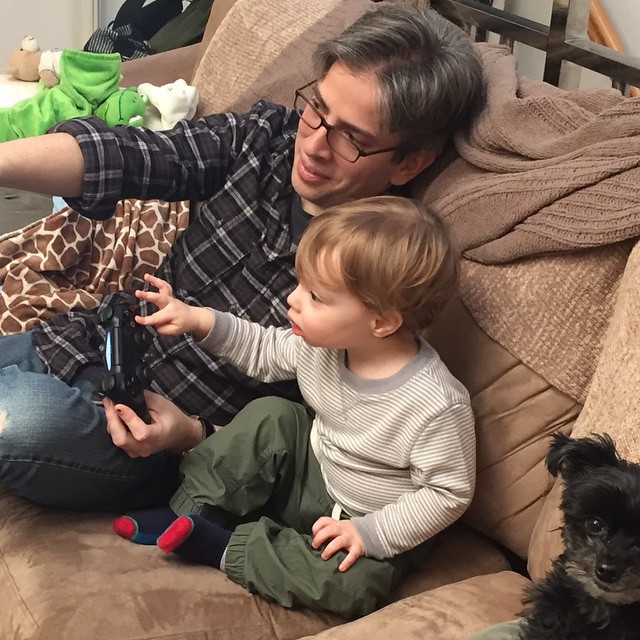
4.  My almost-2-year-old son is infatuated with the Lego Movie – and given that I enjoy it as well, I don’t mind him watching it over and over again.  So I decided that this would be as good a time as any to replay the game again, if only so that he could control Emmet directly.  The game is still buggy as hell, but whatever – if Henry wants Emmet to jump, Emmet jumps, and he gets quite a kick out of it.  (Also, my dog Lily is an expert-level photobomber.)

press x for ethics in game journalism