the first two hours: Saints Row IV

Before I get into Saints Row IV, I should explain why I’ve been quiet here this week.  It’s certainly not for lack of things to talk about.

I finished Gone Home last Thursday.  And I’ve been wanting to talk about it, all the time, here; but instead I ended up writing a 1000-word review of it for the NY Videogames Critics Circle, which will hopefully be going up Thursday or Friday.  (If for some reason it doesn’t run there, it will most assuredly run here.)  The short version is that it is a wonderful, heartbreaking, astonishing experience, and anyone who’s reading this who somehow hasn’t played it yet should get on that shit immediately.  And then, after you’ve finished it, you should dive in to the many wonderful pieces that have been written about it.

And along those lines, fuck it:  this is the postscript to my review, which may or may not end up staying in, being that it’s just links to those wonderful pieces referenced above:

I’ve been playing games since 1982, and I’ve been writing about games since 2008 or so; in all that time, I’m not sure I’ve ever seen so many heartfelt responses to a game before.  These are very spoiler-heavy, but well worth your time if you’ve finished the game and want to keep falling down the rabbit hole:

*     *     *

It is profoundly strange to be writing about Saints Row IV after the week or two I’ve spent ruminating intensely on the profound, emotional experiences I’ve had playing both Brothers: A Tale of Two Sons and then Gone Home, games which feel like they’re using a completely different vocabulary from everything else.   Because after playing those soft, quiet masterpieces, Saints Row IV is a bit like having a pie filled with fireworks thrown into your face at a thousand miles per hour.

I know I’ve complained about how lazy it is for critics to compare one thing to another.  But it’s nearly impossible (for me) to talk about Saints Row without comparing it to GTA.  In my defense, though, Saints Row more or less explicitly demands this comparison.  Here are the very first lines of dialogue in SR4‘s opening cutscene:

“…When the Saints made their presence known to the world in 2006, they were decried for being pretenders to the throne.  The people were confused: were the Saints sociopathic killing machines hellbent on destruction, or puckish rogues living a life of mirth and whimsy?  The Saints needed clarity of purpose, and so the course was set:  More fun, less mercy killing.  This simple  choice revitalized the Saints; transforming them from a degenerate street gang into beloved pop culture icons…”

This paragraph more or less details the design history and development process of the Saints Row franchise, from the first game through the present.  While the first game was a competent but uninspired GTA clone that simply beat GTA4 to the punch to be the first big open-world action game on the current generation of consoles, the second game was where the developers started to work on achieving that “clarity of purpose” – to be over-the-top ridiculous, in stark contrast to GTA4‘s gritty, nihilistic realism.  And the third game was, to put it bluntly, fucking insane.  Ironically, this fully-committed, all-in approach to full-bore insanity is what made the third game such a resounding success; it had finally come into its own, allowed to run free as full, pure id.

To be honest, I had low expectations for SR4.  My understanding is that this game was originally intended to be an expansion pack for SR3, which didn’t necessarily bode all that well since the original expansions for SR3 were a bit lacking.  And then, of course, THQ (the publisher) famously collapsed and died, and so Volition (the developer) was in a bit of limbo for a while.

That SR4 somehow manages to out-do SR3 at every conceivable turn is nothing short of remarkable.

I’m only 2 hours in.  (I stopped playing last night shortly after the narrator told me that I’d finished Act 1.)  And yet I’m already leaping tall buildings in a single bound, zooming and jumping and soaring through the city, destroying cars just by bumping into them.  There is no reason to jack cars anymore; when my stamina is out and I’m forced to walk, like a normal person, I feel like a goddamned snail.

SR4 is no longer a gang-land simulator; it is a superhero simulator.  And where GTA remains firmly on the side of satire, Saints Row has now become a grand parody of this generation’s biggest AAA titles – the videogame equivalent of Weird Al Yankovic on a 48-hour bender of Mountain Dew and LSD.  The opening sequences felt like they were ripped straight out of a warped vision of Call of Duty;  30 minutes later it’s become, among other things, a grand homage to Crackdown‘s orb hunting (which still remains one of my favorite gameplay activities of the last 10 years).  If you needed any further hints as to how self-aware SR4 is, well, not only is there a “Nolan North” option in the voice customization menu, but Keith David plays himself.  As the Vice President of the United States.

The game is utterly ridiculous and incredibly fun.  Not to diminish the amazing achievements of Brothers and Gone Home, of course; those games are fun, too, albeit in a very different way.  SR4, though, is not about subtlety, or emotion, or self-discovery; it is about cramming as much fun per second as humanly possible.  It does not want to enlighten; it wants to entertain.  This, too, is noble.
the first few hours: The Last of Us

Before I start talking about The Last of Us in earnest, I want to mention two interesting things that won’t necessarily fit in the context of the discussion, but are still related to my personal experience with the game:

1.  Slight spoilers – a few hours into the game, you’ll meet two characters named Henry and Sam.  As it happens, Henry is the name of my son, and Sam was the name of my grandfather.   My grandfather died when I was in high school, so Henry never got to meet him.  But there they were, dodging zombies and armed maniacs along with our heroes, Joel and Ellie.

2.  One of the game’s many strengths is how well it conveys atmosphere, especially when you’re in dark basements.  In addition to the sheer visuals, there’s lots of ambient noises and sonic textures that make you feel really claustrophobic and creeped out.  This is doubly effective when there’s an actual mouse in your actual apartment, scratching and squeaking behind the walls, and you’re alone in your living room with a sleeping baby behind a thin wooden door just a few feet away and the lights turned down low.

*     *     *

While I’ve more or less conceded that my desire to be a full-time game journalist is hopelessly impractical at this point in my life, I still occasionally think about getting into the freelance game-review business.  Especially now, given my earlier post about being short on cash.  I mean, I know that reviews don’t necessarily bring in a ton of money, and I wouldn’t always be playing stuff that’s good, but surely there are less pleasant ways to supplement one’s income.

And yet I can’t help but feel that I’d be terrible at it.

For example:  sometimes I feel like it can be a cop-out or a crutch (or, more likely, a habit of laziness) to compare someone’s new work to their old work.   Like:  if you can’t assess a thing for what it actually is without comparing to something that it never tried to be, then you’re probably a shitty critic.

Which is to say, I know that comparing The Last of Us to the Uncharted franchise isn’t fair, because they’re completely different experiences and want to evoke radically different reactions from the player, even if they appear to share a lot of common factors:  the same jaw-droppingly amazing graphics engine, some of the best digital acting in the business (to go along with a very well-written script), a meticulous attention to detail (both in art design and character work), and a relatively even gameplay balance of exploration and combat.

As to that last point, I feel obliged to point out that The Last of Us and Uncharted also share another, more disconcerting feature, and one which is relevant to my attempt at criticism:  when it comes to Naughty Dog’s games, I hate the combat.  I am willing to concede that I might hate it because I suck at it; but it should also be noted that – at least in my opinion – there is always too much of it, and it gets in the way of all of the non-combat stuff which is infinitely more enjoyable.  Maybe it’s just that I’ve never liked the PS3’s controller, especially when it comes to action games, but I always feel ham-fisted and clumsy in combat situations, and even on Easy I die a lot.

I ended up finishing Uncharted 3 on Easy because I wanted to see the end of the game, and shooting bulletproof soldiers had stopped being fun after the 300th kill.  While The Last of Us has a much different combat feel – indeed, the game implies that you can (and should) sneak your way around combat rather than rushing headlong into it – I also am playing it on Easy (after an earlier combat scenario took me 30 deaths and around an hour of frustration to complete), because while I try to sneak around, I always get found, and because I don’t find the combat all that fun (possibly because, as I said, I’m terrible at it), I just want to get it over with as quickly as possible so as to keep the story moving forward.

*     *     *

Tangent #1:  My complaints about the combat in Naughty Dog’s games (and The Last of Us specifically) remind me of my complaints of another of 2013’s major releases – Bioshock Infinite – in that both games feature incredible worlds that you can’t help but want to explore, except for all the crazy people who want to murder you.  I am far more interested in exploring and scavenging and crafting than I am in the combat.  But if there were ever two companies that could actually make the game that I truly want to play in this coming generation – games with fantastic visuals, well-crafted stories and interesting characters  and worlds that beg for exploration and interesting puzzles instead of  combat as the “filler” to get you from point A to point B – I just know that Naughty Dog and/or Irrational could pull it off.

*     *     *

Tangent #2:  I would love it if this new generation of consoles made it possible to invent a new kind of gameplay “filler”.  I suggested “puzzles” in the paragraph above because it was the first thing that came to mind (and because Portal 2 proved that you can make an amazing, full retail product without having to fire a single bullet) but surely there must be something else that can be done.  As I am not a gameplay designer, I have no idea what that might be.  But I would be VERY EXCITED to find out.

*     *     *

Wow.  This was supposed to be a post about my overall impressions of The Last of Us, and I’ve already spent 900 words horsing around, so let’s get to it.

I am around 10.5 hours into TLOU, Naughty Dog’s swansong on the PS3, and judging from the chapter listings in various walkthroughs (not that I’m using walkthroughs – I honestly just wanted to see how much was left), I’m just over the halfway mark.   (I keep feeling like I should defend my using a walkthrough with the express purpose of determining length, even though nobody cares; it’s just that unlike books, music and film, it’s impossible to judge a game’s length while you’re playing it – and this doesn’t even take into account personal play style.  If I weren’t so interested in exploring every single nook and cranny in TLOU, I suspect I’d have arrived at this halfway point after only 5-6 hours, as opposed to 10.)

Leaving aside my personal displeasure at Naughty Dog’s combat system, and my weariness with zombies and the end of the world as a storytelling trope, it is immediately apparent that TLOU is a staggering technical achievement, and deserves all the respect you can give it.  But it is also – at least for me – a difficult game to enjoy.  TLOU is relentlessly dark and grim, with horrific, gruesome violence at almost every turn, and where terrible things happen to good people pretty much non-stop.  (My wife watched me play a little bit yesterday, and she said it felt like a combination of The Walking Dead and I Am Legend – which is pretty much spot-on.)  It is a game that probably shouldn’t be played in long marathon sessions, which is what I usually do with games like this; instead, I’ve been getting little hour-sized chunks here and there for the past week or so and that’s pretty much all I can take before I need to switch over to something a little less gloomy.

I’m not quite sure where the story is going, but I have a pretty good feeling about certain upcoming plot points.  I’m normally not all that quick in terms of picking up that sort of stuff, but I knew what was going to happen to a number of characters long before their fates were inevitably decided.  Of course, this is what happens when you set your story in a gloomy post-apocalypse and you establish early on that anybody, no matter how “innocent”, can die at any moment; you stop being surprised when the plot twists, and instead you find yourself simply wondering how the plot will twist, which (to me) isn’t nearly as interesting a question.

That being said, now that I think about it, I’m starting to think that this is deliberate; the game is trying to evoke a sense of dread, and since the inevitability of death hangs over every scene and character and action, you can’t help but feel a little terrible.  You know that bad things are going to happen; the best you can do is to make sure you have as much ammo and supplies as you can find and hope that you can press on long enough to get to the next cutscene.  This is very much like real life.

Like I said above, I’m playing the game on Easy after struggling for a bit on Normal because the story and the characters are far more interesting to me than the combat, and as such I’m having about as good a time as I can stomach.  I’m still dying, a lot, but I’m still able to press ahead.  I’m finding the core relationship between Joel and Ellie to be authentic, even if it’s maddeningly obvious why Joel acts the way he does and it’s incredibly frustrating that he won’t admit it to himself.   (This Guardian article, which has been linked to a lot on Twitter and which I haven’t yet read all the way through, has a different take on their relationship.)  Still, the digital performances are quite powerful and moving and real, and even if the Guardian is right and the game’s central relationship of an older man taking care of a helpless girl in the face of the apocalypse is yet one more entry on the ever-growing pile of stories featuring male dominance over subservient, weak females – or even if the core problem is simply that the game is being told from the man’s point of view, LIKE IT ALWAYS IS, I still find that, at the very least, TLOU has its heart in the place.

I find myself compelled to press on, even if I don’t really want to.

*     *     *

Amazon is having a gigantic Digital Games Summer Sale, and at the prodding of a friend I ended up buying Need For Speed Most Wanted for $15.  I’d previously been rather sour on the game (1, 2), but the PC version seems to be a completely different beast.  It looks far better than the 360 version, and it also seems to be playing a bit more fairly, too – the AI still rubberbands from time to time but it’s not freakish and unfair, and what constitutes a crash seems to be a lot more consistent.  If you have it and need some Autolog friends, my username (as it is everywhere else) is JervoNYC.

meanwhile

The story of this year’s E3 is still Sony’s press conference.  This is a little disheartening, now that we’re a few days into this thing, because it also means that there aren’t any new games that are blowing people’s minds.

So I figured this is as good a time as any to get a few “First Few Hours” profiles out of the way.

Remember Me:  There’s a lot to like about this game; it’s got a fantastic visual aesthetic, an interesting narrative idea, a female protagonist who isn’t overtly sexualized, a very cool memory-remixing mini-game, and a “design-your-own-combo” system that ought to make the combat sections feel like personal statements.  Alas, the combo system isn’t nearly as creative as I wanted it to be, and in any event the combat is nowhere near as satisfying as the Batman: Arkham games it so clearly is inspired by.  And the environments, while jaw-droppingly beautiful, are claustrophobically linear.  And the load times are absurdly long, even if you install it to the hard drive.  And I got hung up on a boss fight that checked off way too many boxes on my pet peeve checklist (i.e., teleporting enemies, enemies who change the rules of the fight without explaining what it is they’ve changed, etc.).  I still might recommend this to someone who’s better at button mashing and who also has a bit more free time and patience, though; I’d be curious to see where the story ended up.

Animal Crossing: A New Leaf:  I just started playing this morning – long enough to buy a shovel and a fishing line, dig up a few fossils, shake up a few trees and sell some fruit, and put up a $10,000 down payment on a house.  Unfortunately, that’s pretty much all I can do for the time being; my house won’t be ready until tomorrow morning, and there’s no more fruit on the trees or fossils to dig up.  I suspect (well, hope) that there will eventually be more to do, but for now I’m just… waiting.

Scurvy Scallywags:  Ron Gilbert’s had an uneven ride the last few years – I was a big fan of the first DeathSpank but the second one fell flat, and The Cave, while interesting, didn’t really do all that much for me (or at least enough to do more than one playthrough).  Still, when he says he’s doing a pirate-themed Match-3 RPG for the iPhone, I download that shit immediately.  The big twist in this game is that, unlike most Match-3 games where objects only fall down, here the objects come in depending on which direction you swipe – and your enemies appear on the board as objects, too, and you need to be sufficiently powerful enough in order to handle them in combat.  This makes the game a great deal more strategic than you’d expect a Match-3 game to be, as you’ll need to pay attention to enemy placement as well as combo potential.  There are also mini-quests and stat buffs and spells and costume changes and sea shanties and the whole thing is delightful.  Suffice it to say, I’ve been heavily addicted ever since I downloaded it last week.  The only things I’d want changed – and which are probably easily patchable, although what do I know – are the ability to listen to my own audio, and an easier way to compare new costume loot with what I’ve already got equipped.  Highly, highly recommended.

the first hour: Call of Juarez Gunslinger

I knew that my life would change dramatically after my son was born, but I’m still occasionally surprised as to how far-reaching that change actually is.  As far as this blog is concerned, I knew I’d have less time to write, because I also knew that I’d have less time to play.  But while I also knew I’d be sleep deprived, I wasn’t necessarily prepared for my brain’s sudden inability to engage in critical thinking – or even coherent thinking.  When I try to come up with topics to write about, or even just opinions about games I might be playing, I generally get about as far as “I think this is pretty good” and then I just shut down.  Consequently, I often find myself sitting at my desk, staring at an empty post, feeling bad.

(I suddenly find it very strange to think that just a few months ago I was preparing to make some major career moves/concessions in an attempt to kickstart a professional videogame journalism career.  Considering my meager output of late and the lazy quality of what I’ve actually managed to publish over the last few months, I’d have been justifiably fired long ago.)

But I’m also feeling a bit disconnected from games in general.  I’m not sure if that’s because of the baby and my dramatically reduced availability for playtime, or if it’s simply that the release calendar is so dead right now.  My consoles are gathering dust because it’s exceedingly difficult to secure any alone time in the living room, but it’s not like my PC is getting much action either.  As I’d mentioned a few posts ago, I was able to successfully install a new hard drive in my PC, and I’d spent a lot of the last few weeks re-downloading stuff from my Steam library that felt “essential”, or that at least would be fun for a few free minutes while the kid was taking a nap.  But even the “essential” stuff  isn’t quite grabbing me the way it used to.   I’ve been sorta tooling around in Sleeping Dogs again (because I lost my save file when my old hard drive crashed), but that’s pretty much it.

This is more or less why I bought Call of Juarez Gunslinger last night – I needed something new, and when I’d read a few things that said that it wasn’t terrible, that was enough for me to pull the trigger (so to speak).   And I’m delighted to report that even though I’m only 2 missions in, I’m having a pretty great time.  It’s kind of a perfect game for me right now, in that it’s gorgeous-looking, the action is solid and enjoyable, and – most importantly – each mission is relatively short and self-contained, which is ideal for someone in my current (i.e., limited time) situation.

I have no familiarity with the CoJ franchise, and in any event Red Dead Redemption set the bar so high for games set in the Old West that I never bothered with anything else.  (Let me say, once again, that the lack of a PC version of RDR is, perhaps, the biggest bummer of this current generation.)  But as long as I’m making comparisons, the game it most reminds me of is Bastion; the game is narrated as you play it, and in a neat twist the narrator will occasionally switch up how the story is being told, so the action will rewind for a few seconds and then something different will happen.  It’s a novel touch and it keeps you on your toes and engaged in the story.

Action-wise, it’s more or less standard first-person shooting but with an arcade feel – you get XP with every shot that hits an enemy, and the XP changes depending on the quality of the hit – headshots score more than bodyshots, running enemies score more than stationary targets.    This is all to say that when you shoot an enemy, numbers fly out in a very satisfying manner.  There’s almost no enemy AI to speak of – outlaws will occasionally duck behind cover, but they generally stay in one place.  This is all fine, though.  It’s meant to be a shooting gallery, and the action is quickly paced – you’re constantly on the move, running through startlingly pretty environments, shooting your way out of trouble.

And then there are duels, which would appear to be a sort of boss battle mini-game.  You and your enemy size each other up, and as you do so your left thumbstick controls how far away your hand is from your gun, and your right thumbstick controls your “focus” – which has something to do with accuracy, although once you actually start the duel proper you suddenly have to aim again.  I’ve only done two of these, and so I’m still a little hazy on how to do them well, but they’re tense and exciting and pulling them off is very satisfying indeed.

before the first few hours: Bioshock Infinite

I’d been suffering from shooter fatigue for quite a long time before I found that I was enjoying Far Cry 3 almost in spite of myself.   The endless slaughter of virtual enemies was still somewhat tiresome, but FC3 had enough distractions and side projects to take on that I felt like I could still enjoy what the game had to offer.

And then the Newtown shooting happened, and suddenly I felt sick again.

From that link, which I wrote back in December:

The narrative [in FC3] is where the game’s more or less fallen apart for me, is the thing.  While I appreciate that the game is actually attempting to say something (in that you start out as a whimpering trust-fund douchebag and gradually turn into a sociopathic killing-machine douchebag whose friends (the same friends who you’ve been trying to rescue) are super-creeped out by you and your murder-lust (they actually look into the camera (i.e., your eyes) as if they don’t recognize you)) – in other words, the game is saying that killing hundreds of people doesn’t necessarily make you a hero – the game also requires you to kill hundreds of people in order to advance the narrative; you don’t have a choice in the matter.

And then, a few paragraphs down, I wrote this:

I was originally going to start this post with a hypothetical challenge; would it be possible for me to play any games in 2013 that didn’t involve the firing of a gun?  Then I remembered that Bioshock InfiniteTomb Raider and GTA5 were coming, and that pretty much ended that – I won’t be missing any of those games unless my wife or my newborn son is on fire.  BUT.  I think I’m going to try and get through as much of 2013 as possible without playing any shooters.

Well, here we are.  I’ve finished Tomb Raider – and enjoyed it, for the most part.  And I have not played Gears of War: Judgment, or Crysis 3, or Metal Gear Revengeance, or Dead Space 3.

And when I get home tonight, I’m going to be firing up Bioshock Infinite.  It’s one of the only big AAA games that’s coming out this year that I promised I wouldn’t miss.  The original Bioshock is one of the watershed moments of this generation, after all – and even if the gameplay doesn’t quite hold up these days, the atmosphere and the storytelling still do.

But as much as I’m looking forward to checking it out, I’d be lying if I weren’t apprehensive about all the murdering I’m going to have to do.  What does it say about games as a medium when the game that’s being touted and hyped as the most important story-driven game of the generation still makes you kill lots of things as you get from Point A to Point B – and how one of the game’s selling points is that you can kill these things in lots of interesting and unique ways?

*   *   *

I’ve been trying with all my might to avoid any and all preview coverage of Bioshock Infinite.   This even extends to reviews; I’m aware that it’s been getting very high scores, but I’ve not read any actual reviews or analysis.  This has been very hard of late, as the game’s presence has blanketed pretty much every website I visit with ubiquitous advertising.

But I’m also contractually obliged to link to anything that Tom Bissell writes, and his Grantland interview with Ken Levine is, as usual, very interesting and informative without even really getting into the game itself.  They talk about the game mostly from a writer’s point of view; how game writing differs from novels and screenplays, and they even get into this shooting business a little bit:

[TB:]  Here’s the weird thing, to me, about BioShock. It draws in first-person-shooter nuts who love to electrocute people and set them on fire. It also draws in the disaffected philosophy PhD candidate and gives him something to think about while running amok. A belief of mine is that shooters are made for naughty children, and we all like to become naughty children sometimes. When a shooter can take that mischievous core impulse and enrich it with something that feels genuinely thoughtful, well, that’s lightning in a bottle, isn’t it?

[KL:] Look, I can’t say I’m a man of high taste. I’m a man of low taste. I like action movies and comic books — not that all comic books are of low taste. Not that all action movies are of low taste. I like things exploding. I like candy and cookies. I’m not a sophisticate in any way, shape, or form. My wife and I live the lives of 14-year-old kids; we just happen to be married and have enough disposable income that we don’t necessarily have a bedtime. If I could sit around and eat pizza and ice cream — and not fancy pizza — and watch Lord of the Rings and play video games, I’m a pretty happy guy.

Ken doesn’t quite answer the question, and even Tom’s question addresses the perception that I find somewhat troubling, which is that we should at least be grateful that Infinite is offering something more than just an opportunity to kill hundreds of things, even if killing hundreds of things is a vital, integral part of the experience.

Wouldn’t it be something if we could find something else to do to fill in the time between story beats besides shooting a gun?

the first dozen hours: Etrian Odyssey 4

I’ve had my 3DS for a few weeks now, and I must say I’ve been pretty happy with the experience overall – even if the 3D does weird things to my eyes after a while.  The Streetpass feature is pretty neat.  I think I’ve mentioned that I don’t often see people using 3DSs on the subway, but clearly people are bringing them along in their bags or something, because almost every day I pick up 3 or 4 Tags, which is neat.

The game I’ve spent the most time with thus far comes as a big surprise (to me, at least) is Etrian Odyssey 4, which I’ve been playing rather obsessively for the last week or so.   I’d figured, since I’d had such a disappointing experience with Ni No Kuni, that I’d lost interest in JRPGs; but as it turns out, all I need was a breath of fresh air and a completely different context.

EO4 is a radically different experience from pretty much every other RPG I’ve ever played, even if it feels bewitchingly familiar.  It’s a first-person grid-based dungeon crawler (similar to something like Legend of Grimrock), with a turn-based random encounter battle system (much like, well, most old-school JRPGs) – but the key difference is that it also features a map-making system that encourages you to be as detailed as possible.  This comes in handy, as you might imagine, since you’ll frequently go through each maze more than once, and things that you might’ve noticed as odd or significant may end up being important on a 2nd visit.

The game also does a terrific job of making grinding as hassle-free as possible, which is something that I very much appreciate.  For one thing, you can create auto-pilot routes through each maze, which speeds things along quite nicely; for another, you can choose to auto-pilot your way through each random encounter, which makes going through easy enemies much quicker and doesn’t deplete your TP reserves (TP being what you use to activate special skills in battle).

The battles that you do choose to pay attention to, though, are a lot of fun to engage in.  It’s not just mindless button presses – that’s what the auto-pilot mode is for, after all.  Tougher enemies require strategic planning, and the variety of skills you can use mean there’s lots of different tactics you can employ.

The graphics are a little weird, I suppose.  The 3D screen makes battles look like active dioramas, with detailed monsters bobbing and weaving against rather dreary backgrounds.  Indeed, the actual 3D mazes you explore are surprisingly drab and ugly as compared to the rather crisp 2D character drawings; I’m not sure if the art style is meant to be consistent with earlier titles in the franchise (as I’ve never played them) but as an EO neophyte I’m not particularly impressed.  Still, I’m not staying with this game for the graphics.

Nor am I sticking with it for the story, although that may very well be because the story is just now – after a dozen hours of playtime – coming into focus.   In the early going, I was simply assembling my crew to go out on little missions for the local town – and that was enough, frankly.  Now – in the dungeon I literally just discovered about an hour ago – there seem to be larger, world-shaking forces at work, and I suppose I’ll need to save the world somewhere down the line.

One word of caution, in case you read this and decide to check it out – the game doesn’t explain itself particularly well in the beginning.  The very first thing you do is assemble a crew as part of a guild, and the types of crewmember are not necessarily self-explanatory.  (For example, the main melee fighter in your party is called a Landsknecht.  This is, in fact, a real thing, but I had to look it up on Wikipedia.)  Once you finish building your guild, you’ll find yourself in another set of menus – which is actually how you interact with the town.  The menus are a bit obtuse at first, but you get used to them with time.

I’d heard that one of the trademarks of this franchise is its punishing difficulty, which is why I’m grateful that there’s a “Casual” mode – which is still plenty difficult, mind you.  You can’t save mid-labyrinth without going back to town and then re-tracing your steps, which is a drag – especially as you have a limited inventory and it gets full very quickly.  (As a matter of fact, I’m about to go up against a boss, and I’m probably not going to make it – I never had a chance to go back to town, and my party has almost no TP left, and I could very much use some refreshment.)

In any event, I’m really enjoying my experience, and I’d highly recommend it if you’re in the mood for this sort of thing.

revisiting Brutal Legend

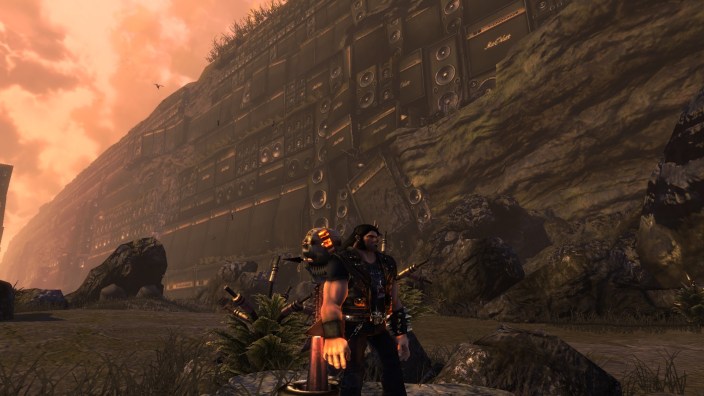
I was home sick today, and so I decided to spend some of my convalescence by downloading the Steam version of Brutal Legend, a game that I still own (and never finished) on the 360.

Brutal Legend - The Wall

This is what I wrote about Brutal Legend back when I was first playing it in October 2009:

I don’t quite know how to express how bummed out I am about Brutal Legend. The art direction is stupendous, and the world itself is just fantastic. I love driving around and exploring the world and seeing all the incredible stuff there is to see, and my compulsive need to seek out hidden collectibles is very well satisfied. The dialogue and cut-scenes are fantastic, and even though the side missions are incredibly repetitive, they almost never last more than a few minutes, and the rewards generally result in neat stuff in Ozzy’s Garage.

But goddamn, the stage battles completely suck all my enthusiasm out of the game. It eventually got to the point where I had completed every side mission and found every hidden thing I could possibly find, just because I wanted to play the game as much as possible without having to go through the stage battles. And, of course, the story can’t progress unless you do those stage battles, and therein lay the tragedy.

I don’t necessarily hate real time strategy games, I’m just not very good at them, and Brutal Legend’s brief tutorials don’t really help me in terms of figuring out what the hell is going on, and the game does such a terrible job of providing adequate feedback, especially when I’m on the ground trying to kill people because my army refuses to move. Once you start getting wounded, and the screen starts turning red and the heartbeat starts pounding louder, you’re almost always dead, and I’ve yet to figure out why. Even when I try to fly away, I die. And even though I’ve eventually won every stage battle I’ve participated in, I really don’t understand why, and the whole thing just feels shoddy and poorly implemented.

I have all the respect in the world for Tim Schafer; I’ll play anything the man works on. But I’m starting to feel that there’s more to a game than art direction and funny dialogue; ultimately, a game either succeeds or fails based on how much fun it is to play, and Brutal Legend is not very much fun at all.

This is Tim Schafer speaking about the game with Rock Paper Shotgun today:

“When Brutal Legend was done, a lot of people wanted the wrapper to it – the heavy metal world – to be [the only unique thing about it],” he said. “They basically wanted the heavy metal funny version of God of War. A very simple hack and slash game. That’s a real tough call for me. It’s hard to say, ‘There’s this other thing that’s not the thing you’re trying to do. The thing you care about and that you love. There’s this other version of it that’s totally different and it would be more successful. Why don’t you make that version?’”

“Maybe it would have been more successful. It would have been more accessible and simpler and easier for people to grasp. But it wasn’t the thing that got me up in the morning and made me want to make the game.”

I am sad to report that my opinions of the game have not changed one bit.  The world is still wondrous, the art direction is still mesmerizing, the characters are still memorable and marvelously performed and animated, the dialogue is still witty and smart, and the story is still engaging… but the gameplay is still shitty.   I understand where Tim is coming from in that RPS quote – making a simplistic hack-n-slash game is probably not as inspiring as coming up with this RTS-esque system – but if you’re going to commit to a complicated system over the more obvious route, then you’ve got to make sure that your audience can follow along with you.  I’m sure some people understood how the game worked, but I never could.  And after my time with it tonight, I’m not sure I’ll ever get there.

It’s also worth bringing up that this PC port is not without some noticeable problems.  Lots of weird graphical glitches and bugs pop up all the time – the mouse cursor will appear in the middle of the screen at random even though I’m playing with a controller, some of the upgrade options in Ozzy’s Garage are totally glitched out, and the audio has a tendency to come and go during the pre-rendered cut-scenes.  (As I type this, I see that Steam just downloaded a 50MB patch; maybe that will help smooth out these rough edges.)

Despite my pessimism, I really would like to see a sequel – this world is too amazing to be lost to time.  I just hope that if they get the chance to make one, that they’ll be able to take as much time as is necessary to make sure the game part works.  Double Fine’s games have never come up short in the story department, or the art department, or any of the other technical/creative departments – they’ve only ever shown their weaknesses during the parts where you actually have to play them.  As I said above, I have nothing but the utmost respect for Tim and his company, and I’ve played pretty much everything they’ve put out, and will continue to do so – I’m certainly waiting with bated breath for the Kickstarter Adventure (whose progress I’ve been trying to not follow, actually).  I wish nothing but success for Double Fine.  I just can’t help but feel that success will only truly arrive once their games are as much fun to play as they are to experience.

ch-ch-ch-changes; the first few hours of Far Cry 3

[Before I get into today’s post, I must link to this newly leaked footage of Ruffian’s cancelled Streets of Rage reboot.  Streets of Rage was one of my JAMS back in the Sega Genesis days; my brother and I played all 3 games for hours and hours and hours.  I’ve been wanting an HD remake for years, and Ruffian seemed like just the right developer to pull it off (even if Crackdown 2 was a shitshow), and so this is very much the epitome of a happy/sad thing.]

_____________________________

I’d be hard-pressed to explain just what’s happened to me over the last few weeks; it could be that the anxiety medications are finally kicking in, or it could be my shift from trepidation to acceptance and now genuine excitement about being a new father, or it could be the simple act of driving a car into New York City and thereby kicking a deeply-held fear square in the teeth.  I suppose it’s some combination of all of those things, but whatever it is, I’ve been feeling like a new, changed man.  And it feels good.

(It feels good even though I turn 37 on Saturday, which is a weird, crooked number that is much closer to 40 than I feel comfortable with.)

In terms of gaming, this feeling of change has manifested itself already, without me even realizing it.  For one thing, as my friend Gred correctly pointed out, I feel a huge weight has been lifted off of my shoulders now that I’ve given up on Assassin’s Creed 3.  Ever since I started this blog as my half-hearted attempt at breaking into professional game criticism,  I’ve felt compelled to play (and try to finish) as much as I can get my hands on, even if only so that I can be part of the conversation – even if that conversation is really just me listening to podcasts and reading smart people on Twitter.  The reality, of course, is that I am not a professional game critic, and I just don’t have the time to spend playing stuff I don’t enjoy just for the sake of being an observer of other people’s conversations.  And now that I can accept that, I kinda like it.

Continuing in that vein, I will not be playing Hitman: Absolution.  I’ve never been able to get into that franchise in previous entries, and their horrendously ill-conceived Facebook ad campaign (covered here with the usual great aplomb by Leigh Alexander) turned me off completely.  I don’t want anything to do with that game or that franchise ever again.

Switching back to the “changed-man” vein, I am playing Far Cry 3.  This is notable (for me, anyway) for three specific reasons:

  • I had absolutely no intention of ever playing this game until the reviews starting coming in;
  • I’m playing it on my PC, instead of the 360; and
  • I’m willingly playing a first-person shooter, even though I’ve been bitching endlessly about shooter fatigue.

And since I’m into bullet points today, I’ve chosen to play FC3 on my PC because, among other things:

  • my 360 has been making terrible sounds lately and I’d really like it to last until GTA5 (unless there’s a PC port; this also goes for Bioshock Infinite);
  • because I don’t want to kick my pregnant wife off the living room couch if she’s comfortable;
  • because the game probably looks better on my medium-grade PC than it would on my 360; and because… drumroll…. 
  • I kinda don’t give a shit about Achievements anymore.

As for the game itself… I’ve heard it described as “Skyrim in the jungle with guns”, and even though I’ve only played for an hour or so, I certainly can see how that description makes sense.  This is one of the most dynamic open worlds I’ve ever seen; things are happening around you constantly, and not just necessarily to you but to your enemies as well.  As an example, I was wandering around hunting for boar when a group of pirates happened to drive up and began attacking me; but then a pack of rabid dogs started attacking them, whereupon I just hung back, patched myself up, and made sure I was ready for whoever survived.  This was not a scripted sequence – this is just something that happened.

And even though I only played for a short time, my shooter fatigue never kicked in.  This is partially because the game is absolutely gorgeous, and it’s really easy to get lost in the scenery.  It’s also partially because there is SO MUCH TO DO.  It’s not just shooting enemies; it’s hunting animals and gathering plants, and about using the materials you get in those hunts and gatherings to craft materials that you absolutely need in order to survive.  There are radio towers you must ascend and disable – which, as in Assassin’s Creed, opens up an area of the world map.  There are pirate outposts you must reclaim for the natives, which turn into fast-travel points.  There are these Trials, which are essentially shooting gallery mini-games, which reward you with points and XP.  Yes, there’s XP – this is just as much an RPG as it is a shooter, with skill trees and abilities and such.

I can only give the game two knocks thus far.  The first is that the main bad guy’s name is alarmingly close to my own last name – they’re not spelled the same, but they’re pronounced almost identically, and he’s a scary motherfucker, and more than a little intimidating.  (The opening sequence of FC3 is absolutely outstanding, and the bad guy’s performance is a particular stand-out.)  The second, more problematic issue is that the game’s display never shuts up.  The game is constantly reminding you of your primary objective, even if you’re deliberately doing a side objective; it is also constantly telling you every time it updates its in-game encyclopedia/codex/whatever, which is unnecessary and annoying and requires too many button presses to get rid of.  This can be frustrating, in that the developers have crafted this amazing, immaculate world for you to explore, which you are constantly being interrupted from exploring.  They won’t just let you be.  Granted, there are wild animals and forest fires and pirates pretty much everywhere, so it’s not like you’d ever truly be at peace in the world – but at least you can be immersed in that experience without constantly being reminded that there’s other stuff you need to be doing.


the first few hours: NFS MW

In order to distract myself from worrying about tonight’s election results, here’s my one-word review for Need For Speed Most Wanted, a game that at one point was one of my most heavily anticipated games for 2012:

*sigh*

Before I went to bed last night, I opened up a post here and wrote down my gut reactions:

  • frustration
  • kinda ugly
  • wildly inconsistent – too easy to crash (SOMETIMES)
  • mini map is in an inconvenient location
  • cops are annoying, and it can sometimes be unclear why they’re after you
  • and yet i played it for 2 hours without stopping.

I said this yesterday, and it bears repeating – I’m not sure how objective I can be about this game.

On the one hand, the Burnout franchise is my one true love in the racing genre, and I’ve probably put more time into both Burnout 3 and Burnout Paradise than all other racing games combined. So I’m willing to cut Criterion a whole bunch of slack, even if what I really want is Burnout Paradise 2 and couldn’t give less of a shit about the Need For Speed brand.

On the other hand, Forza Horizon came out of nowhere to become one of my GOTY contenders; as far as open-world racing games go, it has set the bar remarkably high, and it’s pretty much all I’ve been playing for the last 2 weeks.

NFS:MW feels a bit off, is the thing.

It has police chases, because it’s a Need For Speed game and that’s what a NFS game is, but the chases aren’t exciting as they were in Criterion’s previous NFS game, the excellent Hot Pursuit. Indeed, they become a nuisance after a while – there’s nothing quite as annoying as finishing a race only to then have to spend up to 10 minutes trying to shake the cops (who aren’t chasing anybody else, I might add).

It offers Burnout-esque rewards for taking down your opponents, but until you’ve improved your car (which you can only do by winning races), taking opponents out actually slows you down, allowing the super-rubberband-y AI to speed past you. This happened to me on numerous occasions last night, and it was unbelievably frustrating.

Indeed, there are many reasons why “frustration” was the first thing I wrote in my gut reaction list above. It’s frustrating that the game is inconsistent with what actually makes you crash – sometimes you can sideswipe an oncoming car and nothing happens, but sometimes you can just lightly nick some random piece of geometry and then everything grinds to a halt. It’s frustrating that sometimes the game will offer up some very visible green arrows to tell you there’s a turn coming up, because more often than not there are no green arrows at all and you’ll miss the turn entirely. It’s frustrating that the mini-map is located in the lower-left-hand corner of the screen, which is very difficult to look at while trying to avoid police cars at 150 miles an hour. It’s frustrating that the crashes – which are usually Criterion’s strength – feel endlessly long and drawn out and more or less ruin your race, especially when they happen 100 yards from the finish line, which is something that happened at least 4 or 5 times to me last night – again, because the game was unclear as to what would actually cause a crash or not. It’s frustrating that there’s perhaps too much NPC traffic on the roads, if only because the NPC traffic only seems to negatively affect your progress; there were a number of times last night where the AI cars in front of me just bounced off of oncoming traffic, which is something that almost never happened when I tried it.

The game is also uncharacteristically ugly, at least by Criterion standards (and certainly when compared to Forza Horizon, which generally looks quite stunning).  The car models are pretty sharp, but the buildings and environments seem a little fuzzy and grainy, and the textures can pop in and out sometimes.  And even though I installed the game to my hard drive, there was a surprising amount of slowdown and dropped frames – even in the menus, which is just weird.

I’m also not really all that crazy about the music selection, though I’d probably place the blame on EA for that.  There is no DJ Atomica; and while normally that would be a good thing, here the soundtrack feels like it was curated strictly by EA’s licensing partners; it’s all very drab and forgettable modern rock.

And yet – I did play the game rather compulsively for around 2 hours last night, despite how frustrated I was.  The world is pretty big, and I found myself enjoying the free-roam exploration side of the game – crashing into locked gates, crashing through billboards, competing with the 2 or 3 people on my friends list who’ve also played the game in speed cameras and jump distances.  The Autolog stuff is still the best in class – not that Forza Horizon is shabby in that regard, but everything here is presented very cleanly and clearly, and so it’s very easy to see how I stack up against my friends among a comparatively wide statistical array.

Ultimately, I can’t help but feel that EA is hamstringing Criterion a bit here by asking Criterion to make a game that they don’t necessarily want to make.  Everybody wants more Burnout; I’m not sure anybody was asking for yet another Need for Speed game.  Cramming Need For Speed on top of what ought to be Burnout Paradise 2 ends up making a bit of a mess.  I suppose I can appreciate Criterion maybe wanting to hold off on the real Burnout Paradise 2 until the next generation of consoles arrive – that’s certainly something worth waiting for.   This game, however, really just feels like EA’s desperate need to make its own IP still relevant, at the expense of quality IP that gamers actually want.*

_____________
* This feeling is strangely and ironically reinforced by all the billboards in the city covered with the names of the various EA studios – EA Sports, Bioware, Visceral Games, etc.

the first few/last few hours: Forza Horizon, Dishonored

Before I get started, I want to sing the praises of the WordPress spam filter, which does a great job day in and day out of filtering out all the nonsense.  Like, literal nonsense.  Whoever’s coming up with the text for these spam comments is out of their minds.   Sometimes, though, the spam robots get lucky – and like the 1,000,000th monkey who typed out a Shakespearean sonnet on his typewriter, today’s comment is a thing of beauty.  Just know that my apprehension at inviting sort of spam recursion loop by pasting it here is outweighed by my desire to spread joy and love and poetry wherever I go.

You know what I’m talking about.I quit!A barking dog doesn’t bite!Most people eat, write, and work with their fight hands.You’re welcome.A bad workman quarrels with his tools.Do you realize that all of these shirts are half off?It appears to be a true story.We are divided in our opinions.It feels like spring I’ve been here before

There’s so much to love here.  And not just because “fight hands” yields a marvelous synchronicity with my new favorite iOS game (which just came out last night), Punch Questalthough that is a wonderful touch.

Anyway.  I needed to share that.

As for GAMEZ, I said goodbye to Dishonored last night, and said hello to Forza Horizon.

I had a bad feeling about Dishonored going into last night’s session, to be honest.  I was already in a weird place about it, and there was a part of me that knew that putting it down for 3-4 days wouldn’t soften its edges.  So, yeah; I played for about 20-30 minutes or so and quickly realized that I just wasn’t ever going to get back into it.  The magic was gone.  It no longer felt like an organic, natural environment; I was simply recognizing patterns and exploiting their weaknesses.  The story wasn’t ever compelling enough to keep me moving forward, either – especially since every review more or less panned the ending – and so I decided that I didn’t want to spend my time feeling bad about not liking a game anymore.

I remain in awe of the many things the game does right.  And I salute the developers for taking a chance with a new, bold IP at this stage of the hardware cycle.  I do feel guilty for not finishing it, for whatever that’s worth.

*     *     *     *     *

It took a little while for Forza Horizon‘s charms to become apparent to me.  As much as I love driving games, I don’t really care about cars or car culture, and would never willingly find myself in the middle of the desert at some car/music festival, which is the game’s central premise.  In fact, there’s an awful lot of cut scenes in the beginning of the game – perhaps too many – that go out of their way to sell you on the concept that you’re in this amazing place, doing this amazing thing, meeting all these amazing people, etc.  Say what you will about the problems with silent protagonists; I could not identify with my dude, nor did I ever have any intention of doing so.  I wanted to drive.

And about 30 minutes later, I found myself in driving game heaven.

Once the game removes the tutorial training wheels, you will find yourself on a stretch of open road, free to do whatever you want.  And the game keeps track of everything you do, so even if you’re mindlessly driving (and admiring the gorgeous scenery), you’re also earning points and money simply through the act of drifting, driving on the opposite side of the road, crashing into special signs (that unlock discounts at the garage), narrowly avoiding traffic, etc.  There are also Horizon Waypoints (or something like that – I can’t remember what they’re called) which enable fast-travelling, should you not want to drive to the other side of the map for an event.  Each waypoint features 3 mini-events, the completion of which reduces the cost of fast-travelling.  But that’s besides the point.  The point is that the simple, pure act of driving – not racing, not doing tricks – yields tangible rewards.

love this sort of thing.  This is very much why Burnout Paradise was such a revelation – you were given a huge world to explore, and you were encouraged to explore it.  It wasn’t just window dressing; there were valuables hidden away in every nook and cranny.  I’m not sure how deep Forza Horizon travels down this particular rabbit hole, but the time I spent with it last night was very encouraging.

This is just the kick in the ass the franchise needed, I think.  The regular games are still fine, best-in-class, sure, but they’re also very repetitive – you race the same tracks in the same cars year after year, with marginal graphical improvements and subtle tweaks to performance.  There is an audience for that kind of game, certainly; I’m somewhat of a member, having bought each edition.  But Forza Horizon feels fresh and new and invigorating, and I’m hopeful that we’ll be seeing more of it in the future.